OPG Completes Shaft Excavation for First BWRX-300 SMR Unit at Darlington
OPG has finished excavating and dewatering all three shafts for its first BWRX-300 unit at Darlington, with each reaching full depth ahead of Basemat placement planned for summer 2026.
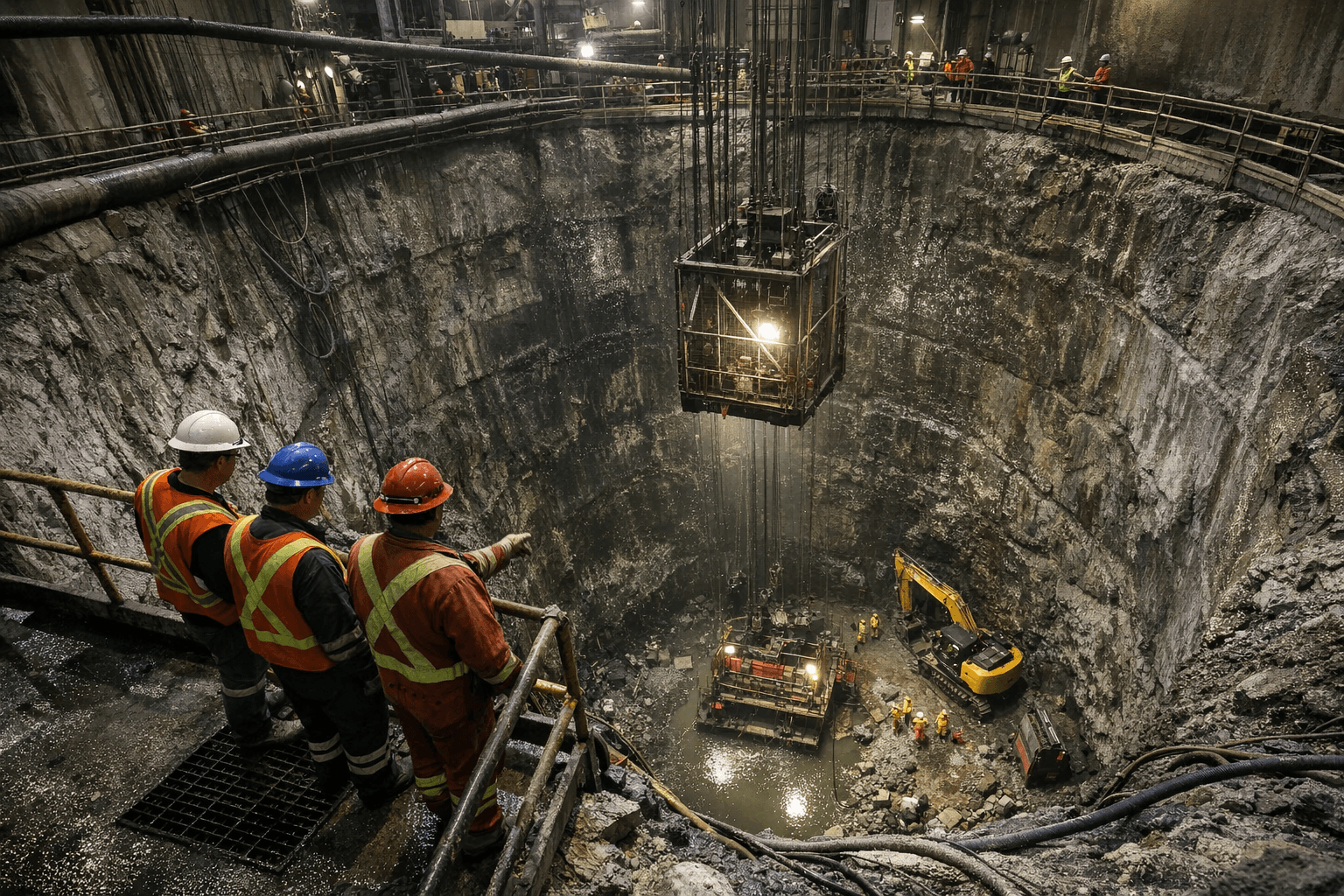
Ontario Power Generation has completed excavation and dewatering on all three shafts tied to the first BWRX-300 unit at its Darlington New Nuclear Project, a milestone that unlocks the next sequence of civil works for what is billed as the G7's first commercial, grid-scale small modular reactor.
The three shafts reached full depth to support reactor construction and cooling systems, with excavation and dewatering completed at the Darlington New Nuclear Project in Ontario, Canada. The three shafts are the reactor building shaft, the forebay shaft, and the condenser cooling water launch shaft. At the forebay shaft, excavation is now complete with the next step being placement of the concrete base slab for the pumphouse basement.
The reactor building shaft completion carries the most immediate downstream consequence. Excavation work on the Unit 1 reactor building shaft has reached 87 per cent completion, and fabrication of Basemat modules, which will serve as the foundation of the Unit 1 reactor building, continues to progress with completed modules being assembled in the Pre-Assembly Building. Once the reactor building shaft is wholly excavated, the fully assembled Basemat will be lifted by heavy crane and placed at the bottom of the shaft in Summer 2026.
Dewatering of the site has commenced in preparation for installation of condenser cooling water pipes from the Turbine Building to the Forebay Shaft, with pipe installation beginning later this winter.
The project is deploying GE Vernova Hitachi Nuclear Energy's BWRX-300 technology, a 300-MWe boiling water reactor design. The Darlington project, now slated to begin commercial service by the end of 2030, remains the most advanced SMR build in North America and positions Ontario as a global first mover on commercial, grid-scale deployment of SMRs. Once all four units are operational, the site will deliver up to 1,200 MW of reliable, affordable, and low-carbon electricity, enough to power 1.2 million homes, according to OPG, with a total projected cost of CAD$20.9 billion.
Long-lead component fabrication is running in parallel with the civil works. BWXT, at its Cambridge, Ontario, facility, has begun cladding work for the reactor pressure vessel, the largest component of the SMR, a 550-tonne vessel that will house the reactor core, coolant, and support structures. The generator rotor has also been forged and is undergoing pre-machining, with OPG suggesting the component is expected to arrive at the site by summer 2027.
The tunnel boring machine that will carve the condenser cooling water path is also ready for its role. Once operational, the 6.97-metre-width Harriet Brooks tunnel boring machine will bore and line a 3.4-kilometre-long tunnel for the project's condenser cooling water system, a key operational feature critical to bringing the first SMR online. The machine was named after Canada's first female nuclear physicist.
The province on May 8 formally authorized OPG to proceed with full-scale nuclear construction following the Canadian Nuclear Safety Commission's April issuance of a Licence to Construct for the first unit. The project is structured as a six-party integrated delivery. The project is backed by a six-year alliance among OPG, GE Hitachi Nuclear Energy, AtkinsRéalis, and Aecon, an industry-first integrated project delivery model for a grid-scale SMR in North America.
The shaft completions also reflect how aggressively OPG has drawn on institutional knowledge accumulated next door. OPG is leveraging more than 7,000 lessons learned from its Darlington Refurbishment project and will incorporate lessons learned from the construction of the first SMR to the rest of the fleet. The refurbishment of the site's four existing CANDU 850 reactors, which collectively deliver up to 1,200 MW of Ontario's baseload power, has run ahead of schedule and under budget, giving the SMR team a directly adjacent data set on what it looks like to execute a nuclear mega-project on this precise piece of land.
With the Basemat crane lift now pencilled in for summer 2026, the reactor building shaft hitting full depth moves from a construction milestone to a hard schedule dependency. The clock on North America's first commercial SMR is running in months, not years.
This article was produced by Prism’s automated news system from verified source data, official records, and press releases, then run through automated quality and moderation checks before publishing. The system is built and supervised by the people who set the standards it runs under. Read our full AI policy.
Did this article answer your question?