Paris Nuclear Energy Summit Unites Global Leaders Behind Clean Power Future
Belgium, Brazil, China, and Italy joined 38 nations pledging to triple nuclear energy by 2050 as world leaders gathered in Paris on March 10.
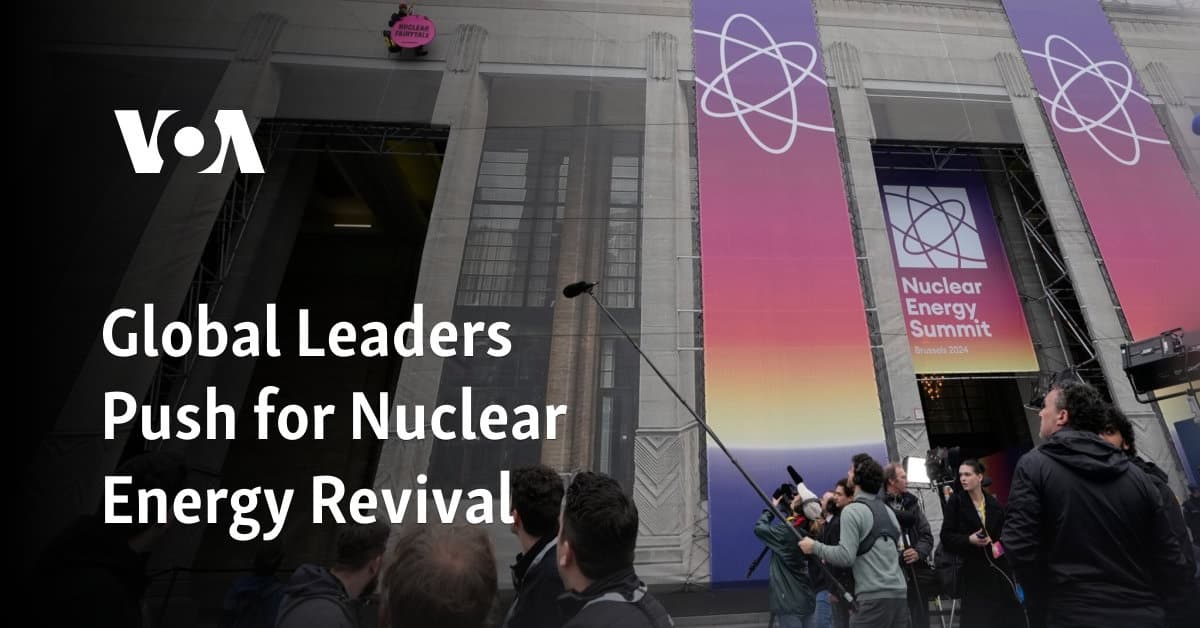
At the Seine Musicale venue in Boulogne-Billancourt, just outside Paris, heads of state, government ministers, industry leaders, and representatives of international financial institutions converged on March 10 for the 2026 Nuclear Energy Summit, hosted by the French government in cooperation with the International Atomic Energy Agency. The gathering placed nuclear power squarely at the center of the world's response to rising electricity demand, climate targets, and the energy security pressures reshaping geopolitics.
The summit's most concrete deliverable came from the World Nuclear Association, which announced that Belgium, Brazil, China, and Italy had joined the Declaration to Triple Nuclear Energy by 2050, adding to a group of 38 countries committed to expanding nuclear's role in delivering clean, secure, and affordable energy systems.
Rwanda's President Paul Kagame offered one of the summit's most direct statements on nuclear's development potential. "Nuclear energy will be central to diversifying Rwanda's energy mix while providing the stability required for industrial growth and long-term transformation," Kagame said. Rwanda recently hosted an IAEA mission to assess its nuclear infrastructure and is among several African nations eyeing small modular reactor deployment as a path toward economic development.
Leaders also pointed to applications stretching well beyond the electricity grid. The IAEA highlighted industrial heat generation, hydrogen production, and power for large data centers as emerging roles for nuclear technology, signaling a broadening of how policymakers frame the technology's value proposition.
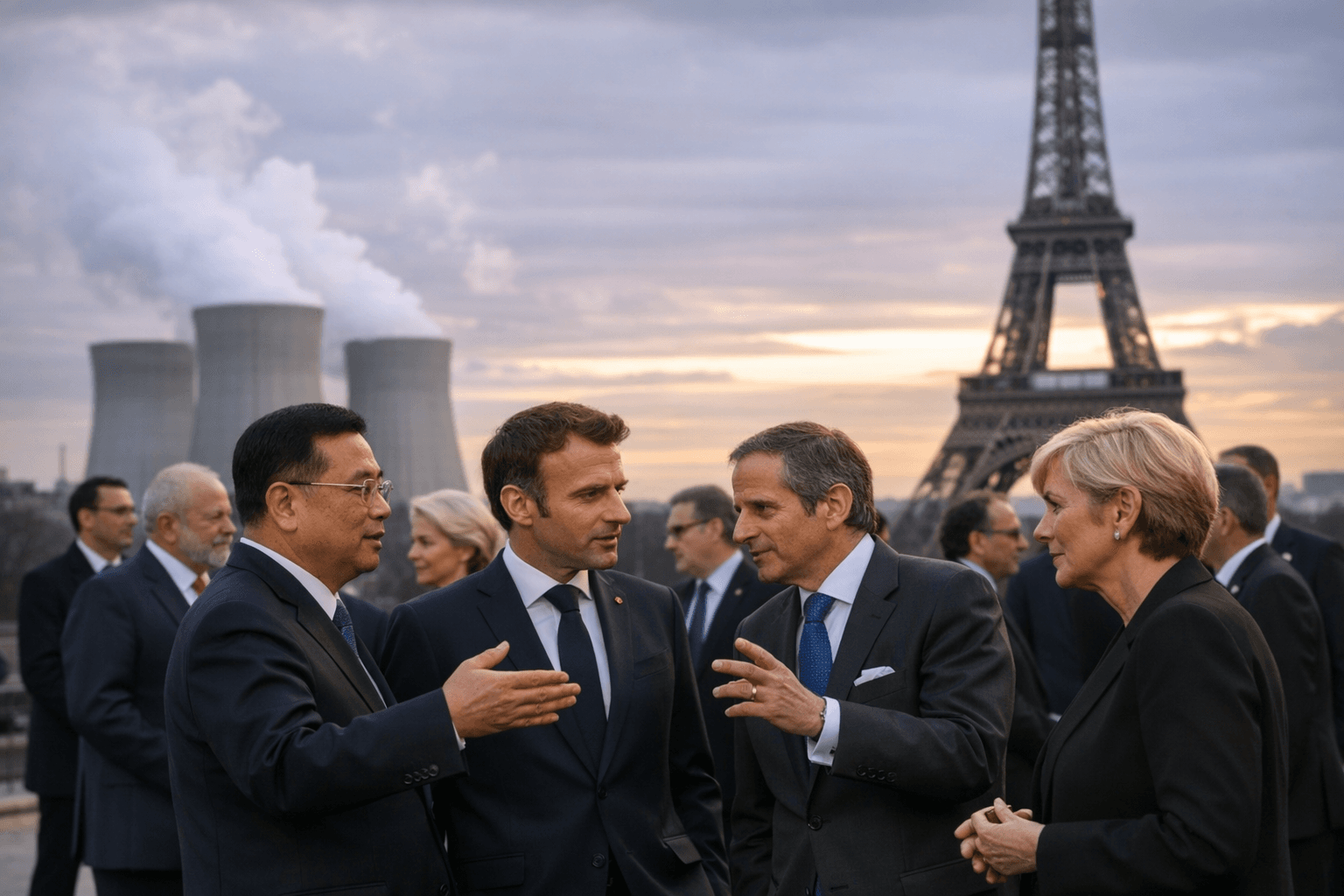
China arrived at the summit as one of the declaration's newest endorsers and with a significant technology story in hand. China's Hualong One reactor design has become the world's most deployed third-generation nuclear reactor technology, with 41 units currently in operation or under construction globally, according to Xinhua. Lin Boqiang, director of the China Center for Energy Economics Research at Xiamen University, framed the moment plainly: "Wind and solar power are intermittent, whereas nuclear power provides stable and reliable output," adding that nuclear energy "serves as one of the crucial pillars supporting economic development for countries and promoting it will play a vital role in achieving carbon neutrality and addressing global climate change."
The European conversation arriving in Paris had been building for months. At Davos in January, EU Commission President Ursula von der Leyen highlighted nuclear energy's role in lowering prices and cutting dependencies, while Sweden's energy minister Ebba Busch outlined plans for a "nuclear renaissance" to secure reliable, dispatchable power for her country. Romania's Minister of Energy Bogdan Ivan cited economic competitiveness as the central driver behind Romania's planned expansion.
The IAEA's own projections underscore why that momentum is difficult to ignore. In September 2025, the agency revised its nuclear power forecasts upward for the fifth consecutive year, estimating global nuclear capacity could more than double by 2050. That trajectory gave the Paris summit both its urgency and its confidence, as Emmanuel Macron took the stage at the Seine Musicale to address a room where the debate had shifted decisively from whether nuclear belongs in the clean energy mix to how fast it can scale.
Know something we missed? Have a correction or additional information?
Submit a Tip

