Photonuclear study measures cross sections, thresholds for producing 195mPt for medical applications
HIγS measurements found 197Au(γ,pn)195mPt cross sections at 27-31 MeV and show measurable production only near ≈30 MeV, but routine accelerator conditions likely cannot produce usable 195mPt.
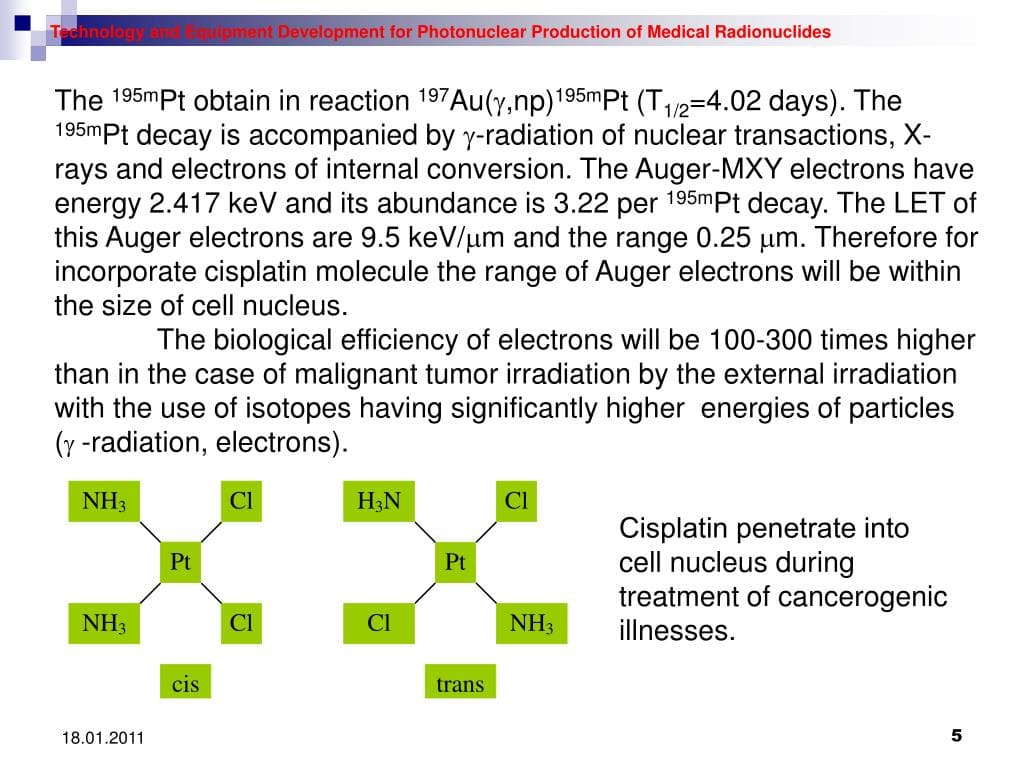
Researchers measured the photonuclear route to 195mPt on gold and found that, despite a low physical threshold, practical production is unlikely at typical accelerator settings. The 197Au(γ,pn)195mPt reaction was probed with a quasi-monoenergetic γ-ray beam provided by the High Intensity Gamma-ray Source (HIγS), using incident γ-ray energies of 27 MeV, 29 MeV and 31 MeV. For the first time, cross sections were experimentally determined in the vicinity of the reaction threshold.
The experiment used an activation method with “a stack of concentric-ring gold targets.” “The induced 195mPt activity was quantified using off-line γ-ray spectroscopy.” Analysis centered on a 98.9-keV γ-ray line. “The observed 98.9-keV γ-ray peak contains contributions from the decays of both 195Au and 195mPt.” “These contributions were successfully extracted using a least-squares analysis of measurements performed at multiple cooling times.” The physical reaction threshold is Eth = 13.96 MeV, but the authors report: “No statistically significant 98.9-keV peak attributable to 195mPt was observed for irradiation energies below 27 MeV, despite the reaction threshold energy of Eth = 13.96 MeV.”
Under the present experimental conditions - specifically a photon flux of ≈108γ/s and irradiation time 8-10 hours - the team concluded that “the production yield is insufficient to detect this rare reaction channel at lower energies.” Their measured cross sections led to a practical cutoff: “The measured cross sections indicate that the 197Au(γ,pn)195mPt reaction begins to contribute measurably at incident photon energies of ≈ 30 MeV, but remains too weak for practical isotope production with bremsstrahlung γ rays at energies typically available at electron accelerator facilities.” They also note that “Although electron energies around 40 MeV are commonly employed for photonuclear isotope production, the present results suggest that such energies are insufficient to yield meaning-ful 195mPt production under realistic experimental condi-tions.”
The result sits against broader photonuclear context. The IAEA notes typical bremsstrahlung maximum energies of 35–40 MeV and uses the 100Mo(γ,n)99Mo reaction as a benchmark, with a maximum cross-section of about 0.16 barns between 14–15 MeV. Photonuclear efforts aim to leverage eLINAC advantages: “A high-intensity eLINAC facility capable of photonuclear radionuclide production has many advantages in contrast to reactor or other accelerator facilities. These advantages include reduced volume of radioactive waste, low cost and operation expense, and fewer nuclear reaction channels, leading to potentially higher radiochemical purity of the final product.” The isotope community still faces data gaps: “188Pt and 191Pt show potential for use in imaging chemotherapy, whereas 193mPt, 195mPt and 197Pt all have possible uses in radiotherapy.” “All require more cross-section measurements, to determine optimum production routes.”

The HIγS study supplies a crucial, if sobering, datapoint: threshold energy does not guarantee usable yield. The experiment gives direct excitation-region measurements and demonstrates the experimental challenge of separating overlapping 98.9-keV decays from 195Au and 195mPt at modest flux and irradiation times. Alternative photon sources and facility upgrades are suggested by fragments of the literature: “Photonuclear reactions using a laser Compton scattering (LCS) gamma source provide a new method for producing radioisotopes for medical” (fragment).
For readers tracking medical isotope supply and radiochemistry, the takeaway is clear: physics allows 195mPt production above threshold, but current measured cross sections and realistic facility parameters put practical production out of reach. The next steps are straightforward - obtain the full experimental cross-section numbers, extend measurements at higher flux and energy, and test high-brightness sources such as LCS or upgraded eLINACs to assess whether 195mPt can be produced at clinical scale.
This article was produced by Prism’s automated news system from verified source data, official records, and press releases, then run through automated quality and moderation checks before publishing. The system is built and supervised by the people who set the standards it runs under. Read our full AI policy.
Did this article answer your question?