PRL global, confinement‑time‑long, flux‑driven turbulence simulation abrupt turbulence transition observed in experiments
A PRL paper reports a global, confinement-time-long, flux-driven turbulence simulation that reproduces an abrupt turbulence transition observed in experiments.
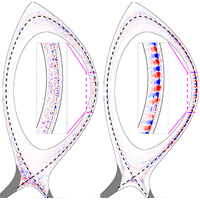
A team of plasma-physics computational researchers published a paper in Physical Review Letters (PRL) that reports a “global, confinement‑time‑long, flux‑driven turbulence simulation of a tokamak plasma edge” that “reproduces an abrupt turbulence transition observed in experiments.” The submitted material describes the simulation outcome as reproducing abrupt, experimentally seen changes in edge turbulence rather than gradual drift.
The same reporting material also states the simulations “reproduce some observations that feature abrupt and large edge‑localized mode crashes,” and frames the computational approach as “nonlinear hybrid kinetic–magnetohydrodynamic simulations” used to reveal energetic‑ion effects on ELMs. The text explicitly links energetic ions to measurable ELM changes, saying “Energetic ions modify, for example, the amplitude, frequency spectrum and crash timing of edge‑localized modes.”
The PRL summary and its associated release place the results squarely in an ITER context, noting that “the most efficient and promising operational regime for the International Thermonuclear Experimental Reactor tokamak is the high‑confinement mode” and that “in this regime, however, periodic relaxations of the plasma edge can occur. These edge‑localized modes pose a threat to the integrity of the fusion device.” The material predicts for ITER “a strong interaction between the fusion‑born alpha particles and ions from neutral beam injection, a main heating and fast particle source, is expected with predicted edge‑localized mode perturbations.”
The mechanisms reported are specific: “A resonant interaction between the fast ions at the plasma edge and the electromagnetic perturbations from the edge‑localized mode leads to an energy and momentum exchange,” the release states, tying the resonant exchange to the observed modifications in ELM amplitude, spectrum and timing. Neutral beam injection is singled out as “a main heating and fast particle source,” which the authors identify as a driver of the fast‑ion population that couples to ELM perturbations.
At the same time, the supplied material leaves key bibliographic and technical details unspecified. The PRL text provided in the materials is truncated and no author names, institutional affiliations, publication date, PRL volume/issue or DOI are included. The available summaries do not identify which experimental device or shot numbers the simulation reproduces, nor do they provide quantitative measures of crash amplitude, frequency ranges, or energy and momentum exchange values.
Essential follow‑ups remain: obtain the full PRL citation and paper PDF to confirm whether the “global, confinement‑time‑long, flux‑driven” description and the “nonlinear hybrid kinetic–magnetohydrodynamic simulations” label describe the same computational runs; request the simulation code name, dimensionality and run durations that define “confinement‑time‑long”; and secure the experimental datasets and diagnostics used for validation, including device names and shot identifiers. Those items are necessary to move from a qualitative headline to the quantitative comparisons fusion planners and ELM control teams will need.
Even with those gaps, the material submitted for this story puts energetic ion kinetic effects, fusion‑born alpha particles and neutral‑beam ions, at the center of a tested pathway by which abrupt turbulence transitions and large ELM crashes can arise, and it argues those effects must be included in optimization of edge‑localized mode control techniques and in designing regimes that are free of such modes.
This article was produced by Prism’s automated news system from verified source data, official records, and press releases, then run through automated quality and moderation checks before publishing. The system is built and supervised by the people who set the standards it runs under. Read our full AI policy.
Did this article answer your question?