PRL Measurement Finds 93mMo Isomer Depletion Orders of Magnitude Lower
A higher-precision experiment published in Physical Review Letters finds 93mMo isomer depletion during ion slowing-down in solid foils far smaller than earlier claims, changing expectations for NEEC-driven triggering.
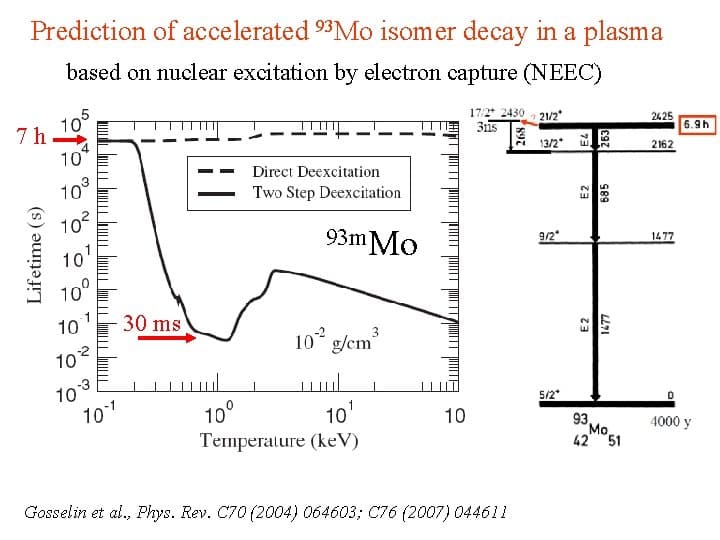
A new, higher-precision measurement has drastically reduced estimates for how often the high-spin 93mMo isomer is driven out of its metastable state during ion slowing-down in solid foils. The Physical Review Letters report finds depletion probabilities that are orders of magnitude lower than earlier experimental claims, forcing a re-evaluation of candidate excitation routes such as nuclear excitation by electron capture, Coulomb excitation, and inelastic scattering.
The 21/2+ isomer in 93Mo is of long-standing interest as a test case for controlled isomer triggering. Experimental signatures hinge on a 268-keV gamma from the proposed triggering level; because the branching ratio of that 268-keV transition from T to F equals unity, counting those gammas directly tracks triggering events. An earlier experimental analysis extracted a substantially larger depletion and reported, “The depletion probability Pexc = 0.01 per 93mMo was extracted from the experimental data.” That 1 percent figure stood in tension with independent theoretical work that produced far smaller probabilities.
Theoretical estimates assembled and referenced around this problem give very different scales. NEEC calculations tailored to targets with Carbon and Lead layers yield probabilities on the order of P ≈ 10−11 or less under the assumed ion energies, and related laser-plasma NEEC scenarios with L-shell recombination peak near P ≈ 10−10. As one summary puts it, “Therefore, the NEEC probability 5 in the experimental target with C and Pb layers considering smaller ion energies than we have assumed for our calculation should remain on the order of P ≈10−11 or less. This order of magnitude corroborates with the results obtained for a laser-plasma-based NEEC scenario for 93mMo isomer depletion where recombination into the L-shell had a seizable contribution and P ≈10−10.” By contrast, Coulomb excitation and inelastic scattering model runs produced probabilities near 10−6 for the Pb and C targets, still many orders of magnitude below the 1 percent extraction.

The recent PRL team took a layered approach to rule out artifacts. They ran a control 7Li + 90Zr reaction that made 93Mo recoils with energies too small to permit NEEC and observed no coincident 268-keV gammas. They also checked for reactions of 90Zr projectiles with the Carbon and Lead target layers and modeled excitation yields using FRESCO for inelastic channels and GOSIA plus RACHEL for Coulomb excitation on incidence to 208Pb. Despite those checks, earlier authors cautioned that “The direct experimental evidence does not point at any nuclear excitation mechanism in particular, and only confirms the depletion of the 93mMo isomer.” That unsettled attribution left room for the new PRL measurement to reframe the debate.
For the nuclear-reactions community this result matters practically: if depletion rates are as low as the new measurement implies, NEEC-based triggering of 93mMo in beam or plasma scenarios is far less accessible than some experimental reports suggested. The immediate next steps are clear - detailed NEEC calculations matched to the exact experimental geometry and energies, repetition of the sensitive gamma-coincidence runs with higher statistics and tighter control of target composition and recoil charge states, and cross checks using the same codes and transition data such as the 4.85(9)-keV 21/2+ → (17/2)+ E2 strength with B(E2) = 72 e2 fm4. Watch for follow-up theory papers and targeted experiments that either confirm the PRL numbers or uncover overlooked reaction channels; until then, the case for easy isomer triggering in 93mMo looks much slimmer.
Know something we missed? Have a correction or additional information?
Submit a Tip

