Safety-Focused Guide for Hobbyists on Nuclear Detectors, Instrumentation, and Measurements
A practical primer for hobbyists and students that explains detectors, instrumentation, and measurement principles while prioritizing strict safety and legal compliance.

1. Purpose and scope
This guide is written for hobbyists and students in the Nuclear Reactions community who want an intellectual, safety-first introduction to detectors, instrumentation, and measurement principles. It is explicitly a practical primer that emphasizes strict safety and legal compliance and is not an instruction manual for building or operating radioactive sources or regulated devices. Keep the frame of reference clear: learning concepts, recognizing instrumentation, and asking the right safety questions are the intended outcomes.
2. Conceptual overview of nuclear detectors
Think of detectors as sensors that convert ionizing radiation into measurable electrical signals; this primer treats detector types at a conceptual level so you can understand differences without instructions for construction or operation. Common families discussed conceptually include gas-filled detectors, scintillators, and semiconductor detectors, each has distinct sensitivity, energy response, and typical laboratory uses. For hobbyists and students, focus on how detectors respond (pulse production, pulse height distribution, and count rates) rather than on intrusive hands‑on assembly; again, this resource stresses strict safety and legal compliance.
3. Gas-filled detectors (concepts, uses, limitations)
Gas-filled detectors like Geiger–Müller and proportional counters are useful to illustrate fundamental detection physics without operational details; they demonstrate how ionization in a gas produces pulses whose amplitude and frequency carry information about radiation. Geiger–Müller tubes give robust count-rate information but lack energy discrimination, while proportional counters provide pulse-height differences that hint at energy but require more complex electronics. For hobbyists and students, learn the conceptual trade-offs, sensitivity versus spectral information, while avoiding any guidance on sourcing, assembling, or operating high-voltage supplies, consistent with the primer’s safety boundary.
4. Scintillation detectors (concepts and interpretation)
Scintillators pair a photon-generating material (plastic, NaI, or CsI) with a light sensor to illustrate how radiation energy can be translated into light and then into electrical pulses; this is an excellent conceptual bridge to spectroscopy without operational instructions. Understand that scintillator types differ in light yield, decay time, and energy resolution, plastic scintillators are fast but offer poorer energy resolution compared to inorganic crystals, information valuable when interpreting curves or spectra conceptually. Hobbyists and students should treat scintillation as a case study in signal conversion and signal processing while maintaining strict legal and safety compliance.
5. Semiconductor detectors (conceptual strengths and constraints)
Semiconductor detectors, such as silicon and germanium types, demonstrate how solid-state physics enables superior energy resolution and compact designs; they are useful to study measurement fidelity and resolution concepts without implying hands‑on activities. Note that high-purity germanium detectors illustrate the limits of energy resolution for gamma spectroscopy, but their cryogenic and regulatory needs place them clearly outside hobbyist operation, this primer keeps those devices in the “study only” category to respect legal and safety boundaries. Use semiconductor detectors to learn about electronic noise, charge collection, and spectral peak shapes as pure concepts.
6. Instrumentation chain and electronics (conceptual components)
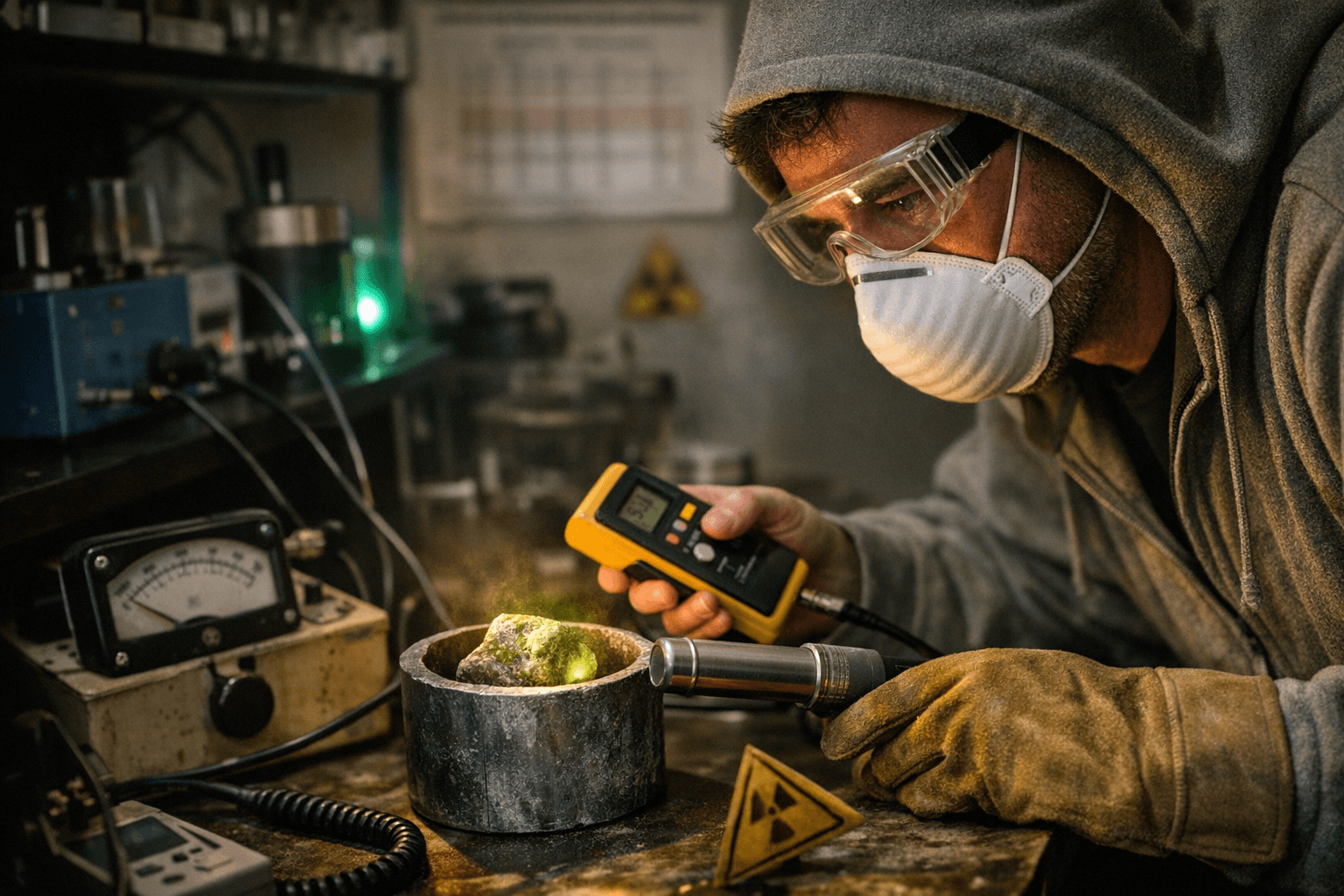
A detection event becomes useful data through an instrumentation chain: detector → preamplifier → amplifier → discriminator → multichannel analyzer (MCA) or counter → data logger. Learn how each block shapes the signal: preamplifiers preserve charge, amplifiers set pulse heights, discriminators gate thresholds, and MCAs sort by pulse height for spectroscopy. For hobbyists and students, appreciating this chain helps interpret published spectra and understand how dead time, gain, and thresholds affect reported counts, without any operational or procurement guidance, preserving strict safety and legal compliance.
7. Measurement principles and basic units
Understand measurement fundamentals: activity in becquerels (Bq) quantifies decays per second, counts per minute or counts per second reflect detector response, and detection efficiency links the two. Statistical uncertainty follows Poisson behavior for count-based measurements, where the standard deviation of N counts is roughly the square root of N; this is essential for evaluating whether differences in measurements are meaningful. Dead time, background subtraction, and detector efficiency are the core corrections you must conceptually apply when interpreting data; this primer frames these corrections for learning, not for operational execution.
8. Calibration, quality assurance, and traceability (conceptual approach)
Calibration should be understood as the process of relating instrument response to known standards, but hobbyists and students should treat calibration as a study area and defer practical calibration to licensed laboratories or supervised educational facilities. Quality assurance includes routine checks of background, linearity, and stability over time; knowing these concepts helps you ask smarter questions about any dataset you encounter. Traceability to standards and documented procedures is a hallmark of responsible measurement practice and is part of the strict safety and legal compliance emphasis of this guide.
9. Safety, legal compliance, and ethical boundaries
Safety and legal compliance are non-negotiable: this primer repeatedly emphasizes strict adherence to regulations and explicitly states it is not an instruction manual for building or operating regulated systems or handling radioactive material. As a hobbyist or student in the Nuclear Reactions community, prioritize learning in supervised, authorized environments and consult institutional radiation safety officers or certified labs when experiments require equipment or sources. Ethical practice includes transparent recordkeeping, avoiding unapproved acquisition of regulated components, and never attempting to operate devices that require licensing.
10. Practical, safe ways to learn and practice
There are safe, legal alternatives for hands-on learning that align with this primer’s purpose: work with sealed educational sources under institutional supervision, use simulation software to model detector response, and participate in community lab sessions run by licensed institutions. • Simulations let you vary detector parameters and see effects on spectra without any physical risk. • Supervised lab time provides real data and access to trained personnel who ensure compliance. Always confirm that any activity occurs under official authorization and conforms to local regulations; this guide’s framing dates to February 21, 2026 and reiterates strict safety and legal compliance.
11. Data interpretation, reporting, and responsible communication
Interpreting measurements responsibly means reporting counts with uncertainty, declaring background conditions, and stating whether efficiencies or corrections were applied. For hobbyists and students, practice writing clear measurement notes that record date, instrument conceptual configuration, and environmental factors; these records are essential when you later consult certified experts. This primer encourages rigorous documentation and careful phrasing when sharing findings within the Nuclear Reactions community to avoid misinterpretation or unsafe follow-up actions.
12. Community resources and next steps
Continue learning through supervised coursework, mentorship from licensed professionals, and community forums that prioritize safety and legality; treat this primer as a conceptual map rather than a “how-to” list. Seek out local university outreach programs, national labs’ public events, and certified training courses to deepen practical skills under authorized oversight. Finish with a commitment: approach detectors, instrumentation, and measurements as intellectual pursuits that demand respect for the technical, legal, and safety frameworks that govern the field.
Conclusion This safety-focused primer equips hobbyists and students in the Nuclear Reactions community with conceptual tools to understand detectors, instrumentation, and measurements while maintaining strict safety and legal compliance. Keep studying, ask informed questions, and always pursue practical experience through authorized, supervised channels rather than attempting unsanctioned operation or construction.
This article was produced by Prism’s automated news system from verified source data, official records, and press releases, then run through automated quality and moderation checks before publishing. The system is built and supervised by the people who set the standards it runs under. Read our full AI policy.
Did this article answer your question?