Scientists create plasma mirror boosting light toward Schwinger limit
A Gemini plasma mirror pushed more than 9 mJ into harmonics, edging the Schwinger chase closer. The harder question is whether that can ever become a repeatable source.
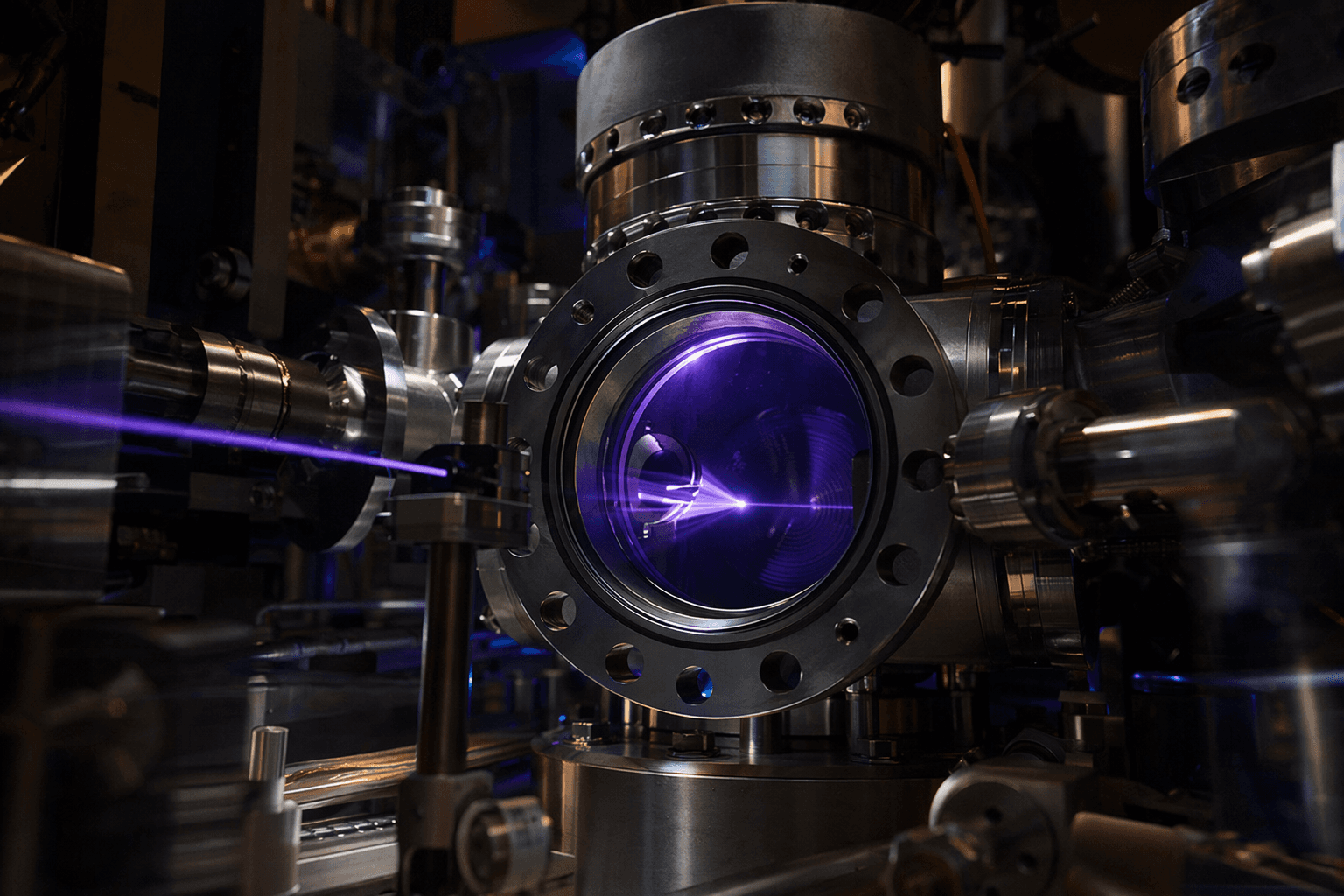
Oxford, Queen’s University Belfast and the Science and Technology Facilities Council’s Central Laser Facility have pushed plasma-mirror physics into a new regime, using the Gemini laser to turn an ultra-intense shot into an unusually bright ultraviolet and purple harmonic beam. In Nature’s April 22, 2026 paper, “Efficiency-optimized relativistic plasma harmonics for extreme fields,” the team reported more than 9 mJ between the 12th and 47th harmonics, a result Oxford says could eventually create the most intense source of coherent light ever.
The key advance was not just making harmonics, but matching the efficiency curve theory predicted. By fine-tuning the driving laser’s temporal profile on sub-picosecond timescales, Robin Timmis, Peter Norreys and colleagues showed that the plasma mirror could couple relativistically intense pulse energy into the emitted harmonic cone far more effectively than before. Nature says that combination of spatial compression, attosecond phase locking and efficient coupling opens a path toward a coherent harmonic focus that could boost intensity by many orders of magnitude, toward the Schwinger limit above 10^16 V/cm, or above 10^29 W/cm^2.
For the nuclear reactions crowd, the commercialization question is the right one: what does this actually unlock beyond a headline intensity record? At this stage, the clearest near-term value is as a laboratory extreme-ultraviolet and attosecond source concept, not as reactor hardware. The hard engineering gap is still repetition rate, target durability, beam transport and stable operation outside a one-shot experiment. That is why the 2023 Nature Communications liquid-sheet plasma mirror work matters too, because it pointed toward bright, stable, high-repetition-rate attosecond sources, while the 2021 Nature Physics plasma-mirror paper had already argued that intensities above 10^25 W/cm^2, and up to the Schwinger regime, would be the real physics frontier.
This is still a laboratory milestone, but it is a more commercially relevant kind of milestone than a pure field-strength claim. Peter Norreys and Robin Timmis have now shown that the Gemini platform can be tuned into a coherent harmonic focus, with Brendan Dromey and Mark Yeung at Queen’s Belfast and the CLF team helping turn the concept into an experiment. If this line of work scales, it could matter first for radiation sources and nuclear instrumentation, and only much later for anything that looks like fusion-adjacent deployment. For now, the advance says the mirror is real; the reactor pathway is still the open question.
Know something we missed? Have a correction or additional information?
Submit a Tip
_67350.jpg&w=1920&q=75)
_191f165e_79211.jpg&w=1920&q=75)