Serbia Eyes First Nuclear Power Plant, Targeting Grid Connection After 2040
Serbia's energy minister wants construction of the country's first nuclear plant to start before 2035, with grid connection targeted after 2040.

Serbia's Minister of Mining and Energy, Dubravka Đedović Handanović, confirmed in early March 2026 that her government is actively considering building the country's first nuclear power plant, with construction aimed to begin before 2035 and a grid connection targeted after 2040. The announcement, reported by NucNet on March 9, puts flesh on a policy shift that became legally possible only in December 2024, when Serbia's National Assembly amended a 35-year prohibition on nuclear power plant construction.
The timeline Đedović Handanović outlined has three distinct milestones. The first two preparatory phases of Serbia's nuclear programme are expected to be completed by 2032, at which point the minister noted that small modular reactor technology may be sufficiently mature to factor into technology selection. Construction would then begin before 2035, with commissioning targeted shortly after 2040. "When we are institutionally, regulatoryly and personnel-wise prepared, we will be able to choose a partner and a technology carrier and enter the construction process so that after 2040 we will have a nuclear power plant connected to the grid," she said.
The financial scale is substantial. Đedović Handanović said approximately €3 billion would be needed for plant construction alone, set against a broader national energy investment plan of at least €14.4 billion between 2028 and 2035, a figure cited by President Aleksandar Vučić. At the Serbia 2030 national strategy presentation on March 7, the minister framed nuclear as the centrepiece of that envelope: "Thirty percent of all planned investments until 2035 are for the energy sector. Above all, this includes the start of construction of a new nuclear facility, the first in our country." Depending on the technology ultimately selected, the first generating unit would carry a capacity between 1,000 MW and 1,650 MW.
Serbia is currently working with France's EDF in the preparatory phase, drawing on the company's technical expertise, but the government has kept its options open. Discussions have also taken place with South Korea's KHNP, and Rosatom has made a formal pitch. In February, Rosatom Director General Alexey Likhachev visited Belgrade and met with President Vučić, later leading a delegation that sat down with Đedović Handanović, with Russian Ambassador Alexander Botsan-Kharchenko also present. Likhachev presented Rosatom's international portfolio, citing ongoing projects in nine countries including China, India, Egypt, Turkey, and Hungary, covering around 30 power units of various capacities. He claimed Rosatom holds "more than 90% of the world market" for foreign nuclear power plant construction, a figure Rosatom itself put forward. The delegation proposed forming a joint working group covering public education, personnel training, and regulatory analysis, and Rosatom separately reported that Likhachev discussed attracting Serbian companies to its international projects and enrolling Serbian students at Russian universities.
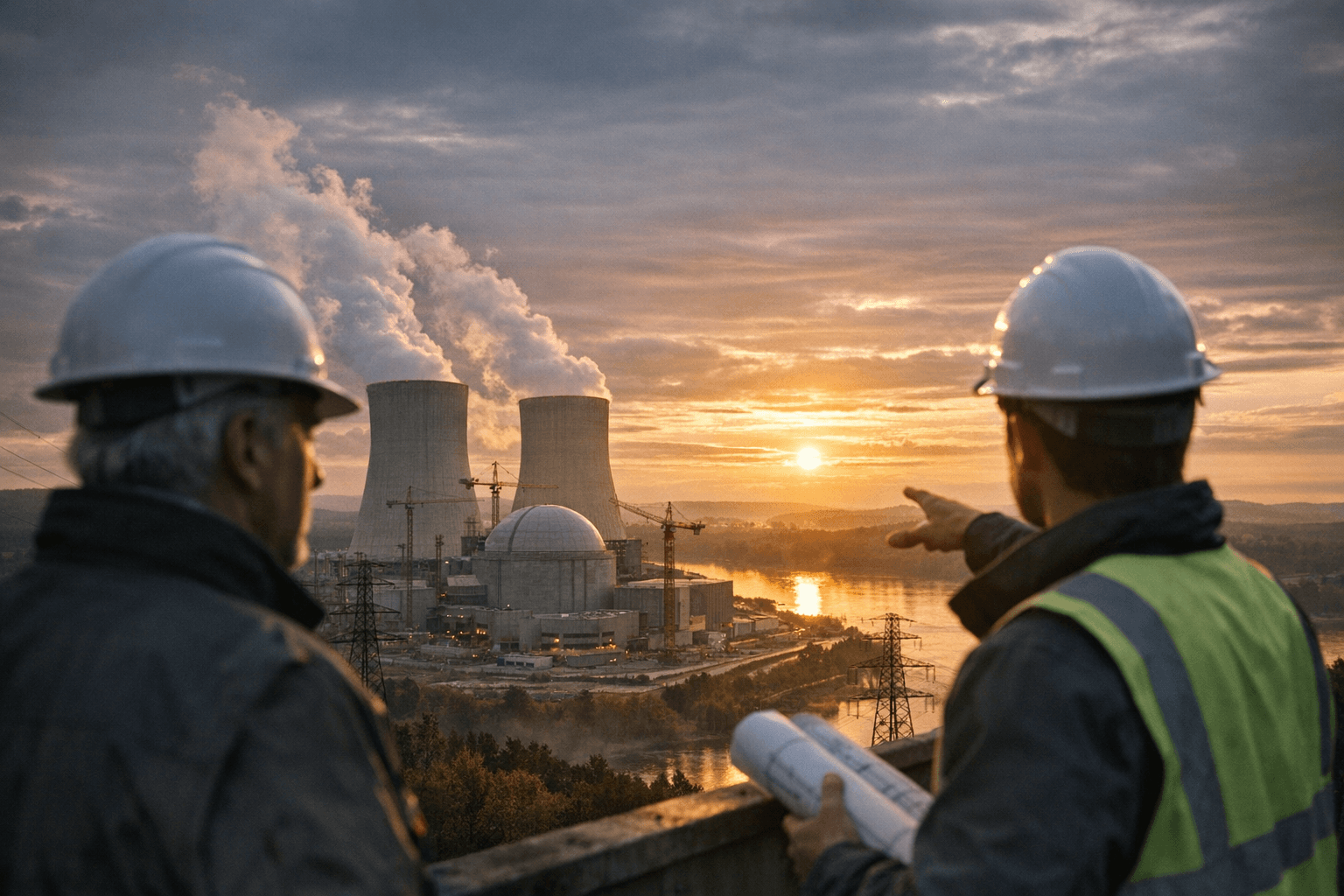
On the institutional side, a National Nuclear Energy Programme Implementation Organisation, known as NEPIO, was expected to receive government approval by the end of February. Workforce development is also a stated priority. "We need to strengthen personnel, bring back our experts from abroad and invest in the education of new engineers," Đedović Handanović said in an interview broadcast on Radio Television of Serbia on March 9.
A transparency question hangs over the preparatory work. The expert publication Nuklearna Perspektiva reported that a preliminary study completed last summer has not been released to the public, with the ministry responding on multiple occasions that the document is in a "harmonization process" and will be submitted to EDF for approval before publication. The selection of a construction partner has been characterised by some observers as a process likely to be driven as much by politics as by technical criteria.
The next concrete markers to watch are formal NEPIO approval, public release of the preliminary study, and any announcement narrowing the field of technology vendors, steps that will clarify whether Serbia's pre-2035 construction target holds.
Know something we missed? Have a correction or additional information?
Submit a Tip

