STAR BES-II Net-Proton Fluctuations Show 2 to 5 Sigma Deviations
A status report (arXiv:2602.08356) shows STAR BES-II net-proton cumulants deviate 2–5σ from noncritical baselines, tightening the hunt for the QCD critical point.

A concise status report on arXiv (arXiv:2602.08356) synthesizes net-proton fluctuation measurements from the STAR experiment at Brookhaven’s RHIC and finds statistically significant departures from models that omit a critical point. The paper reviews cumulant and factorial cumulant ratios up to fourth order from RHIC BES-II collider and fixed-target data and notes deviations that, depending on observable and baseline choice, span roughly two to five standard deviations.
STAR measured gold–gold collisions with centre-of-mass energies √sNN between 7.7 and 27 GeV per nucleon pair during BES-II, and the largest discrepancies show up in most-central, head-on collisions when peripheral collisions are used as the reference. The reported differences are against several classes of noncritical baselines: hadronic transport models, thermal models with canonical-ensemble treatment, and hydrodynamic approaches with excluded-volume effects. The arXiv submission is compact - 10 pages with six figures - and has been accepted as a contribution to the EPJ special issue on high density nuclear matter.
Higher-order cumulants of net-proton multiplicity are the community’s sharpest tools for this search because they are sensitive to the growth of correlation length near a critical point. The report’s emphasis on cumulant and factorial cumulant ratios up to fourth order aligns with longstanding theoretical guidance that event-by-event multiplicity fluctuations are a primary experimental window onto the QCD phase diagram. That phase diagram is often explained with a simple analogy to water: distinct phases and an end point of a first-order transition can exist in QCD matter at finite temperature and baryon chemical potential.

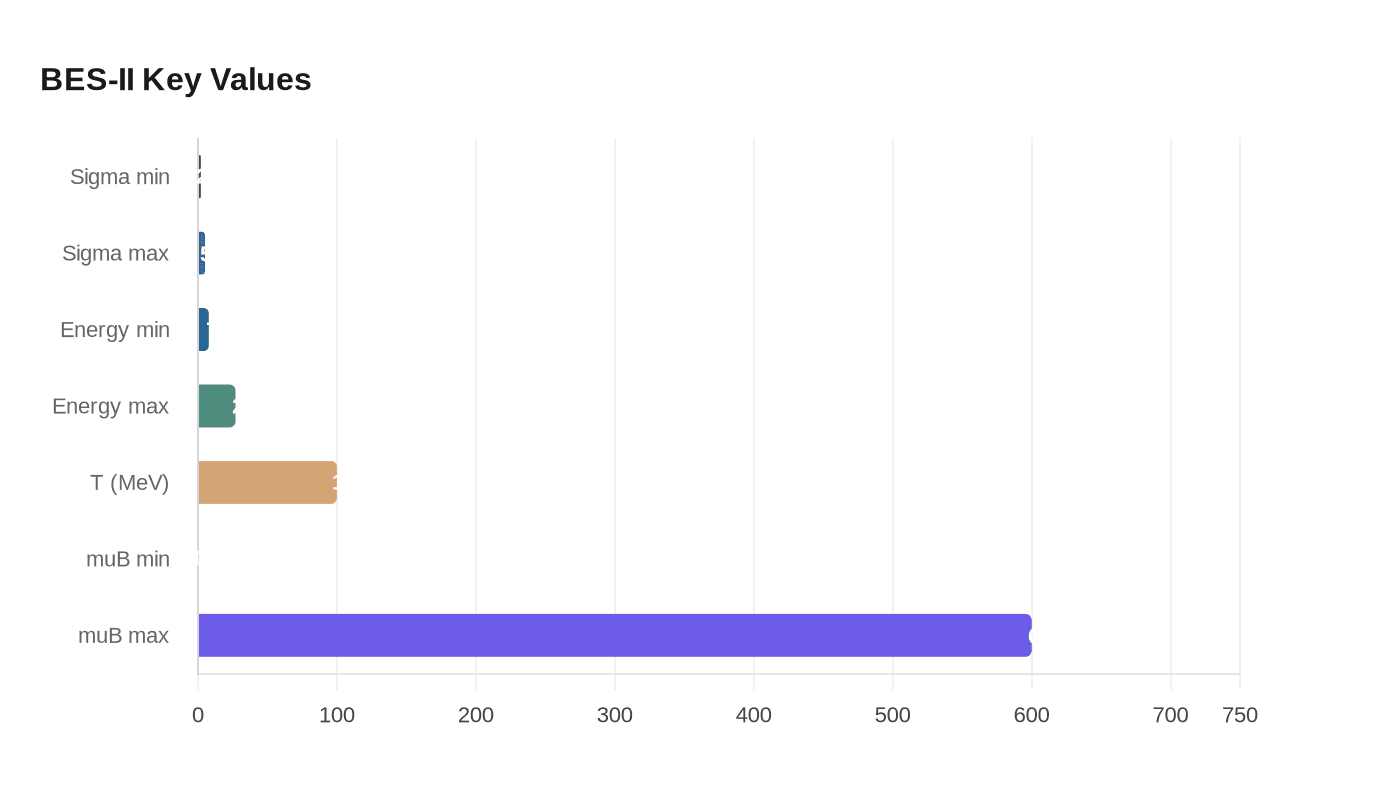
Caveats remain. Decades of review literature and conference summaries stress that noncritical fluctuation sources can mimic or mask any true critical signal; dynamical modeling of critical fluctuations and careful control of background effects are essential for interpretation. Past work also emphasizes that the experiments probe temperatures around T ∼ 100 MeV and baryon chemical potentials µB in the range 0–600 MeV, where theoretical uncertainty about the exact coordinates of a critical point persists.
For the Nuclear Reactions community, these results are both a spark and a checklist. The 2–5σ deviations narrow parameter space and motivate focused follow-up: detailed comparisons to transport and thermal models with tuned parameters, expanded dynamical simulations that include critical fluctuations, and independent scrutiny of acceptance, efficiency, and centrality-reference choices. The arXiv status report packages the BES-II evidence and flags where theoretical and experimental cross-checks must land before a claim of discovery.
What comes next is straightforward: modelers must fold realistic critical dynamics into their codes, experimentalists must publish full differential results and cross-check centrality baselines, and the field will watch whether independent analyses and future runs sustain or erode the 2–5σ signals. If the deviations hold up under that pressure, the long hunt for the QCD critical point will have tightened considerably.
This article was produced by Prism’s automated news system from verified source data, official records, and press releases, then run through automated quality and moderation checks before publishing. The system is built and supervised by the people who set the standards it runs under. Read our full AI policy.
Did this article answer your question?