Switzerland Could Build Two New Nuclear Reactors to Meet Electricity Demand, Axpo Reports
Axpo's new energy report models two scenarios for Switzerland's electricity future — one with two new nuclear reactors that would slash the need for renewable expansion, but only if Switzerland lifts its construction ban.
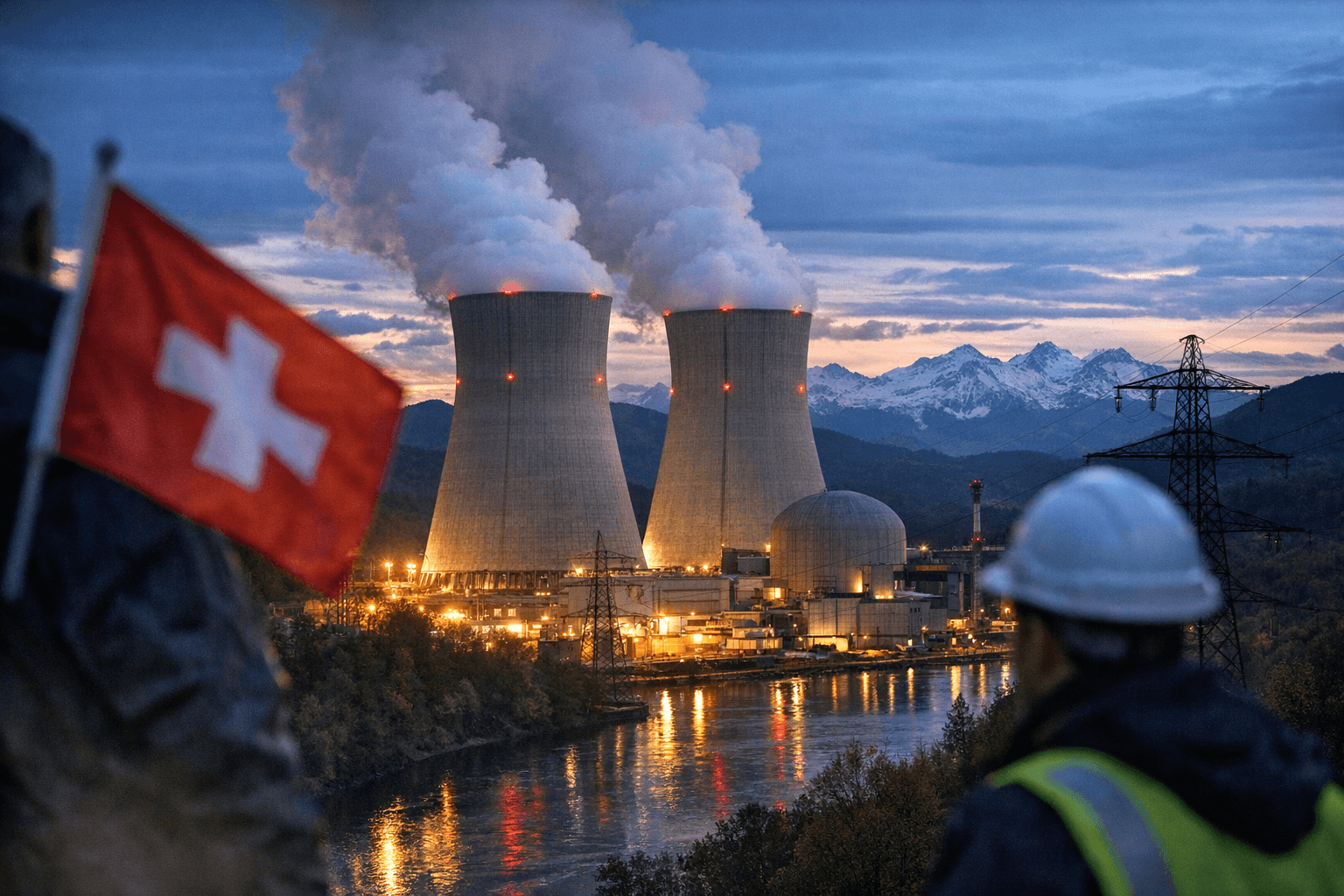
Swiss energy company Axpo Group has presented a report modelling two distinct pathways for meeting increasing electricity demand in Switzerland, one of which involves building two new nuclear power plants alongside expanded renewables. The report's nuclear scenario carries an immediate political prerequisite: Switzerland's ban on the construction of new nuclear power has been in place since 1 January 2018, and any move toward new-build would require lifting it.
Axpo's report outlines the two scenarios with precision. Scenario 1 leans on a diversified grid without new nuclear: "Scenario 1 consists of a balanced mix of hydropower, more photovoltaics, significantly more wind power, and a number of market-active gas-fired power stations as a flexible supplement." Gas-fired stations are not decorative in that mix. As Axpo puts it, "the latter meet the steadily growing demand for flexible generation resulting from the expansion of renewables to ensure winter supply, especially during critical weather conditions." The company frames this path as better aligned with current policy direction: "As the additional CO2 emissions from gas-fired power stations remain negligible within the overall picture of Switzerland's CO2 balance in 2050, this scenario is most in line with the decisions taken to date by the electorate." From a corporate standpoint, Axpo adds that the renewables-plus-gas approach "allows for reduced state involvement and greater reliance on market-based mechanisms" and "offers greater flexibility for long-term technological developments."
Scenario 2 is where the nuclear question sharpens. "In Scenario 2, Switzerland opts to build two new nuclear power plants. These work alongside other technologies, including hydropower, more photovoltaics, more wind power and flexible, market-responsive gas-fired power stations." The key distinction is in what new nuclear would relieve: "new nuclear power plants would significantly reduce the need for expansion in all other technologies." That is not a trivial observation in a country already wrestling with the pace of wind and solar rollout. Axpo's own assessment of the scenario is measured: "Scenario 2 with new nuclear power plants is worth considering, but is not a priority for Axpo as a company."
Crucially, both scenarios are presented as viable. Axpo states that the reports "outline two possible scenarios — with and without new nuclear power stations. Both enable a reliable, sustainable and affordable supply."
The report also identifies four actions Axpo calls "no-regret" moves, required regardless of which path Switzerland ultimately takes: ensuring the long-term operation of existing nuclear power stations; focusing the subsidy scheme on winter; accelerating the expansion of wind power; and creating the right conditions for market-active gas-fired power stations. For Scenario 1 specifically, Axpo sets out two non-negotiable preconditions: "The pace of wind power expansion must increase significantly, while the necessary framework conditions must be set for the long-term operation of nuclear and gas-fired power plants."
The timing of this analysis is not abstract. Axpo notes that electricity demand in Switzerland looks set to rise in the coming years, while the country's two oldest nuclear power plants, Beznau I and II, are scheduled to be shut down in 2032 and 2033. Wholly owned by Axpo, the Beznau nuclear power plant consists of two almost identical plants, each with a light water reactor and a 365-megawatt capacity. Since commissioning, Axpo has invested more than CHF2.5 billion in retrofitting and modernising the two units at Beznau, with a further CHF350 million committed to ensure operation until 2033.
On the legislative side, Switzerland's parliamentary upper house has voted in favour of lifting the country's longstanding ban on constructing new nuclear power plants, with lawmakers having until August 2026 to decide on both the popular initiative and the government's counterproposal. Andreas Pautz, head of the Centre for Nuclear Engineering and Sciences at the Paul Scherrer Institute, has estimated that regulatory hurdles and public votes could delay any construction until at least 2040.
The Axpo report was produced with institutional rigour typical of the company's energy policy work. Axpo says its experts "work with top Swiss research institutions and independent advisory board of academics, industry and environmental leaders plus cross-party politicians to produce agenda-setting reports that inform debate." Politically, the study, particularly its assessment of nuclear energy, is a significant one that will likely feed into political debates, especially since it provides argumentative fodder for both opponents and supporters of nuclear.
What the report does not provide are construction timelines, reactor capacities, prospective sites for the two new plants, or cost estimates for either scenario — details that will become critical if Swiss lawmakers move to formally open the door to new-build in the months ahead.
This article was produced by Prism’s automated news system from verified source data, official records, and press releases, then run through automated quality and moderation checks before publishing. The system is built and supervised by the people who set the standards it runs under. Read our full AI policy.
Did this article answer your question?