U.S. Advanced Nuclear Supply Chain Faces Market Paralysis, Russian and Chinese Dependencies
The U.S. nuclear supply chain is caught in a market paralysis loop, with Russia and China supplying critical materials like lithium-7 and nuclear-grade graphite that America can't yet replace.
The U.S. advanced nuclear industry has a foundational problem that no amount of reactor design innovation can fix on its own: it can't build what it can't supply. A report released March 20 by the Nuclear Scaling Initiative, based on analysis by energy consultancy Solestiss and backed by the Bezos Earth Fund, puts a name to what practitioners have long sensed: a "self-reinforcing cycle of market paralysis" in which suppliers won't invest without firm demand, and buyers won't commit without a functioning supply chain.
The U.S. is failing to scale up a supply chain required to service a growing fleet of new nuclear energy and must coordinate better to standardize manufacturing. The stakes are geopolitical as much as industrial. Dillon Allen, president of the advisory services division at Solestiss, who started his career in nuclear propulsion in the U.S. Navy, warned that once you're building four to eight AP1000s and a handful of SMRs of other sizes, you start running into smaller component bottlenecks.
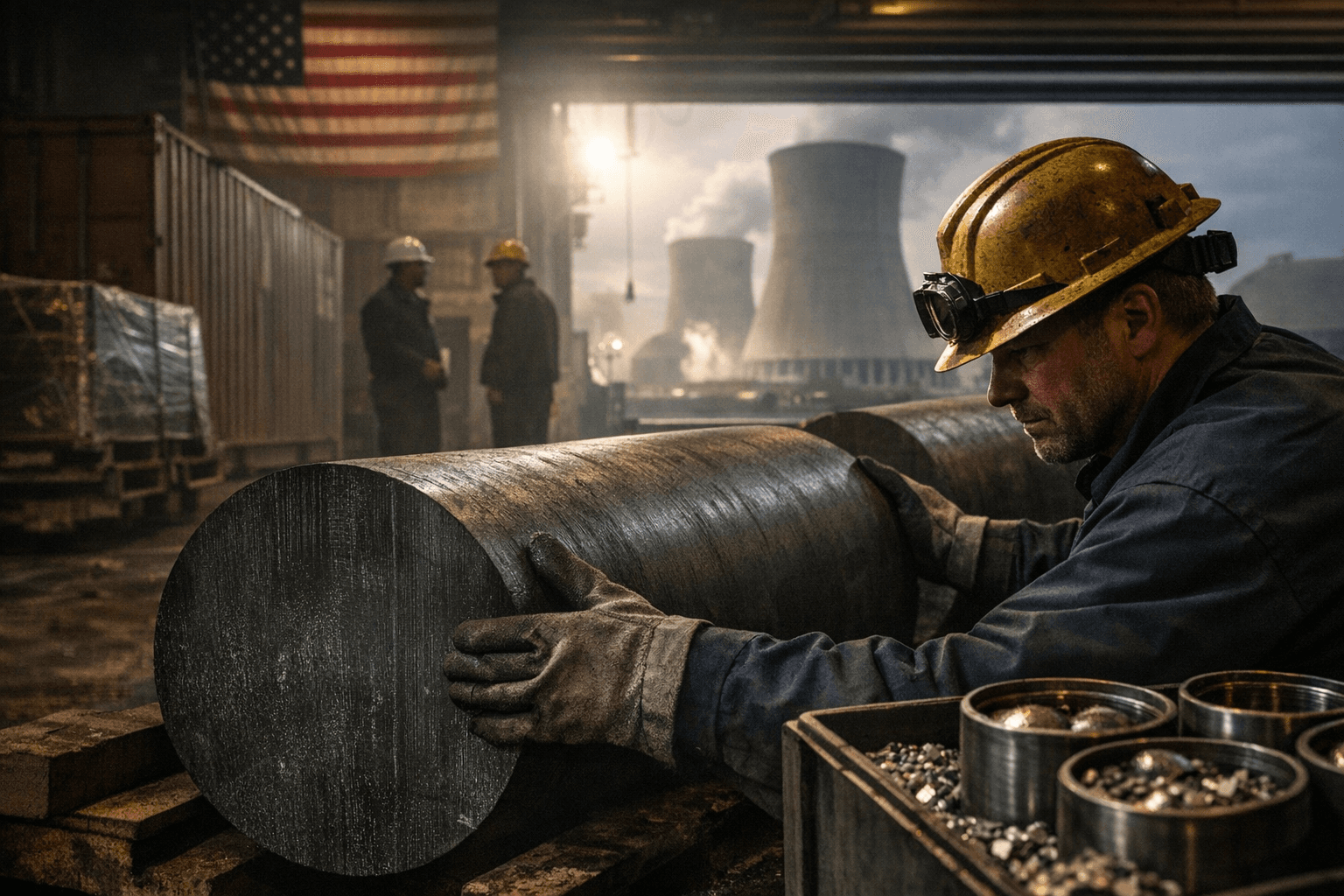
Allen's full diagnosis is blunter still. "The U.S. advanced nuclear supply chain is caught up in a complex geopolitical landscape," he said. "Current supply chains rely heavily on Russia and China for lithium-7, nuclear-grade graphite, and uranium conversion and enrichment. Downstream manufacturing bottlenecks and a shortage of skilled nuclear labor only add to that risk, meaning that without coordinated investment and workforce development, the United States may struggle to deploy nuclear energy at the scale needed to meet long-term energy demand."
One of the key constraints on the ability to deliver new projects at scale is the availability of workers. Beyond commonly cited shortages in construction craft labor, the report also identified a critical lack of nuclear-qualified machinists, welders, inspectors, nondestructive examination specialists, and project managers. Compounding this is a "looming retirement wave" and a federal push for 300 GW of new nuclear capacity by 2050. In response, the report recommends "dramatic investments" in more centralized and standardized training and education at local, state, and federal levels, citing the initial nuclear workforce buildout in the 1950s and '60s as a potential template.
The report's central structural fix is an order book: a committed pipeline of reactor orders that can simultaneously give suppliers the confidence to invest and manufacturers the volume to drive down costs. NSI executive director Steve Comello framed it directly: "An order book can create the predictability needed to strengthen supply chains, grow a skilled workforce, and reduce the delays and cost overruns that have historically slowed progress."
The report recommends the repeated deployment of Gen III+ reactor designs to rebuild the foundation of domestic manufacturing, workforce, and qualification capacity. Three designs are named explicitly as the recommended focus: the Westinghouse AP1000, the Holtec SMR-300, and the GE Vernova Hitachi BWRX-300. The rationale is pragmatic: Gen IV technologies raise multifaceted concerns around cost, fuel readiness, supply-chain maturity, and workforce preparedness that make them a poor anchor for rebuilding domestic industrial capacity. Build the base first, then scale into the next generation.
The GE Vernova Hitachi BWRX-300 is the first small modular reactor being built in North America. Construction began in May 2025 at Ontario's Darlington New Nuclear Project site, with four planned units that can collectively power over one million homes and businesses. The fact that this milestone unit is under construction while its supply chain is still described as a bottleneck-laden work in progress illustrates exactly the gap the NSI report is trying to close.
The U.S. should ultimately focus on designs it can scale up rather than spreading its efforts in many different directions, said Stephen Comello, the executive director of the Nuclear Scaling Initiative. The report notes that the Department of Energy made a similar call for an order book in its "Pathways to Commercial Liftoff: Advanced Nuclear" report, released in 2023 and updated in 2024 and early 2025; that DOE report is no longer available on the DOE website.
NSI also released a new comparison tool alongside the report to help evaluate the growing field of reactor designs, though the specific metrics and methodology behind it have yet to be made public. Rather than presenting a definitive roadmap, the report aims to surface practical observations and real-world bottlenecks identified by suppliers, labor groups, developers, and public sector actors, drawing on interviews with more than 40 industry stakeholders. That practitioner grounding is what makes the market paralysis diagnosis credible: this isn't a modeling exercise, it's a read of where the industry actually stands. The question now is whether government and industry will move before the first BWRX-300 unit in Ontario exposes just how thin that supply chain really is.
This article was produced by Prism’s automated news system from verified source data, official records, and press releases, then run through automated quality and moderation checks before publishing. The system is built and supervised by the people who set the standards it runs under. Read our full AI policy.
Did this article answer your question?