U.S. and Ecuador Sign Civil Nuclear Cooperation Agreement on Peaceful Energy
Ecuador's $2B blackout crisis, which cut power for 14 hours a day in 2024, drove Landau and Sommerfeld to sign a civil nuclear cooperation MOU April 1.
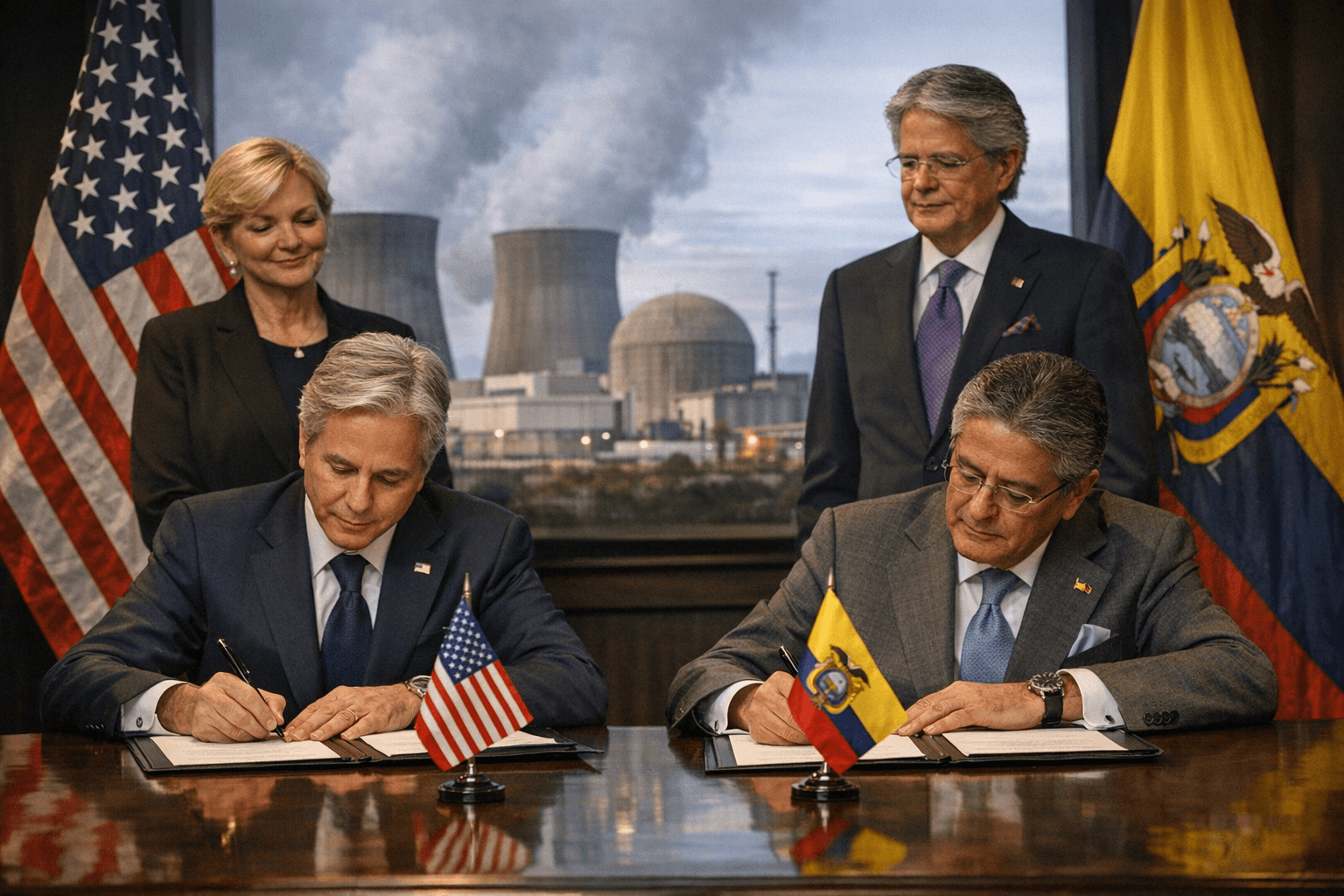
Christopher Landau and Ecuador's Foreign Minister Gabriela Sommerfeld signed a Memorandum of Understanding on civil nuclear cooperation in Washington on April 1, formalizing a diplomatic partnership that traces its urgency to Ecuador's worst energy crisis in recent memory.
Ecuador experienced rolling blackouts of up to 14 hours per day in 2024 after drought conditions depleted water levels at hydroelectric plants. With 78 percent of the country's total electricity generation tied to hydropower, the prolonged dry season that year left Ecuador's grid exposed and, according to Ecuador's Central Bank, power outages caused economic losses of about $2 billion.
President Daniel Noboa, who took office in late 2023 as the crisis was accelerating, has been explicit about his preferred remedy. Noboa announced a proposed Nuclear Energy Bill aimed at introducing nuclear power into the country's energy mix, with nuclear energy positioned as a clean, safe, and modern alternative. Ecuador's nuclear energy plan contemplates a 300-megawatt small modular reactor in the medium term and a 1-gigawatt reactor in the long term. In May 2025, Ecuador became a member of the IAEA. The country is also a signatory to the Treaty of Tlatelolco, the 1967 instrument that established Latin America and the Caribbean as a nuclear-weapon-free zone. That nonproliferation baseline is precisely what Washington requires before signing this kind of agreement. The State Department's media note tied the MOU explicitly to "the highest standards of nuclear safety, security, and nonproliferation."
Landau arrived at the signing table as one of the State Department's sharper Latin America hands. Confirmed as Deputy Secretary of State in a 60-31 Senate vote, the seasoned diplomat and attorney previously served as U.S. Ambassador to Mexico from 2019 to 2021. He is an American lawyer and diplomat who studied law at Harvard University. Under Secretary of State Marco Rubio, the department has positioned civil nuclear exports as a geopolitical instrument, offering U.S.-backed partnerships as a direct alternative to state-subsidized deals from Russia's Rosatom and China's CGN, both of which have expanded influence in the developing world through government-to-government nuclear arrangements.
The MOU covers peaceful applications including research reactors and medical isotope production and establishes a framework for regulatory capacity building and technical assistance. It is a precursor instrument. A formal Section 123 Agreement under the Atomic Energy Act of 1954 would be required before any significant nuclear trade or equipment transfers, meaning commercial arrangements remain several diplomatic and regulatory steps away.
For companies across the U.S. nuclear supply chain, particularly those working in regulatory consulting, research reactor design, isotope production, and workforce training, Ecuador now sits on the map as an early-stage market. The Department of Energy typically implements the technical work flowing from these agreements, while the NRC provides regulatory alignment support. The pipeline is long by design. With Noboa already advancing a nuclear bill and Ecuador holding full IAEA membership, the political will in Quito is not in question.
Know something we missed? Have a correction or additional information?
Submit a Tip

