Cockatoo keeps pestering African grey brother during cardboard fort play
Brody’s cardboard fort is funny until Sweet Pea barges in, and that clash shows how different birds ask for attention, play, and space.
A cardboard fort can tell you a lot about a bird household
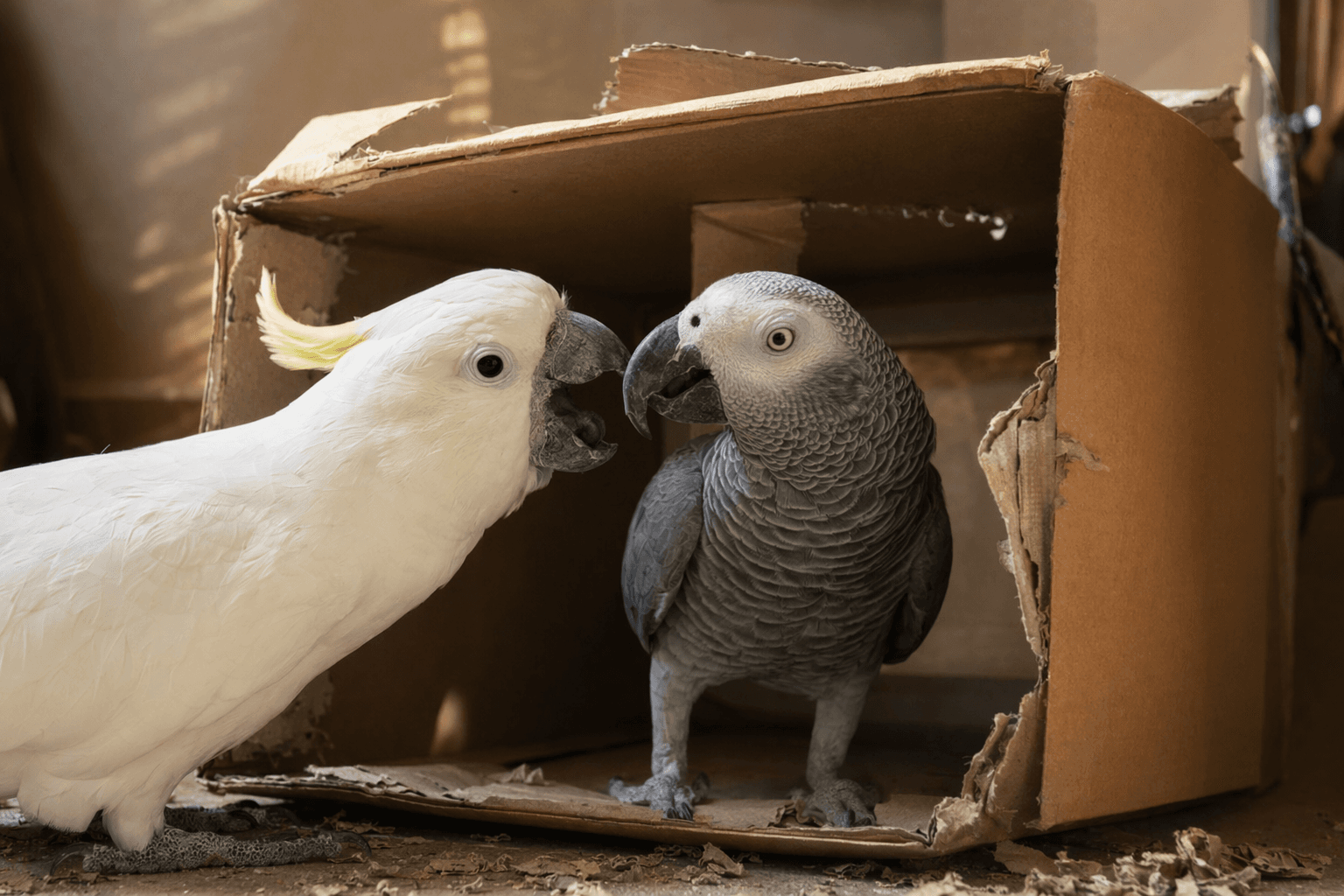
Brody, the African grey, wants to build and work. Sweet Pea, his cockatoo sister, wants to insert herself into the middle of the project. That simple setup, repeated across a run of PawNation sibling-style clips, is more than a cute bit of bird theater. It is a clear window into how parrots use enrichment differently, how they seek attention in their own ways, and how easily a playful scene can turn into tension if a home does not give each bird enough to do.
The cardboard fort matters because it is doing real behavioral work. In the wild, parrots may spend 240 to 360 minutes per day foraging, while captive parrots only forage about 30 to 72 minutes. That gap is enormous, and it explains why a plain box can become so valuable: it gives a bird something to shred, explore, and work through instead of sitting with unmet instincts. The Association of Avian Veterinarians recommends hiding treats inside chewable objects like cardboard boxes, bags, or cups, turning everyday household clutter into foraging enrichment rather than waste.
Why the box is doing more than keeping Brody busy
A box fort is not just a toy, and it is not just a cheap way to occupy a parrot for a few minutes. It gives a bird stimulation, a constructive outlet for chewing, and a safer place to satisfy destructive urges that would otherwise land on furniture, trim, or cage parts. When Brody is absorbed in his cardboard project, he is showing species-appropriate behavior, the kind of focused activity parrots are built to perform.
That matters because boredom is not a minor inconvenience in bird homes. Veterinary Partner notes that more than 20 million pet birds live in the United States, and boredom, along with the stress of not being able to perform natural behaviors, is one of the common challenges of captivity. Left unmanaged, that boredom can move into stress and behavior changes that are much harder to reverse.
The warning signs are not subtle once you know what to watch for. Veterinary Partner lists feather picking, self-destructive behavior, fearful or aggressive behavior, trembling, excessive vocalization, and screaming as possible signs that a bird is struggling. A bird busy with a box fort is often a bird less likely to invent its own trouble.
Sweet Pea’s interruption is funny, but it is also informative
Sweet Pea’s role in the clip is what gives the story its real household lesson. She does not simply sit nearby and admire Brody’s work. She climbs in, perches on his fort, and even stretches out a foot to touch him, as if the entire project exists for her commentary. In the later PawNation post, she is literally evicted from Brody’s cardboard fort, which makes the whole scene feel like a small ongoing family saga rather than a single lucky moment.
That pattern is useful because it shows that birds do not all respond to enrichment in the same way. Brody is content to build and engage with the box itself. Sweet Pea seems to want access, interruption, or perhaps the social leverage of being in the middle of his space. In a real home, that difference can be the whole story. What looks like ordinary teasing may actually be one bird seeking interaction while another is trying to protect a valued project.
When a second bird keeps intruding, it is worth asking whether the behavior is playful, competitive, or rooted in a lack of other outlets. Repeated pestering can be a sign of overexcitement, resource competition, or a bird trying to commandeer attention in the only way it knows how.
What multi-bird homes can learn from Brody and Sweet Pea
The smartest takeaway is not to stop giving parrots projects. It is to give them enough projects, in enough places, that one bird does not have to keep hijacking another bird’s fun. The Association of Avian Veterinarians describes five kinds of enrichment for pet birds: sensory, nutritional, manipulative, environmental, and behavioral. That is the part many homes miss. A single box is helpful, but a well-set-up bird space usually needs a mix of textures, jobs, and challenges.
- Separate foraging stations so one bird is not constantly stealing the other’s rewards.
- Multiple chewable items, including boxes, cups, and bags, so there is no single “hot” object everyone wants at once.
- Enough space for one bird to retreat without being cornered.
- Different forms of enrichment in rotation, so the birds are not competing for the same toy every day.
- Individual attention time, because social contact is not a substitute for mental work.
A practical multi-bird setup often includes:
That last point is important. Birds may be flock animals, but flock life is not the same as constant togetherness. Lafeber notes that parrots are social creatures and that sibling or flockmate bonds can be complicated in captivity. Even when two parrots are siblings, they may behave more like roommates forced to share space than lifelong companions who naturally settle every dispute. Buying two parrots does not guarantee they will keep each other company.
Why African greys and cockatoos can be such a tricky pair
Brody’s species adds another layer to the story. Lafeber describes African grey parrots as highly intelligent, highly social, and in need of mental stimulation. That combination makes them especially likely to benefit from puzzle-like foraging, shreddable materials, and tasks that reward focus. A cockatoo, by contrast, may bring a louder social style into the room, one that is less about private concentration and more about interaction, dramatic presence, and physical involvement.
That is why Sweet Pea’s behavior reads as more than comic mischief. She is showing a different social strategy. Brody wants the fort; Sweet Pea wants the fort and the interaction that comes with it. In a home with both styles, the goal is not to choose a winner. It is to prevent the birds from turning one toy into a scarce resource.
A household-management lesson hidden inside the laugh
The best bird homes do not rely on luck to keep peace. They build conditions where curiosity has somewhere to go and where each bird can choose a different kind of engagement. That is the real lesson behind Brody’s fort and Sweet Pea’s intrusions: enrichment is not only about reducing boredom, it is about managing social pressure before it becomes conflict.
A cardboard box can be play, foraging, chewing, and environmental design all at once. It can also become a flashpoint if only one box exists and two birds want the same attention from it. The fix is not to eliminate the fort. The fix is to make sure the house has enough forts, enough choices, and enough private attention for each parrot to stay busy without turning every session into a takeover.
That is how a funny sibling clip becomes a serious care reminder. In multi-bird homes, enrichment is not decoration. It is the difference between a lively flock and a volatile one.
This article was produced by Prism’s automated news system from verified source data, official records, and press releases, then run through automated quality and moderation checks before publishing. The system is built and supervised by the people who set the standards it runs under. Read our full AI policy.
Did this article answer your question?