Complete Parrot Grooming Guide: Feathers, Nails, and Beak Care
Overgrown nails and a misshapen beak can cause real pain for your parrot; knowing which tasks to handle yourself and which to leave to a vet makes all the difference.
Your parrot's nails click against the perch with every step. The tips are curling slightly, snagging on your sleeve when he climbs your arm. It's easy to put off, but those nails are telling you something: grooming time is overdue.
Routine grooming is not glamorous work, but it is some of the most important preventive care you can give a companion parrot. Done right, it prevents painful conditions, supports healthy feather quality and flight capability, and doubles as genuine bonding time. The challenge is knowing which tasks belong in your hands and which require an avian vet. Here's how to navigate all three areas: feathers, nails, and beak.
Feather Care and Bathing
Feathers are a parrot's first line of defense against temperature fluctuations, UV exposure, and physical wear. Regular bathing keeps them in good condition, removes dust and dander, and stimulates natural preening behavior. The method you use matters less than the consistency: some birds prefer a shallow dish they can wade into, others respond better to a gentle misting from a spray bottle, and a few will happily stand in a light shower stream. What matters is that the water is warm but never hot, and that every session is supervised.
Moulting cycles add another layer to feather management. During a moult, your bird is producing new pin feathers, those waxy, blood-filled shafts that emerge before the mature feather unfurls. Pin feathers on the head and neck are particularly sensitive, as the bird cannot reach them to preen independently. This is a natural opportunity to help, and gentle assistance with head pin feathers can become part of your routine. Pay close attention to asymmetrical feather loss, which can signal something beyond a normal moult and warrants a veterinary conversation.
Bathing frequency should be tailored to your bird's species, activity level, and temperament. A cockatoo living in a dry climate may benefit from daily misting; a smaller species in a humid environment might be content with a few baths per week. Watch how your parrot responds and adjust accordingly.
Nail Trimming and Filing
Overgrown nails are one of the most common and preventable grooming problems in companion parrots. Left unchecked, they curve inward, catch on cage bars and fabric, and make perching uncomfortable. In severe cases, they can alter the bird's gait and posture in ways that compound into bigger health issues over time.
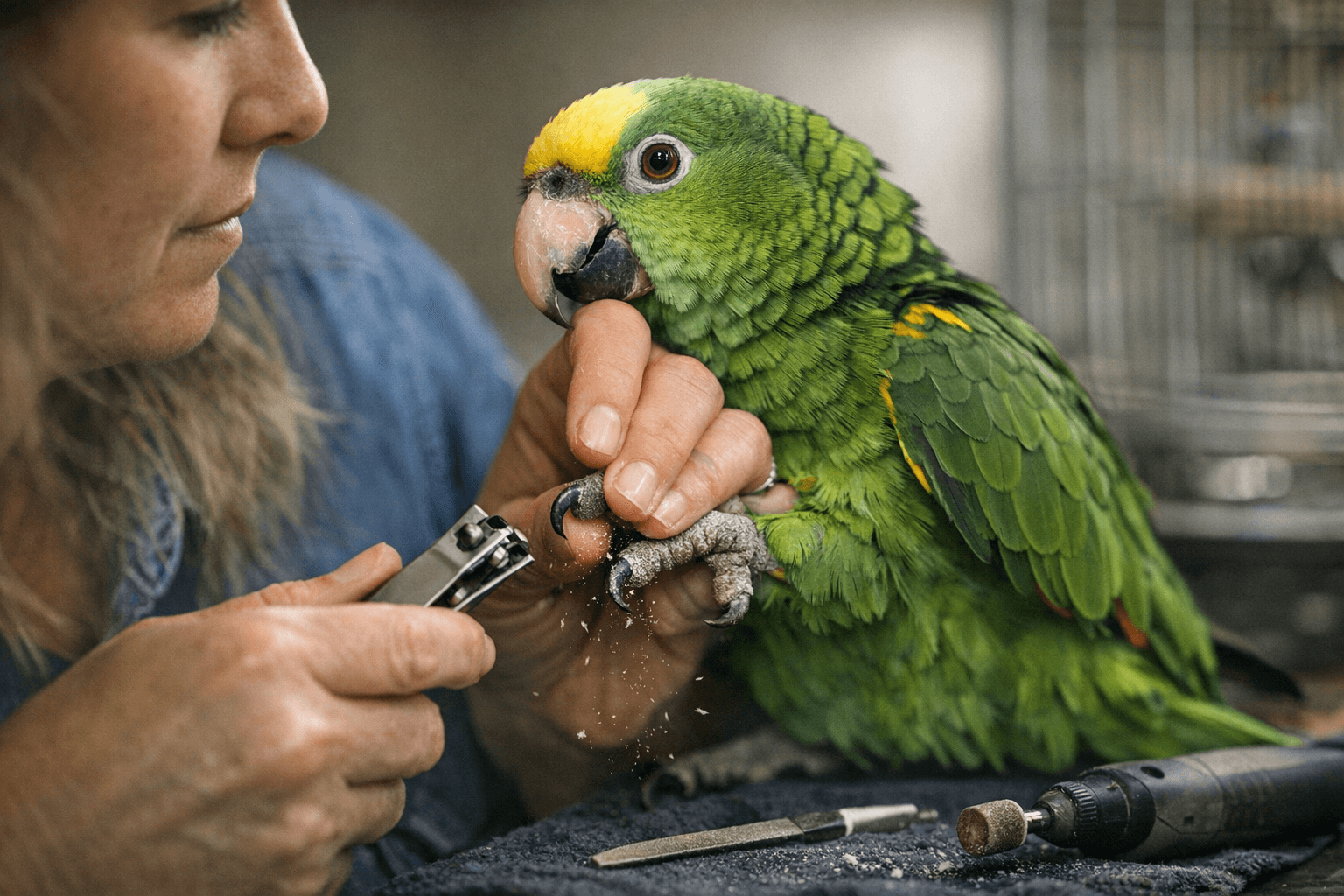
The key anatomical feature to know is the quick: the blood-rich vein that runs through each nail. Cutting into the quick causes pain and bleeding, so the goal is always to trim just the sharp tip, well clear of that vein. In light-colored nails, the quick is often visible as a pinkish line running through the center. In dark nails, trim conservatively and use a file to smooth the tip rather than relying solely on clippers.
A grooming perch, typically one made from concrete or rough mineral material, can reduce how often you need to trim by naturally wearing down the nail during everyday movement. It is a practical enrichment strategy that keeps nails manageable between formal sessions.
When it is time to clip, work through these steps:
1. Have styptic powder within reach before you begin. If you nick the quick, apply it immediately to stop the bleeding.
2. Use a restraint method appropriate to your bird's size and temperament. Smaller parrots can often be wrapped loosely in a soft towel; larger species may need a second person to assist.
3. Work quickly and calmly. Short sessions ending with a reward are far less stressful than long, combative ones.
4. File after clipping to remove any sharp edges that could snag on fabric or feathers.
If your bird's stress response to nail trims is severe, positive reinforcement training is the long-term solution. Teaching a foot-targeting behavior, where the bird voluntarily places its foot in your hand on cue, can transform nail trims from a wrestling match into a cooperative routine.
Beak Care
The beak is both a tool and a sensory organ, and it requires a fundamentally different approach than nails. A healthy beak self-maintains through natural use: chewing, foraging, and wiping the beak on perches all contribute to keeping it properly shaped. The most effective thing you can do at home is provide the right enrichment. Wooden chew toys that encourage vigorous biting, mineral blocks for light shaping, and cuttlebone as a supplemental surface-wearing resource all support natural beak maintenance without any intervention from you.
What you should not do is attempt to shape or trim a significantly overgrown beak yourself. The beak has a blood supply, nerve endings, and a complex layered structure that varies considerably between species. Aggressive home trimming risks cracking, bleeding, or creating an irregular bite that compounds the original problem. When overgrowth or structural deformity is present, that work belongs with an avian vet or experienced avian technician, period.
Warning signs that require professional attention rather than a home fix:
- Sudden beak chipping or cracking
- Bleeding from or around the beak
- A swollen or discolored cere (the fleshy area just above the beak)
- Reluctance to eat or visible difficulty manipulating food
- Asymmetrical beak growth
Any of these can indicate underlying health issues ranging from nutritional deficiencies to infection, and none of them should be managed at home with a nail file.
Positive Reinforcement: The Foundation of Stress-Free Grooming
The single biggest variable in how smoothly grooming goes is how the bird feels about the process. A parrot that has learned to associate handling, toweling, and nail contact with rewards will tolerate grooming far more readily than one whose only experience of it has been restraint and stress.
Positive reinforcement builds that association deliberately. Start with whatever your bird finds most rewarding, typically a favored treat or enthusiastic verbal praise, and pair it with the earliest steps of grooming: picking up the foot, touching the nail, hearing the sound of clippers nearby. Work gradually, always at the bird's pace, and keep sessions short enough that you can end on a positive note every single time.
This approach pays dividends beyond the grooming table. A bird that trusts handling is also easier to examine in a veterinary setting, which has real implications for its long-term health care and your vet's ability to catch problems early.
Your Equipment Checklist
Having the right tools on hand before you start prevents mid-session scrambles that spike stress for both you and the bird:
- Bird-specific nail clippers or small, sharp scissors for tinier species
- A nail file or fine emery board for smoothing after clipping
- Styptic powder, with cornstarch as an emergency backup
- A grooming perch for passive, day-to-day nail maintenance
- A spray bottle or shallow bathing dish suited to your bird's preference
- A soft towel for safe restraint or post-bath warmth
When to Involve Your Avian Vet
Routine bathing and light nail filing sit squarely within what most owners can manage at home. Everything beyond that, particularly beak work and any situation involving bleeding, deformity, or unexplained feather changes, belongs in professional hands.
Regular weigh-ins are a surprisingly powerful monitoring tool that most owners overlook. Parrots are adept at masking illness, and a gradual weight drop is often the first detectable sign that something is wrong. A kitchen scale accurate to the gram, used consistently each week, gives you a reliable baseline that makes subtle changes visible before they become serious emergencies.
If you are new to grooming or uncertain about your technique, the best investment you can make is a hands-on session with a local avian vet or experienced bird handler who can demonstrate safe nail clipping on your specific bird. That kind of one-on-one instruction is worth more than any written resource because it accounts for your parrot's individual size, temperament, and quirks. Think of it as a tutorial that pays off at every single trim session going forward.
Grooming is not a chore to dread. With the right tools, a consistent training approach, and a clear sense of where the professional boundaries are, it becomes one of the most reliable ways to keep your parrot healthy and your relationship with them built on genuine trust.
This article was produced by Prism’s automated news system from verified source data, official records, and press releases, then run through automated quality and moderation checks before publishing. The system is built and supervised by the people who set the standards it runs under. Read our full AI policy.
Did this article answer your question?