How to Enrich Your Parrot's Life With Toys, Foraging, and Social Play
Scout, a 13-year-old caique, stopped destroying his feathers within ten weeks of enrichment changes. Wild parrots forage 4-8 hours daily; your captive bird needs that same challenge.
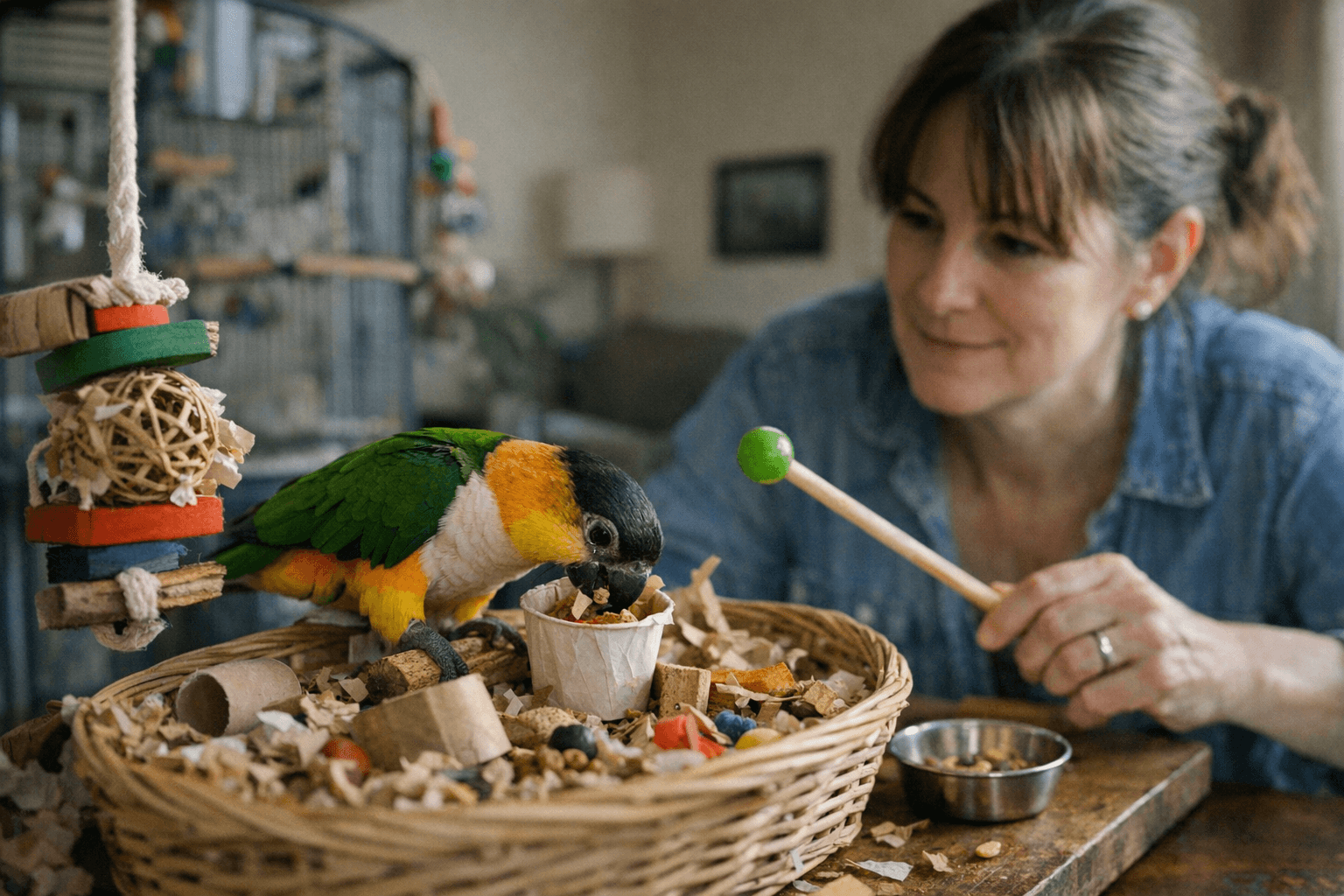
Scout, a 13-year-old Black-headed Caique, had been shredding his own feathers for months when his owner Abbie sought help from certified parrot behavior consultant Pamela Clark in early 2018. Scout didn't play with toys. He didn't forage. He cruised the cage floor and, with nothing better to occupy himself, turned his beak on his own plumage. Within two and a half months of rebuilding his enrichment from scratch, including daily foraging tasks, targeted training sessions, and a diet overhaul, Scout had stopped the destruction entirely.
His story isn't unusual. What's unusual is how clearly it illustrates the core problem: captive parrots are intelligent, foraging-focused animals living in an environment that gives them almost nothing to do.
Here's the stat worth sharing with every parrot owner you know: research compiled by LafeberVet shows wild parrots spend between 40% and 75% of their waking hours foraging, roughly 4 to 8 hours of active food-seeking every single day. A bowl of pellets sitting in a cage addresses maybe fifteen minutes of that drive. The rest lands on your furniture, your fingers, and, if you're Scout, your own chest feathers.
Why enrichment is non-negotiable
Unlike dogs or cats, most psittacine species are not domesticated animals. They've retained their full suite of wild instincts: the drive to navigate complex environments, manage flock relationships, and spend the majority of the day working for food. In captivity, those drives have nowhere to go. The result is boredom, and boredom in a parrot looks like screaming, feather picking, aggression, and stereotypic repetitive behaviors. Thoughtfully designed enrichment replicates the demands of wild life within the safety of your home; it is not optional any more than nutrition or veterinary care is optional.
The four enrichment categories
Foraging enrichment is where most captive birds are most underserved. Hide portions of your parrot's existing diet, pellets, safe fresh vegetables, kitchen-safe fruits, inside puzzle feeders, cardboard tubes, or paper-wrapped parcels. Rotate the task daily so novelty stays intact. Critically, the mechanics matter: foraging toys should require actual manipulation, pulling a cork, rotating a dial, sliding a panel. The physical act of working the beak and feet delivers as much value as the food reward itself. Don't use foraging as a vehicle to add extra treats; use it to deliver the balanced diet your bird already needs.
Manipulative toys address physical and cognitive needs simultaneously. Reliable materials include bird-safe woods such as manzanita, apple, and untreated hardwood dowels; untreated leather strips; coconut shell pieces; and natural fiber rope in moderation. The variable you need to calibrate is difficulty. A young bird, a recovering bird, or a species new to enrichment needs simple tasks. A bored, high-energy macaw or an experienced African grey needs something that makes them genuinely work. If a toy is destroyed in ten minutes with no apparent satisfaction, it was too easy. If the bird ignores it entirely, it may be too intimidating or unfamiliar.
Social enrichment is routinely undersupplied by owners who assume physical presence equals meaningful interaction. It doesn't. Daily one-on-one time, short positive reinforcement training sessions, and supervised out-of-cage time are what actually satisfy a parrot's social needs. Training earns a disproportionate return: simple cues like "step up," target-touch, or recall build trust, engage problem-solving circuits, and give you a reliable communication framework. Video calls and mirror time can serve as brief adjuncts when you're genuinely unavailable, but they are not substitutes for real interaction. Treat them like background radio, not a conversation.
Sensory enrichment is the most overlooked category. Rotate background sounds, nature recordings and soft music work well, rather than leaving a loud television on all day. Offer tactile variety through different perch types: rope perches for grip exercise, natural wood branches for varied foot positioning, and concrete-coated perches for passive nail maintenance. Supervised access to a shallow water dish for bathing rounds out the sensory picture and directly supports plumage health.
The 7-day enrichment rotation
The goal is sustained novelty without daily chaos. A weekly framework keeps things fresh without requiring constant new purchases:
1. Day 1: Medium-difficulty foraging puzzle; pellets or vegetables hidden in a cardboard tube sealed with crumpled paper
2. Day 2: Manipulative toy swap; rotate in a fresh wooden block or coconut shell toy, retire the one from last week
3. Day 3: Sensory focus day; introduce a nature soundscape during midday hours and offer a shallow bath dish
4. Day 4: Training-focused session; ten to fifteen minutes of positive reinforcement, mixing practiced and new cues
5. Day 5: Elevated foraging difficulty; multi-layer paper wrapping or a puzzle feeder requiring sequential steps to access food
6. Day 6: Social enrichment priority; extended supervised out-of-cage time, interactive play, exploration of a safe room
7. Day 7: Observation day; minimal new stimuli, note which toys your bird returned to most this week and log them
Pull destroyed toys the moment they're destroyed, regardless of where you are in the weekly cycle. A frayed rope or a splintered piece of wood is a hazard, not just an aesthetic problem.
Safety and decision points: what's actually safe
Metals to avoid absolutely: copper, zinc, lead, and galvanized metal are all toxic to birds. Acrylic and unknown plastics can shatter into sharp-edged fragments. Treated leather and dyes with unclear composition don't belong in your bird's cage under any circumstances.
For DIY builds, cardboard, paper towel rolls, safe wooden blocks, and natural fiber rope are all solid starting points. When you knot rope into a swing or wrap food into a parcel, check that no opening is large enough to trap a foot or head, and that no knot is small enough to catch a toe. Never use staples or strong adhesive anywhere a bird can reach with its beak.
Inspect toys daily. Not weekly. Daily. Loose strings, tiny parts, and sharp edges appear fast, especially with aggressive chewers. Repair or replace at the first sign of wear.
When enrichment becomes overstimulation
More is not always better. Frantic escape attempts, panting, increased aggression, or flat disinterest are all signs that an enrichment item or session has exceeded what your bird can handle. Older, arthritis-prone birds need gentler physical options: lighter toys, lower perches, foraging tasks that don't demand sustained gripping strength. High-energy species like macaws need greater complexity and more physical engagement, including flight opportunities where safely possible.
Positive engagement has a recognizable signature: sustained focus on a task, relaxed body posture, and vocalizations that sound exploratory rather than distressed. When you see that combination, you've found the right level for that bird, on that day.
Building a plan that actually sticks
Keep a simple enrichment log for one week. Track which items attracted the most sustained attention, which were ignored, and which produced that relaxed, exploratory behavior. That record tells you more about your individual bird than any species generalization. Rotate more of the winners, retire the clear misses, and introduce new items one at a time so you can actually tell what's working.
Scout's turnaround took two and a half months of consistent adjustment and attention from both Pamela Clark and Abbie. That's the realistic timeline: not a single new toy, but a sustained practice of observation, rotation, and gradual difficulty increases. The 4-to-8-hour foraging window your bird was built to fill won't close on its own. Filling it thoughtfully is what separates a thriving parrot from one that fills the silence another way.
This article was produced by Prism’s automated news system from verified source data, official records, and press releases, then run through automated quality and moderation checks before publishing. The system is built and supervised by the people who set the standards it runs under. Read our full AI policy.
Did this article answer your question?