RSPCA and RVC Guides Outline Essential Diet and Care Standards for Parrots
A seed bowl and small cage are still the default in many parrot homes, but RSPCA and RVC guidelines reveal why that combination quietly costs birds their health.
Picture Mango, an eight-year-old African Grey who has eaten a commercial seed mix since the day he came home. His feathers are dull, his weight has crept up without any obvious change in portion size, and he scratches constantly. His owner has searched online, found contradictory advice, and stuck with seeds because "that's what birds eat." When Mango finally visits an avian vet, the diagnosis is predictable: chronic nutritional deficiency built up over nearly a decade of well-meaning but misinformed feeding. The fix is achievable, but it requires dismantling assumptions that internet forums have been reinforcing for years.
This is precisely the gap that the RSPCA's pet-bird care pages and the Royal Veterinary College (RVC) parrot fact sheets are designed to close. Both organisations consolidate veterinarian-reviewed, practical guidance on diet, housing, enrichment, grooming, and behaviour, and both are explicit that popular ownership habits routinely fall short of what parrots actually require. What follows is a myth-by-myth breakdown of where clinical evidence and everyday practice diverge the most, anchored by a printable checklist you can put on your fridge today.
Myth 1: Seeds are a natural, healthy diet
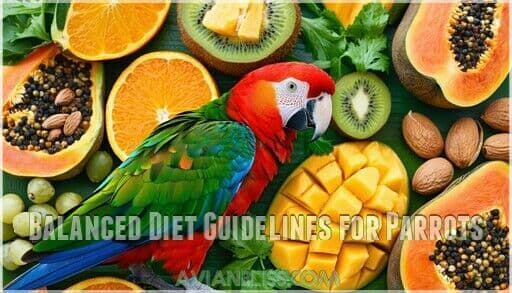
This is the most widespread and most damaging misconception in parrot keeping. The RSPCA is unambiguous: about three-quarters of a parrot's food should be pellets containing all the vitamins and nutrients they need, with the remaining quarter made up of washed fruits and vegetables. The RSPCA's own guidance describes the ideal diet as "a combination of nutritionally complete pellets, specially made for parrots, along with a variety of fresh fruits and vegetables."
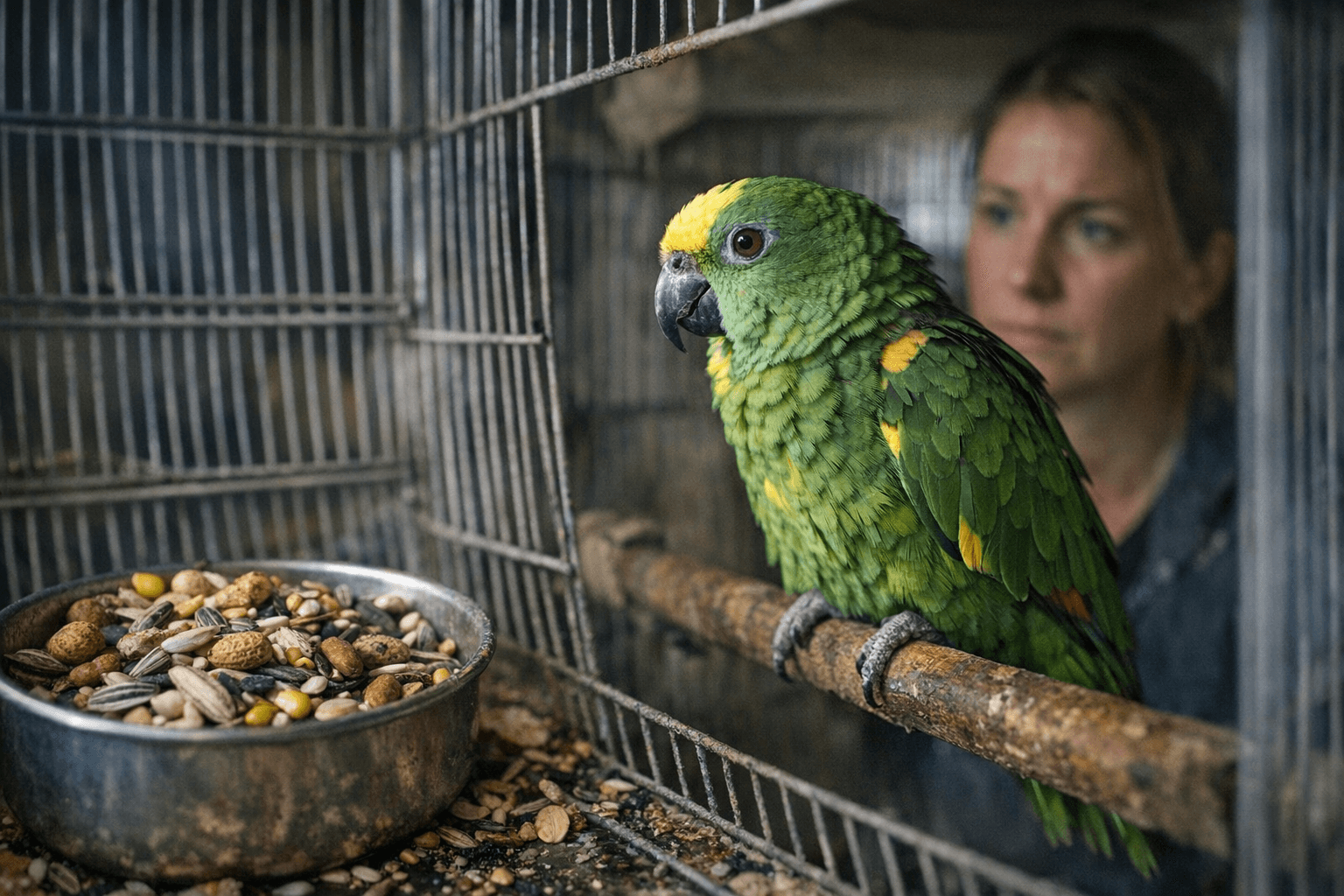
The problem with seed mixes is not that seeds are inherently poisonous, but that birds self-select destructively when given a bowl of mixed seeds. Parrots will instinctively pick out the fattier seeds and nuts from a mix, because in the wild they fly long distances every day to find food, so they have evolved to prioritise calorie-dense options. In a cage, that survival instinct produces a highly unbalanced intake. Seeds lack calcium, vitamins, and other key nutrients, and birds eating only seeds often develop vitamin A deficiency, obesity, and other nutritional disorders.
Species variation adds another layer of complexity. Lories and lorikeets require nectar and a substantially higher fruit content than most parrots. A generic seed mix fails them even more comprehensively than it fails an African Grey or an Amazon. Both the RSPCA and RVC emphasise that every care decision, including diet, must be tailored to species.
For birds like Mango who have been on seeds for years, the transition to a pellet-forward diet needs to be gradual and monitored. The RSPCA and RVC both recommend veterinary consultation before large diet changes and suggest using regular weighing, body-condition scoring, and where necessary lab testing to track progress.
Myth 2: Any cage that fits the bird is fine
Cage size is consistently underestimated at the point of purchase. The RSPCA's guidelines for caged animals require that the animal must be able to stretch, meaning the wingspan of the bird must be considered, and it must not touch the sides of the cage. For large species such as macaws, that standard eliminates the majority of enclosures sold in high-street pet shops.
Birds need to be able to fly freely every day. The best home you can give them is a large aviary with plenty of space for flying, but if that is not possible, they still need a large indoor space where they can fly safely. Beyond raw dimensions, the guidance recommends safe perches of mixed diameters to support foot health and prevent pressure sores, alongside regular supervised out-of-cage time every day.
Myth 3: Enrichment is optional, or a toy here and there is enough
"My parrot has a mirror and a bell and seems fine" is a sentence avian vets hear constantly. The RSPCA and RVC are clear that enrichment is not a luxury and that rotation is as important as provision. Enrichment should include foraging puzzles, safe chewable items, and meaningful opportunities for species-typical behaviours: climbing, shredding, and manipulating objects. A toy that was engaging in week one becomes invisible by week three. Keeping a rotating bank of different enrichment items and cycling them on a weekly schedule maintains the cognitive stimulation that an intelligent, long-lived bird requires to stay psychologically healthy.
In the wild, birds naturally forage for their food, and giving them a similar experience in captivity is important for their wellbeing. Hiding food inside foraging toys or wrapping treats in safe paper replicates this and significantly reduces boredom-driven behaviours such as feather-plucking and repetitive pacing.
Myth 4: You only need a vet when the bird looks sick
Parrots are prey animals and are neurologically programmed to mask illness until the effort of masking it becomes unsustainable. By the time a parrot visibly looks sick, it has typically been unwell for a meaningful period. Annual checkups are recommended so the veterinarian can get to know your bird and establish what is normal for them, and you should also be aware of a local emergency facility that can treat your bird outside of regular hours.
Red flags requiring immediate attention include feather and beak abnormalities, unexplained weight loss, any discharge from the eyes or nares, vomiting, and respiratory signs including wheezing or tail-bobbing. Routine parasite screening is recommended as appropriate for the species and environment.
For birds arriving in rescue or sanctuary settings from unknown backgrounds, the standard is considerably more rigorous. The RSPCA and RVC both specify strict quarantine protocols, baseline blood work, crop and parasite checks, and fecal testing, all managed under veterinary guidance, before any new bird joins an existing population.
Myth 5: Household air is safe for birds
This one surprises owners who have kept birds for years without incident. More obvious signs like a change in the colour or consistency of droppings, discharge from nostrils or eyes, vomiting, or wheezing should be immediate calls for alarm, but airborne threats often cause damage long before any visible symptom appears. The RVC fact sheet specifically cautions against aerosolised toxins from certain non-stick cookware, scented candles, and aerosol sprays. Overheated PTFE-coated pans release fumes that can kill a bird within minutes, and many owners do not connect the two events because the exposure is invisible.
Avocado, chocolate, and caffeine are the dietary equivalents, all well-documented bird toxins that should be absent from any food a parrot can access. These are not "a small amount is probably fine" situations.
Myth 6: Sleep manages itself
Avian veterinarians and bird behaviourists generally recommend that most pet birds do best with between 10 and 12 hours of darkness a night, with some species doing better with slightly more. Species from more temperate regions, such as Australian parakeets and Ringnecks, may need 10 hours of light and 14 hours of darkness in the winter months. What this means in practice is that a parrot left in a lit, noisy living room until midnight is not getting adequate rest, regardless of how relaxed it appears during the day. A consistent, quiet, dark sleep space makes a measurable difference to mood, hormone regulation, and long-term health.
Myth 7: Parrots are manageable, low-commitment pets
"Parrots are not low-maintenance pets dressed up in colorful feathers. They are intelligent, social, and physiologically demanding animals." Both the RSPCA and RVC are explicit that prospective owners should research species lifespan, noise levels, and social requirements before adoption. Some macaws live 60 or more years, meaning a bird purchased for a teenager may outlive multiple generations of its family. The commitment is not just financial but temporal, social, and emotional.
Your printable daily and weekly parrot care checklist
Cut this out, print it, stick it on the fridge. If Mango's owner had been working from a list like this, years of nutritional catch-up could have been avoided.
- Every day:*
- Change water, morning and evening
- Offer pellets as the primary food (roughly 75% of total intake)
- Offer a portion of fresh fruit or vegetables (roughly 25%); remove uneaten fresh food after two hours
- Provide supervised out-of-cage time
- Check droppings for any change in colour, consistency, or volume
- Ensure 10 to 12 hours of darkness and quiet for sleep
- Every week:*
- Rotate enrichment toys and foraging puzzles
- Weigh your parrot and log the reading
- Clean perches, cage floor, and accessories
- Check beak, nails, feathers, and eyes for abnormalities
- Every year (minimum):*
- Book an avian-experienced vet check-up, even if the bird appears healthy
- Request appropriate parasite screening
- Reassess cage dimensions against your bird's full wingspan
- If planning any diet transition, consult your vet before starting
The gap between what parrots need and what most of them get is not usually malice. It is outdated information, repeated so many times online that it looks like consensus. The RSPCA and RVC guidance exists precisely to replace that recycled advice with something birds can actually thrive on.
This article was produced by Prism’s automated news system from verified source data, official records, and press releases, then run through automated quality and moderation checks before publishing. The system is built and supervised by the people who set the standards it runs under. Read our full AI policy.
Did this article answer your question?