Spotting Training Plateaus in Parrots and Reigniting Their Learning Progress
Your parrot isn't being stubborn; it's plateaued. Here's how to recognize the signs and get the learning moving again.
Every parrot owner hits that wall eventually. Your bird has been nailing its target training, stepping up on cue, maybe even stringing together a few words. Then one day, nothing. The sessions feel flat. Your parrot looks away, chews on its foot, or just goes through the motions without any real engagement. That's a training plateau, and it's more common than most people realize. The good news: it's also fixable.
What a training plateau actually looks like
A plateau isn't your bird refusing to train. It's subtler than that. You'll notice your parrot performing familiar behaviors mechanically, without the alertness and enthusiasm it showed when it was first learning. Response times slow down. Your bird might start offering older, easier behaviors to get the treat rather than attempting the new skill you're working on. Some birds get visibly restless during sessions; others just seem checked out. If you've been running the same session structure with the same treats, in the same corner of the room, for weeks on end, you've probably set the conditions for a plateau yourself, without realizing it.
The distinction worth making here is between a plateau and a behavioral problem. A bird that's biting, screaming, or refusing to come out isn't necessarily plateaued; it may be stressed, hormonal, or unwell. A plateaued bird is generally fine in every other regard. It's just stopped progressing in training. That distinction matters because the solutions are completely different.
Why parrots plateau
The short answer is that the challenge has disappeared. Parrots are cognitively demanding animals. Species like African Greys, Amazons, and the various cockatoo species are wired to solve problems, and when training stops presenting problems worth solving, they disengage. The reward loses its value too, particularly if you've been using the same treat every single session. A piece of almond that once produced intense focus becomes background noise after the hundredth repetition.
There's also a physical dimension. Parrots have relatively short optimal training windows, typically five to ten minutes before attention degrades. If you've been pushing sessions longer hoping to force a breakthrough, you're more likely compounding the plateau than resolving it. Fatigue looks a lot like stubbornness from the outside.
Session timing matters more than most owners account for. A bird trained right before its nap window, or immediately after a stressful interaction, is working against its own biology. Over time, that accumulated friction builds into what looks like a plateau but is really just a bird that's learned to dread the training mat.
Diagnosing your specific situation
Before you change anything, spend two or three sessions just observing. Don't push for the new behavior. Run easy, familiar cues and watch how your bird responds. Is it engaged but not progressing? Is it disengaged entirely? Does it perk up for certain treats but not others?
Keep a basic log. You don't need a spreadsheet; even a note on your phone tracking what behavior you worked on, how many successful repetitions you got, and what treat you used will start revealing patterns within a week. Most owners who do this discover the plateau began right when they unconsciously raised criteria too fast or stopped varying the reward.
Practical strategies to break through
The most effective first move is almost always backing up. Return to a skill your bird mastered weeks ago and run a few clean, successful repetitions with high-value reinforcement. This isn't regression; it's rebuilding momentum and re-establishing that training sessions produce good outcomes. A parrot that's been struggling and failing needs to remember what winning feels like.
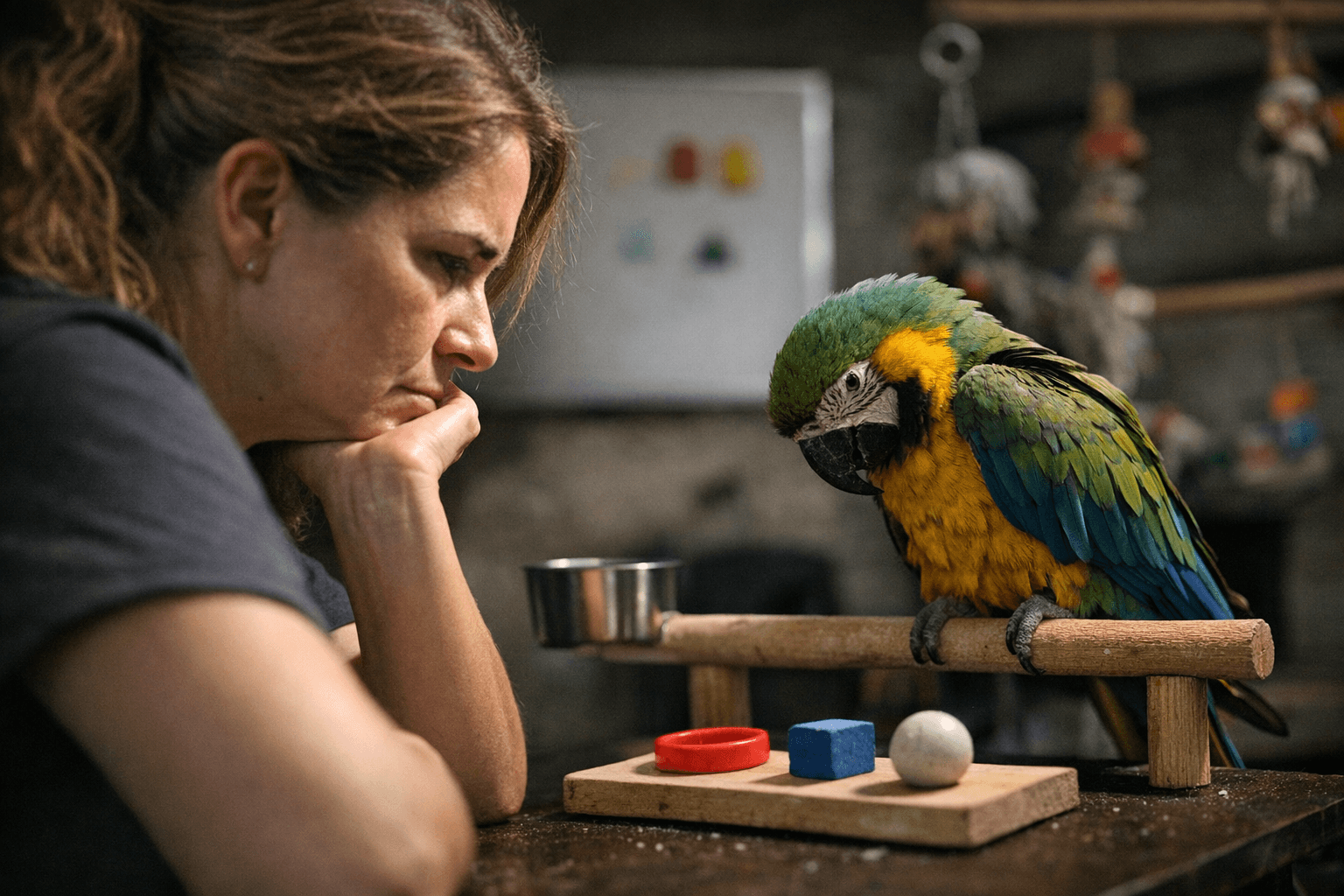
From there, try these specific adjustments:
- Rotate your treat selection. If you've been using sunflower seeds exclusively, switch to a small piece of nutrient-rich food your bird doesn't get outside of training, like a fragment of walnut, a tiny cube of cooked sweet potato, or a bite of whatever your particular bird goes crazy for. The novelty reactivates the reinforcement value.
- Shorten your sessions aggressively. Drop from ten minutes to three. End on a success, always. A three-minute session that finishes with your bird alert and wanting more is worth ten sessions that end in mutual frustration.
- Change the environment. Move the training perch to a different room. Train in the morning instead of the afternoon. Small contextual changes force your bird to re-engage its attention rather than running on autopilot.
- Introduce a targeting variation. If you've been using a standard stick target, try a different object. Many birds respond to novel stimuli by snapping back into active problem-solving mode almost immediately.
- Use "errorless learning" to introduce the next criterion. Instead of waiting for your bird to attempt the new behavior and failing, shape the environment so success is nearly inevitable, then gradually increase difficulty from there. This is especially useful for complex behaviors like retrieving objects or color discrimination tasks.
The role of enrichment outside training
One thing that often gets overlooked: a bird that's mentally stimulated throughout the day learns faster during training sessions. Foraging toys, novel objects, and social interaction outside of formal training build the cognitive flexibility that makes structured learning stick. If your parrot spends most of its day in a static cage with the same toys it's had for six months, don't be surprised when it seems dull and unmotivated by noon. Rotate enrichment weekly. Hide food in different locations. Give your bird problems to solve on its own terms, not just yours.
When to get outside help
If you've cycled through treat rotation, session length adjustments, environmental changes, and a two-week reset period and you're still seeing zero progress, it may be worth connecting with an experienced parrot trainer or a certified applied animal behaviorist. Some plateaus are rooted in subtle health issues, mild nutritional deficiencies, or stress sources in the home environment that aren't obvious to the owner. A fresh set of eyes can identify what you've stopped being able to see.
Training a parrot is genuinely one of the more rewarding things you can do with a companion bird. The intelligence these animals bring to a well-structured session, when they're engaged, is something that never gets old. Getting through a plateau isn't about pushing harder. It's about stepping back, reading your bird accurately, and rebuilding the conditions that made learning fun in the first place.
This article was produced by Prism’s automated news system from verified source data, official records, and press releases, then run through automated quality and moderation checks before publishing. The system is built and supervised by the people who set the standards it runs under. Read our full AI policy.
Did this article answer your question?