Romano's Macaroni Grill Shrinks to 9 Locations After Wave of Closures
Romano's Macaroni Grill is down to nine restaurants after a dozen closures this year. The brand now spans seven states, with two airport sites and a new Utah opening.
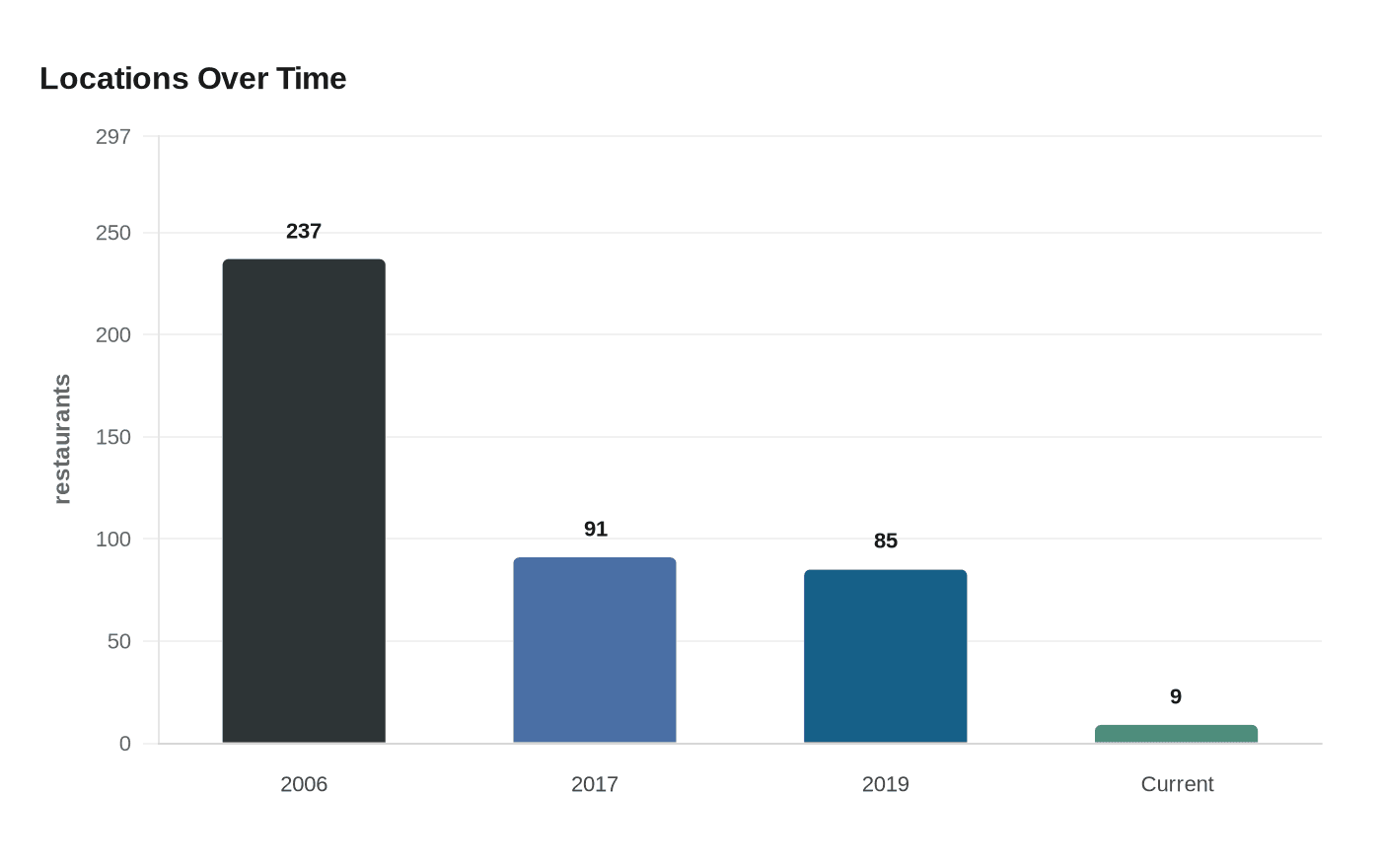
Romano's Macaroni Grill has been whittled down to just nine restaurants nationwide, a sharp drop that puts fresh pressure on one of the best-known names from the Italian-American casual dining boom. The chain closed a dozen locations in 2025 alone, and its footprint now stretches across seven states, California, Colorado, Florida, Illinois, Ohio, Texas and Utah, with two of those remaining restaurants inside airports.
The company said the latest round of shutdowns came as lease expirations hit, but the deeper story is how far the brand has slid from its peak. Romano's Macaroni Grill had 85 locations in 2019, and the chain once reached 237 restaurants in 2006. That scale is gone. The Utah location cited in the report opened earlier this month, a rare bit of expansion in a year defined by contractions.
Founded in San Antonio in 1988 by restaurateur Phil Romano, the chain was acquired by Brinker International in 1989 and then passed through a long list of owners, including Golden Gate Capital, Ignite Restaurant Group, Red Rock Partners and RMG Acquisition Co. The repeated handoffs point to a brand that never found a stable long-term playbook after its early growth. In 2017, Romano's Macaroni Grill filed for Chapter 11 bankruptcy protection and finished that year with 91 stores after closing nearly a third of its locations.
That history helps explain why the current slide feels less like a one-off closure wave and more like the last stage of a longer retreat. Midpriced pasta concepts once had room to spread across malls, airports and suburban retail strips. Now the operators that survive are usually the ones with tighter real-estate strategies, a clearer identity, and a menu position that still feels worth the check. Romano's Macaroni Grill, despite its name recognition and decades in the market, has been unable to keep enough locations open to hold that middle ground.
Jason Kemp, who became president and CEO in July 2023, is now leading a brand that is far smaller than the one that made its name in the 1990s and 2000s. The chain's remaining nine restaurants show how thin the room has become for legacy Italian-American casual dining, where scale, lease discipline and a sharper value proposition matter more than nostalgia ever did.
Know something we missed? Have a correction or additional information?
Submit a Tip