AI is reshaping professional photography, forcing brands and photographers to adapt
AI is already altering fashion shoots, from campaign comps to client expectations, but the human shooter still matters where garment truth, set control, and trust are on the line.
AI enters the fashion workflow at the point where the photo already exists
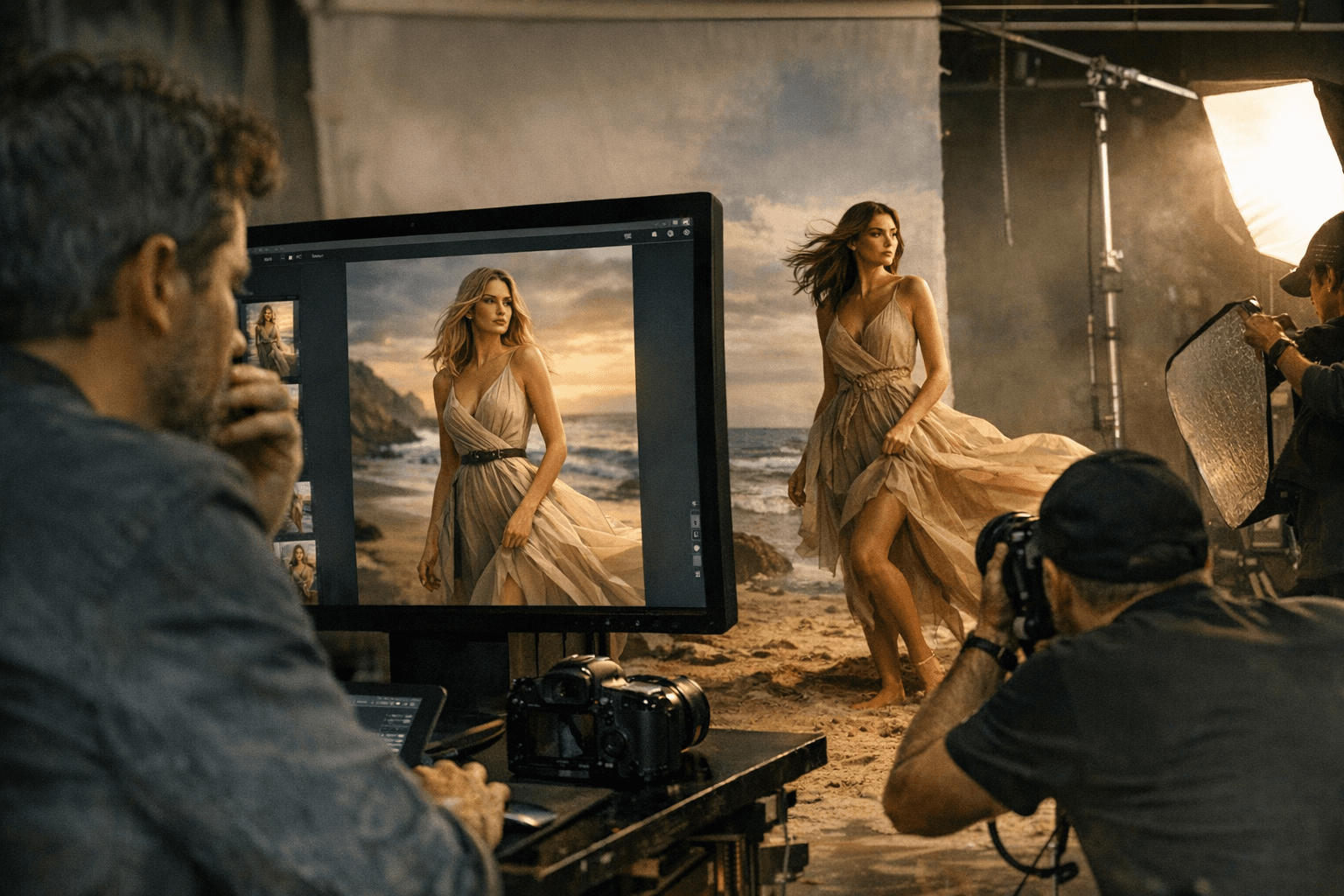
The sharpest change in professional photography is not a robot replacing the camera. It is a camera shoot feeding a machine afterward. Mango’s 2024 teen campaign shows the new pattern clearly: the brand said a photographer shot real garment photos first, then those images were fed into a generative AI model to build the campaign assets. That matters because it moves AI from novelty to production tool, and it tells every fashion and commercial photographer where the pressure is landing first: on the parts of the job that can be multiplied, modified, or repackaged after the shutter clicks.
That is why the disruption feels so immediate. AI is not just speeding up editing. It is reshaping how brands think about the entire image pipeline, from concept and preproduction to final delivery. Vogue’s framing is blunt: AI is everywhere, and fashion photographers are being forced to adapt.
The first paid tasks under pressure are the ones that can be generated or iterated
The jobs most exposed right now are the repeatable image tasks built around variations, not singular moments. If a brand wants multiple backgrounds, faster concept mockups, alternate crops, or quick changes to a campaign mood, AI can now cover part of that work before a photographer ever gets a call. Adobe markets Firefly as commercially safe and trained on licensed content, while Getty Images offers a generative AI product trained exclusively on licensed visuals. Those offerings tell clients that image generation is becoming a legitimate workflow, not a side experiment.
That changes client expectations fast. Once a marketing team can ask for a dozen versions of a concept in less time, the photographer is no longer just being hired for the hero shot. The job starts to include the ability to supervise a visual system, not just create a single frame. In practice, that pushes pricing away from a simple day rate and toward bundled value: concept development, on-set capture, post-production judgment, and rights-aware delivery that AI can support but not fully replace.
What still needs a human shooter is the part AI cannot physically witness
For all the machine-generated output, brands still need someone on set when the image depends on actual garments, real fabric behavior, controlled light, and live direction. Mango’s campaign is the perfect example: the AI came after the real garment photography, not before it. That tells you where the defensible value still lives. A human photographer still owns the look of the cloth, the fit on the body, the timing of the pose, the relationship between product and model, and the decisions that make a campaign feel credible rather than synthetic.
That human layer matters even more when the result has to survive scrutiny. Commercial clients may be comfortable with AI-assisted finishing, but they still need the kind of judgment that protects brand trust. The photographer who can deliver a clean capture, direct talent, and keep the product truthful is still doing work AI cannot independently perform.
Retouching, preproduction, and pricing are being rewritten together
The easiest mistake is to think AI only affects post-production. It reaches backward into preproduction and forward into billing. WPP’s 2024 annual report says its AI-powered marketing operating system combines agency services with generative AI and 3D imagery, which is another sign that brands are reorganizing around faster concepting and more fluid asset creation. When agencies can test ideas in a mixed environment of agency work, AI generation, and 3D imagery, photographers are asked to justify not just the final image, but the planning, taste, and control that got it there.
That is changing how photographers package their services. Retouching is no longer just polish. It is part of a larger promise: consistency across AI-modified assets, accurate handling of skin and fabric, and the ability to make work feel intentional rather than assembled. Preproduction becomes more valuable too, because the client wants fewer surprises once the machine enters the pipeline. The photographers who can speak that language are not competing only on aesthetics anymore. They are competing on workflow reliability.
The backlash is not about technology alone, it is about labor and authorship
The 2025 Vogue/Guess AI-model ad controversy sharpened the argument because it pushed the question out of the editing room and into public view. The backlash was not simply about whether the image looked realistic. It was about creative labor, authenticity, and what happens to the people whose work once anchored a campaign. Once AI-generated models enter the mix, the issue becomes bigger than efficiency. It becomes a debate over who gets credit, who gets paid, and what counts as photographic authorship.
That is why this conversation keeps circling back to names and brands the industry recognizes. Mango, Guess, Vogue, Adobe, Getty Images, and WPP are all signaling different versions of the same future: one where AI is embedded in the commercial image economy, not hovering outside it.
Professional photographers are not rejecting AI, they are negotiating its terms
The most useful response from the profession has not been panic. It has been adaptation. The Professional Photographers of America, which says it has 35,000 creative members in more than 50 countries, has been publishing AI-focused guidance rather than treating the technology as a taboo. On March 13, 2025, the group held a conversation with CEO David Trust about AI and preserving authenticity in photography. On September 12, 2025, it published guidance on using AI for business strategy, content planning, marketing ideas, and understanding numbers.
That shift is important because it reflects how working photographers actually survive change. AI can help with planning, messaging, and business analysis, but it also forces a harder question: what parts of your service are uniquely yours? The answer is rarely “just the file.” It is the eye, the direction, the set judgment, the trust, and the ability to make a brand look deliberate instead of generic.
Documentary photography is drawing the line more sharply
Commercial photography may be adapting to AI faster, but documentary standards are keeping the ethical stakes visible. World Press Photo continues to require entrants to follow a code of ethics and evaluates submissions for accurate and visually compelling insights. That distinction matters because it shows where the industry still insists on human accountability. In documentary work, AI is not just a workflow tool. It can threaten the basic contract between image and reality.
That tension is the real story behind the technology. The photographers who will hold value in this next phase are not the ones who merely use AI the most. They are the ones who know where it belongs, where it fails, and where a real camera, a real set, and a real eye still matter more than any generated substitute.
This article was produced by Prism’s automated news system from verified source data, official records, and press releases, then run through automated quality and moderation checks before publishing. The system is built and supervised by the people who set the standards it runs under. Read our full AI policy.
Did this article answer your question?