Astrophotographer Endures Minus 28 Degrees for Rare Triple Sky Alignment
Angel Fux spent a night at minus 28 C on Dent d’Hérens to capture a rare triple arch, where Milky Way arms and Gegenschein briefly lined up above the Alps.
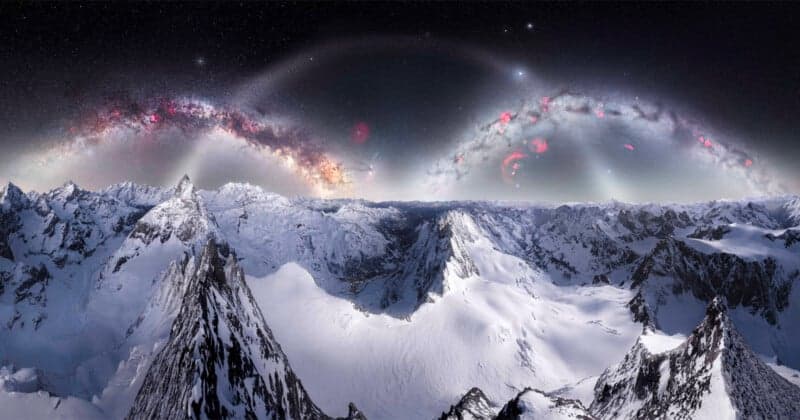
Angel Fux spent a freezing night on Dent d’Hérens, a summit just under 4,200 meters on the Italy-Switzerland border west of the Matterhorn, for one frame that almost never comes together. Dropped off by helicopter and collected the next morning the same way, she waited in temperatures that fell to about minus 28 degrees Celsius, or minus 18 degrees Fahrenheit, for a rare celestial alignment that produced three distinct sky arches over the snowy Alps.
The image, titled Three Sky Arches over Snowy Alps, was featured by NASA’s Astronomy Picture of the Day on April 21, 2026. The scene is a double reward for astrophotographers: the two sweeping arms of the Milky Way and a third arch created by zodiacal light, or Gegenschein, the faint counterglow made by sunlight scattered by interplanetary dust. That third band is what pushes the photograph from beautiful to extraordinary, because it requires a combination of dark skies, the right season, and a clean horizon that rarely cooperate at the same time.
Fux had already spotted the phenomenon years earlier and tried to photograph it from a lower altitude the previous year, but she wanted a darker, cleaner sky. That meant going higher and accepting much harsher conditions. Her setup reflected that tradeoff: an astro-modified Nikon Z6 II, a Nikkor Z 20mm f/1.8, a Benro Polaris star tracker, a sleeping bag rated to minus 30 degrees Celsius, three-layer boots with crampons, heavy winter clothing, and a rope-and-harness system so she could remain secured outside the tent. A Nikon profile from December 2024 had already noted that photographing this kind of scene was dangerous without a guide, and Fux has also documented high-altitude work with Nikon in projects such as The Shot Above in the Peruvian Andes.
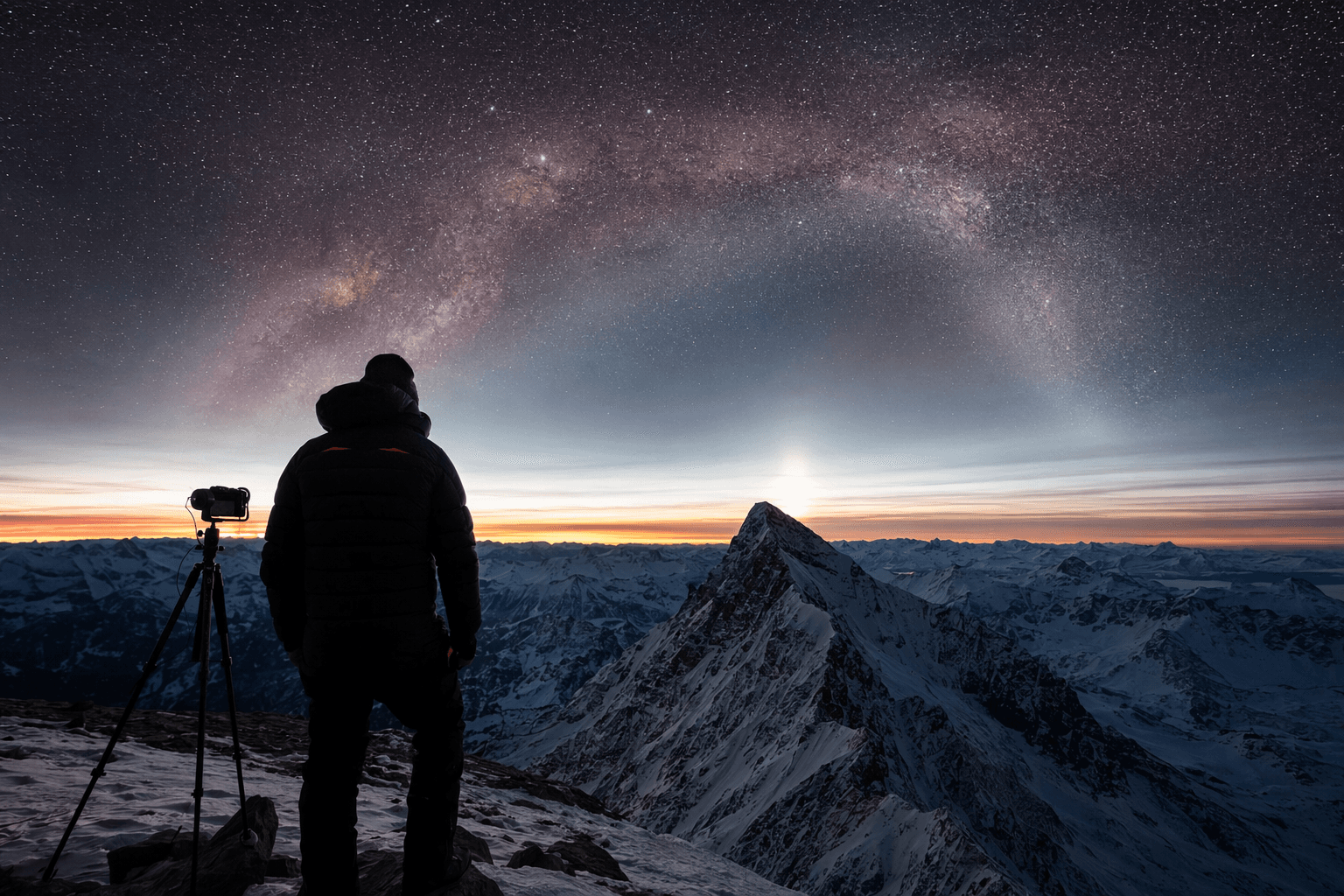
The payoff has been building for some time. Capture the Atlas named Fux among its Milky Way Photographers of the Year 2025 for a separate double-arch image, and her own blog says the Dent d’Hérens project grew out of earlier observations of the same phenomenon. The current frame already shows how much advanced astrophotography depends on planning, timing, and physical endurance, not luck. The sky window is brief around the equinox, the location is punishing, and the margin for error is tiny. When it all locks into place, the result is the kind of image that resets the bar for what nightscape photographers will try next.
This article was produced by Prism’s automated news system from verified source data, official records, and press releases, then run through automated quality and moderation checks before publishing. The system is built and supervised by the people who set the standards it runs under. Read our full AI policy.
Know something we missed? Have a correction or additional information?
Submit a Tip