DJI Drone Captures Breathtaking Close-Up Footage of China's Kinetica-2 Rocket Launch
A DJI panoramic drone captured close-up footage of China's Kinetica-2 igniting 753 tonnes of thrust at Gobi Desert dusk, and the viral clip is a masterclass in high-stakes aerial imaging.
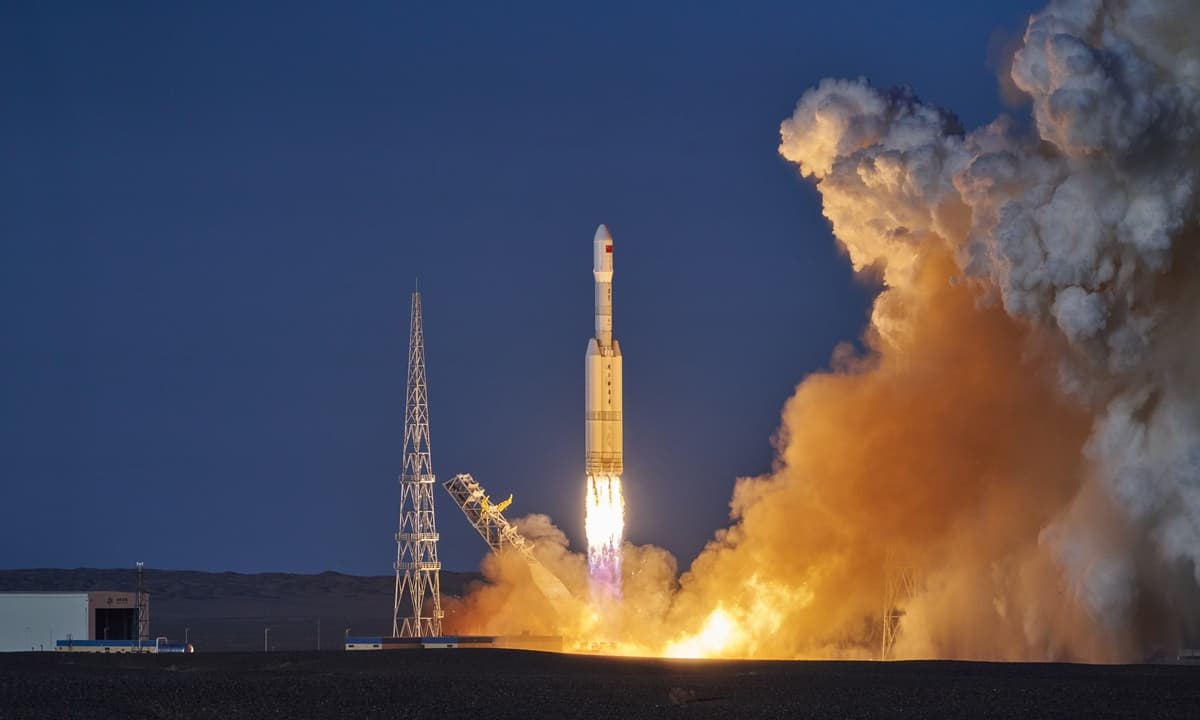
The footage CGTN journalist Wu Lei posted from the Kinetica-2 Y1 maiden launch says everything about what DJI hardware can do in the right hands: a panoramic drone hovering close enough to a 53-meter, 625-metric-ton rocket to capture nine YF-102 engines igniting in sequence, 753 tonnes of thrust punching the three-booster vehicle skyward from the Gobi Desert at dusk. The clip went viral immediately, drawing reactions from aerospace and photography communities worldwide.
Getting this close requires institutional authorization, not just a charged battery. Launch Area 140 sits within the Dongfeng Commercial Space Innovation Pilot Zone at Jiuquan Satellite Launch Center, an active military-adjacent facility where airspace falls under strict joint civilian-military control. Any drone operating near a launch of this scale requires explicit clearance from site operators and air traffic control. DJI's FlySafe geofencing system automatically flags restricted launch corridors; near a live event of this magnitude, those zones extend well beyond what standard unlock procedures cover. The footage and its proximity suggest fully coordinated access, not a freelance gamble.
Flight planning for a rocket launch centers on one variable above all others: position relative to the exhaust plume. Kinetica-2's Common Booster Core configuration means three separate booster cores igniting simultaneously, producing a wider, denser smoke base than a single-core vehicle. The Gobi Desert's flat terrain and minimal obstruction make for predictable plume drift, but desert thermal activity at dusk can shift smoke horizontally without warning. A lateral position off the vehicle's axis, rather than directly downrange, gives the best visual depth and plume separation while keeping the drone clear of the blast overpressure corridor.
The 19:00 Beijing Time liftoff placed the camera in near-golden-hour conditions, roughly 40 minutes before sunset at that latitude in late March. That is both a gift and a trap. The warm ambient sky delivers dramatic color separation against the exhaust column, but the contrast between the ignition fireball and the darkening desert floor will blow highlights catastrophically on auto-exposure. Set exposure manually and meter to the mid-plume, not the flame core. Shutter speeds in the 1/1000 to 1/2000 range freeze the ignition moment and preserve the flame diamonds visible in the exhaust without clipping the entire column.
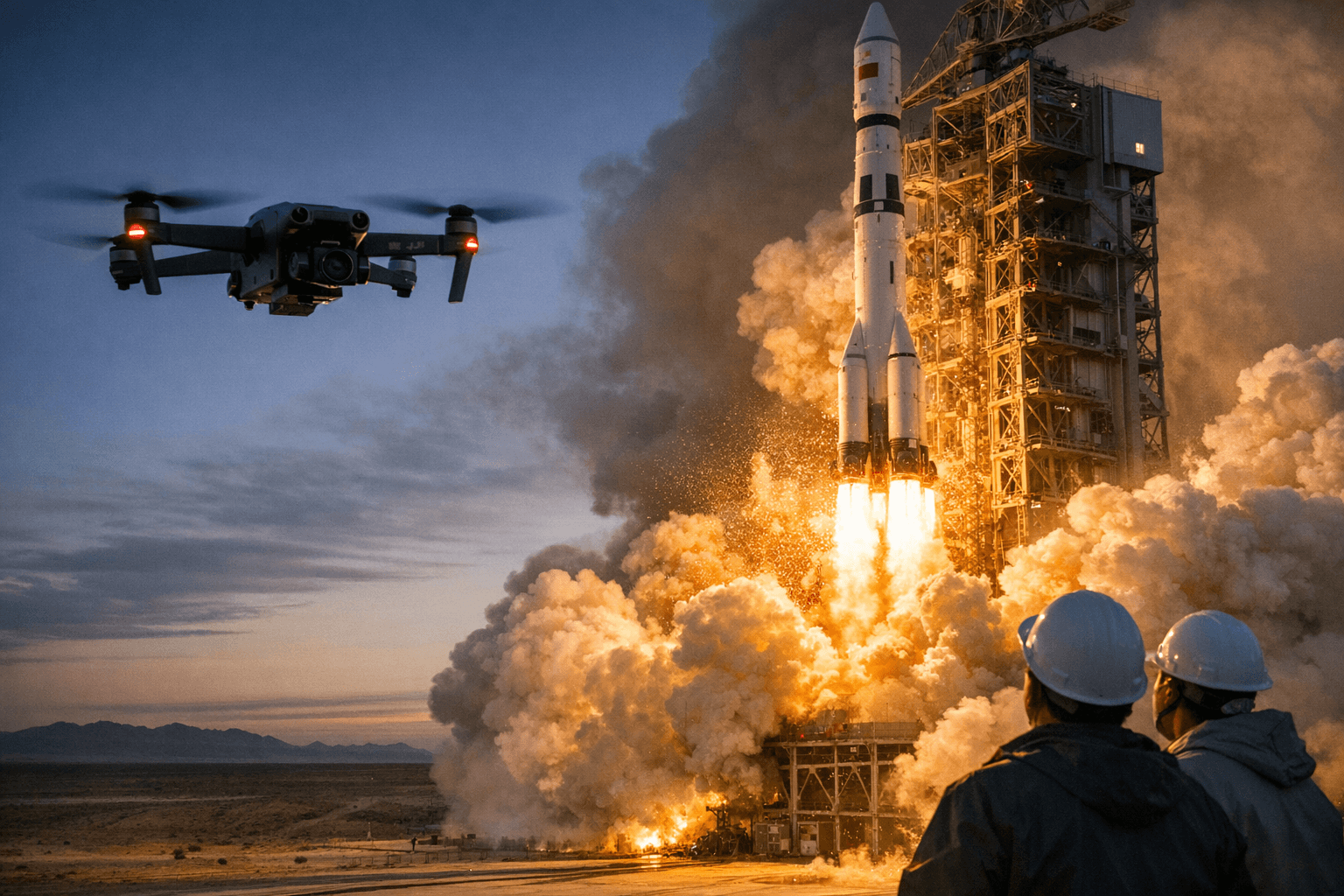
Stabilization is the variable that separates usable footage from scrap at this scale. The shockwave from a 625-metric-ton vehicle clearing its pad generates a pressure wave that reaches a hovering drone before the sound does. DJI's mechanical three-axis gimbal absorbs high-frequency vibration effectively, but the lower-frequency pressure pulse from an event like this can induce a visible jostle in footage. Pre-positioning at altitude, rather than hovering close to ground level where reflected overpressure compounds, limits that effect considerably.
The Kinetica-2 itself is a genuine milestone beyond the footage: China's first rocket to adopt a Common Booster Core design, built by CAS Space under the Chinese Academy of Sciences, it delivered three satellites to orbit on its maiden flight including the 4.2-tonne Qingzhou prototype, a future resupply vehicle for China's Tiangong Space Station. CAS Space VP Yang Haoliang noted that even in its current non-reusable configuration, Kinetica-2's launch cost is already comparable to SpaceX's Falcon 9 in reusable mode, with a 100-km reusability recovery test planned later in 2026.
For any similar shoot, the checklist starts with written airspace authorization secured well before launch day. Fix white balance and exposure manually before ignition; metering will chase the fireball and lose the plume. Position laterally off-axis, gain altitude to reduce ground-reflected overpressure, and pre-roll video at least 60 seconds before T-0. Set your return-to-home altitude high enough to clear the acoustic pressure wave. When 753 tonnes of thrust lights up, there is no time to consult the settings menu.
Know something we missed? Have a correction or additional information?
Submit a Tip

