DJI Sues Insta360 Over Six Patents in China Amid Drone Launch
DJI filed a patent ownership lawsuit against Insta360's parent Arashi Vision in Shenzhen three days before the Avata 360 launch, targeting six patents tied to ex-DJI staff.
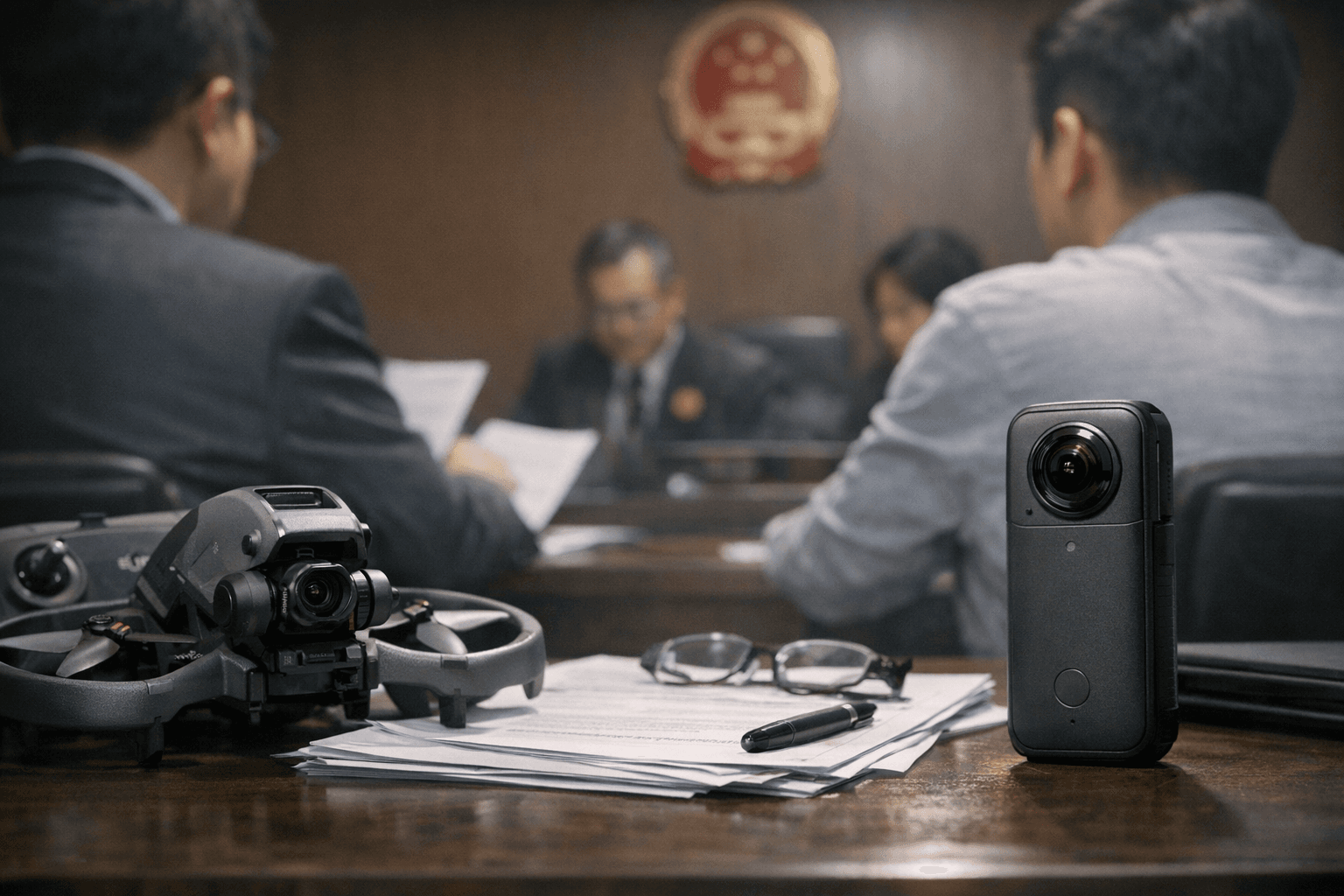
DJI filed a patent ownership lawsuit against Insta360's parent company, Arashi Vision, in the Shenzhen Intermediate People's Court on March 23, 2026, targeting six patents it claims belong to DJI under Chinese intellectual property law. The timing was anything but coincidental: the Avata 360 was slated for a March 26 release, shaping up to be DJI's first true 360-degree FPV drone, putting the lawsuit squarely in the window of maximum competitive pressure on its fastest-rising rival.
This marks the first time DJI has initiated a patent ownership dispute in China. The patents in question are mainly related to key technological areas such as drone flight control, structural design, and image processing. In its complaint, DJI stated that the patents were developed by former employees within one year after leaving the company, and that these inventions are closely related to the work tasks they were engaged in during their time at DJI.
The legal hook is a specific provision of Chinese IP law. Under Chinese law, inventions made by an employee within twelve months of leaving a company and closely related to their previous work belong to their former employer. DJI is now demanding an official transfer of these patent rights. A particularly striking detail buried in the complaint: some inventors were listed as "requesting anonymity" in Arashi Vision's domestic Chinese patent filings, but their real names were disclosed in the corresponding international PCT filings where full disclosure is required.
The market reacted immediately. The ongoing hardware war has already left its mark on the stock market, with the share price of Insta360's parent company Arashi Vision plummeting by almost seven percent after DJI's complaint became public. DroneDJ put the closing price at CNY181.15 ($26.23), against a broader Shanghai market that itself fell 3.6% that day.
Insta360 founder and CEO JK Liu fired back on Weibo without hesitation. Liu stated: "Basically, this is about a few former DJI employees who joined Insta360 and applied for patents during their time with us. DJI claims ownership of these patents." He clarified: "DJI claims that any patents generated by employees within one year of leaving DJI should belong to DJI. We carefully reviewed the patents applied for by these employees during that period. The evidence shows that all ideas and innovations were independently created at Insta360."
Liu also went on offense. He revealed that Insta360's team found DJI's products could fall within the scope of 28 Insta360 patents, spanning 11 hardware/structure patents, 8 software-method patents, 6 control-method patents, and 3 accessory patents, but Insta360 chose not to sue. "We understand why GoPro and DJI sued us," Liu wrote, "established players hate losing market share."
On the flight control patent at the center of DJI's complaint, Liu was direct. He described the key disputed patent as one that lets users achieve an FPV-style "building dive" with one button press, saying: "This was my idea, and I was deeply involved in refining and approving it. Under current flight restrictions, this patent isn't very useful, so the feature wasn't implemented. If DJI wanted this patent, they could've just asked for it."
The backdrop here matters. In December, Insta360, through its Antigravity drone brand, launched the Antigravity A1, marketed as the world's first 8K 360 drone, with its pitch built around bringing the "shoot everything, reframe later" philosophy of 360 cameras into the air. The response was immediate, with reported sales exceeding CNY30 million ($4.3 million) within 48 hours in China. DJI's lawsuit landed squarely as the Avata 360 was days away from going head-to-head with that product.
Liu noted Insta360 spent over $10 million to win a prior GoPro case and said the company is approaching this situation with the same mindset. In the meantime, the company says it is focused on launching seven or eight new products and series this year, including gimbal cameras, lavalier microphones, and another drone. Whether the Shenzhen court ultimately sides with DJI's service-invention theory or Insta360's independent-development defense, the six patents now sitting before that court represent the legal front line of one of imaging's most consequential product rivalries.
Know something we missed? Have a correction or additional information?
Submit a Tip

