ESA’s JUICE camera captures rare interstellar comet 3I/ATLAS in color
JUICE caught interstellar comet 3I/ATLAS in color from more than 180 million kilometers away, then waited three months for the data to reach Earth.
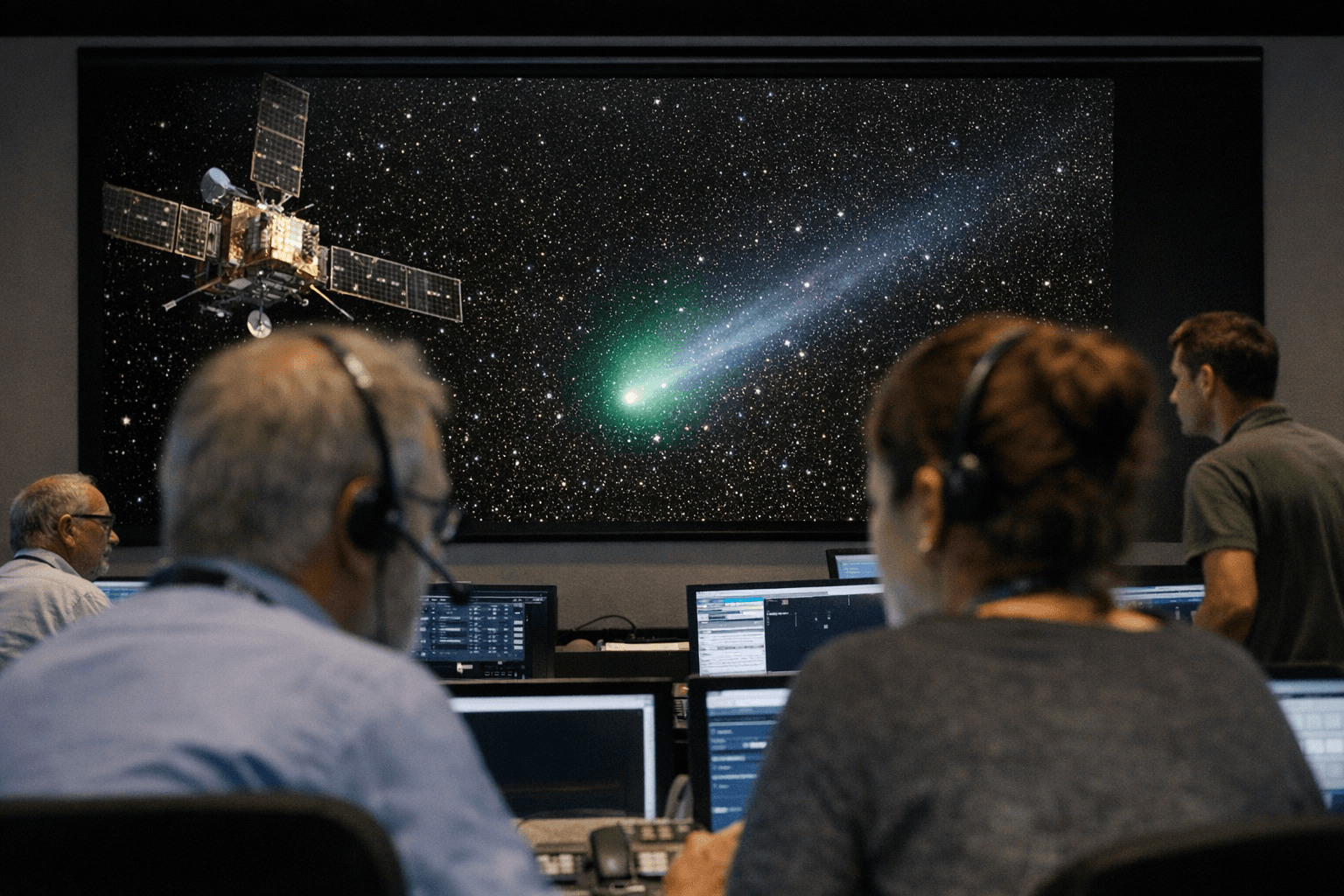
From more than 180 million kilometers away, ESA’s JUICE spacecraft turned interstellar comet 3I/ATLAS into a color frame that feels almost impossible to make. The JANUS high-resolution science camera captured a red-green-blue composite showing the comet’s green glow, a result of gases in the coma emitting at green wavelengths, while the surrounding stars held their own colors in the background.
That image carries extra weight because 3I/ATLAS is not just any icy visitor. ATLAS first reported it from Río Hurtado, Chile, on July 1, 2025, and the Minor Planet Center designated it 3I/ATLAS = C/2025 N1 (ATLAS) the next day. It is only the third confirmed interstellar object after 1I/ʻOumuamua and 2I/Borisov, which is why every new look at it feels like a small event in itself.
For photographers, the interesting part is not only the subject, but the method. This was not a casual snapshot from a passing camera. DLR said the JANUS campaign used 120 images recorded over several weeks, and JUICE gathered images and measurements from about 63 million kilometres during the encounter. ESA said scientists waited about three months for the data to travel back to Earth before they could start pulling together the photos, spectra, and measurements. In camera terms, that is reach, tracking, timing, and patience all pushed to an extreme.
The mission itself was not originally supposed to be chasing science targets during its cruise to Jupiter. ESA said the operations team moved fast after realizing JUICE had a clear view of 3I/ATLAS from the far side of the Sun, roughly aligned with Venus’s orbit, and switched on five science instruments to take advantage of the chance. Olivier Witasse called 3I/ATLAS a “rare and unexpected visitor,” which is exactly how it reads: a once-in-a-blue-moon subject appearing inside a mission plan that was built for something else.
The comet has since drawn attention from a wide spread of spacecraft, including Hubble, JWST, SPHEREx, Psyche, STEREO, MAVEN, SOHO, Parker Solar Probe, and Europa Clipper. That kind of follow-up shows why this frame matters to photography-minded readers: even in deep space, the fundamentals stay familiar. A camera still has to find the subject, hold it steady, separate signal from noise, and make exposure choices precise enough to reveal something the eye would never see on its own.
Know something we missed? Have a correction or additional information?
Submit a Tip