Photographer Captures Wingsuit Skydivers Soaring Beneath Alaska's Aurora Borealis
Four years of planning came down to one night near Palmer, Alaska, where Michael Clark photographed Red Bull wingsuit flyers soaring beneath the aurora borealis.
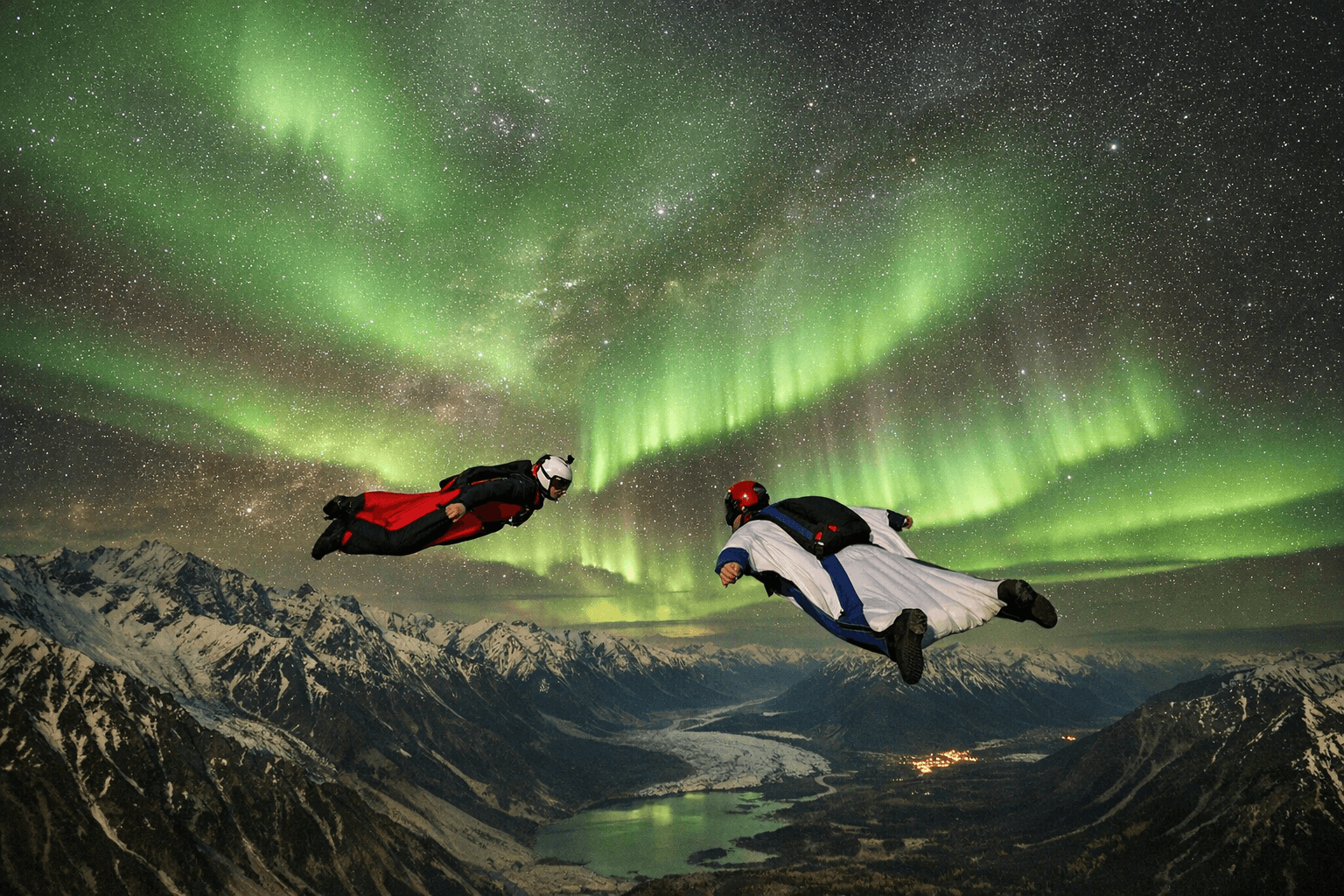
Four years passed between Jeff Provenzano's first phone call to Michael Clark and the night a team of wingsuit skydivers finally flew beneath Alaska's Aurora Borealis with cameras waiting. The final shoot landed on March 23, 2026, near Palmer, after weather, wind, and auroral activity aligned just long enough to attempt what Clark had spent years calculating was even possible.
"It was originally the idea of Jeff Provenzano," Clark said. "He called me about this project maybe four years ago to see if it was even possible to capture images at night under the aurora."
The answer required more than a yes or no. Clark, who holds a background in physics, worked through the fundamental conflict at the heart of the project: aurora photography rewards long exposures and elevated ISO, while fast-moving wingsuit flyers demand the opposite. Freezing a body in freefall beneath a dim, shifting sky meant designing exposures that could serve both simultaneously. His solution leaned on high-sensitivity sensors, fast lenses, and preplanned flight trajectories so subjects would move through a predictable slice of the frame.
Executing that vision on location involved a logistical architecture most editorial shoots never approach. The Red Bull Air Force team coordinated helicopters, safety pilots, and multiple test jumps above Palmer before committing to a final attempt. Contingency plans covered equipment failure, weather deterioration, and the unpredictability of the aurora itself, which can intensify or vanish within minutes. Repeated postponements pushed the team through false starts before March 23 finally delivered conditions close enough to workable.
Lighting calibration added another layer of complexity. Any supplemental source bright enough to illuminate suits and faces risked washing out the aurora behind them, collapsing the image into a lit subject against black sky. Clark's team had to dial exposure and ambient fill so that both the green curtain overhead and the human forms in the foreground registered with equal presence. The rehearsal jumps served double duty, validating framing and confirming that safety systems held at night under conditions the team had never previously combined.
The project sits at the intersection where adventure sports, editorial photography, and brand storytelling converge. Red Bull's Air Force unit has long operated at that crossing, but the Alaska shoot pushed technical and logistical demands into territory that required a photographer whose physics background was as relevant as his camera craft. For anyone working in night-action photography, it functions as a compressed case study in what pre-production actually buys: not guaranteed results, but the margin of preparation that makes a result possible when conditions finally cooperate.
Know something we missed? Have a correction or additional information?
Submit a Tip

