Roberto De Micheli’s versatile kit spans wildlife, fashion and travel
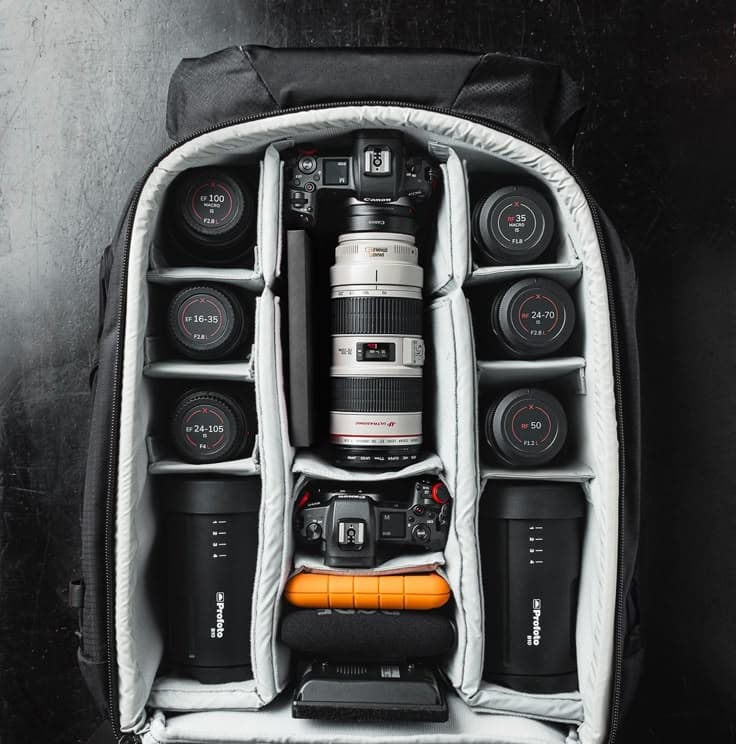
Roberto De Micheli’s bag is a lesson in range: a medium-format fashion setup, a Canon backup, and support gear that moves from studio to travel.
A kit built to move with the assignment
Roberto De Micheli, known in the DPReview forums as roby17269, is based in Jersey City, USA, and his camera bag makes one point very clearly: the modern photographer rarely lives in just one genre. He began in wildlife photography, moved more toward fashion work, and still keeps travel, kids’ photography, and family outings in the mix. That kind of spread changes the way a kit gets built. Instead of chasing a body or lens for one narrow specialty, De Micheli has assembled a system that protects his look while staying flexible enough to follow the job.
The useful part of his setup is not that it is expensive. It is that every choice seems tied to a repeatable need: subject separation, pleasing rendering, reach when the frame changes, and enough support gear to work in the studio or on location. For hobbyists trying to cover more ground with fewer purchases, that is the real lesson. Buy for the overlap between your subjects, not for the fantasy of a perfectly separate kit for each one.
The Hasselblad that anchors his fashion work
De Micheli’s current favorite setup is the Hasselblad X2D II 100C paired with the XCD 50mm f/2.5, and that pairing tells you a lot about the look he wants. For fashion and editorial work, he is clearly prioritizing the rendering and subject isolation that medium-format gear can give, rather than chasing the widest angle or the most speed. He also keeps the XCD 35–100mm f/2.8–4 zoom around when he needs more range, which gives the system flexibility without forcing him into a different brand or style of camera.
Hasselblad introduced the X2D II 100C in 2025 as a 100MP medium-format camera with true end-to-end HDR. The company says it also includes AF-C continuous autofocus, 425 PDAF zones, LiDAR-assisted AF-S, and 10-stop in-body image stabilization. That combination matters for a photographer moving between controlled and less predictable situations, because it brings modern autofocus and stabilization into a format often associated with deliberate, slower work.
The XCD 35–100E is just as revealing. Hasselblad describes it as a wide-angle to medium-telephoto zoom aimed at landscape, portrait, street, and travel photography. That scope mirrors De Micheli’s own mixed practice: a lens that can cover multiple shooting moods is more valuable than a bag full of specialty glass that only works in one lane.
Why his second system is still serious business
De Micheli’s backup and alternate system is a Canon R5, not a casual spare body. Canon lists the EOS R5 as a full-frame RF-mount mirrorless camera priced at $2,999 body-only in the U.S., which places it firmly in professional territory. His lens set around it is equally deliberate: the RF 50mm f/1.2, RF 85mm f/1.2, RF 100–500mm, and RF 35mm f/1.4.
That lineup shows a photographer who knows where his eye naturally goes. De Micheli describes himself as more of a telephoto photographer than a wide-angle shooter, and the Canon kit reflects that preference with long glass and fast portrait primes rather than a heavy commitment to sweeping perspectives. If you find yourself reaching for compression, separation, and tighter framing more often than broad environmental views, that is a clue that your own kit should lean the same way.
The practical lesson here is simple. A second system does not have to be a downgrade. If it is built around the lenses you actually use, it can serve as a parallel toolset for travel, family work, or any assignment where a different body or mount gives you a better fit.
The support gear tells the rest of the story
De Micheli’s bag is not only about cameras and lenses. His support gear includes a heavy Manfrotto tripod with a geared head for catalog and studio work, Broncolor Siros L 800 strobes, a Profoto B1 500 for lighting, and a DJI drone when he wants an aerial point of view. That spread suggests a photographer who moves comfortably between controlled studio setups and more fluid location work.
The tripod choice is especially telling. A geared head is a tool for precision, and that makes sense in catalog and studio work where tiny compositional adjustments matter more than speed. The Broncolor Siros L 800 strobes handle the more formal lighting side, while the Profoto B1 500 adds a battery-powered option for working away from the wall socket.
Profoto describes the B1 500 as a battery-powered monolight with AirTTL, and its user guide notes high-speed sync support with compatible Air Remote TTL transmitters. In plain terms, that means the light is built for location work where portability and sync flexibility matter. If your own shooting moves between portrait sessions, small productions, and outdoor setups, the same logic applies: one reliable portable strobe may be more useful than a larger pile of niche accessories.
What this kit teaches photographers who want fewer purchases
De Micheli’s setup works because each piece earns a second job. The Hasselblad is not only for fashion, it is also a refined tool for editorial-style travel and portrait work. The Canon system is not only a backup, it is a different way to cover telephoto-heavy assignments, family scenes, and travel without changing the way he sees.
A few practical takeaways stand out:
- Build around your most common shooting distance. De Micheli says he favors telephoto work, so his kit leans toward lenses that compress space and isolate subjects.
- Pick lenses that cross genres cleanly. The XCD 35–100E and the RF 100–500mm are not one-trick tools; they help a single bag work harder across travel, portrait, and lifestyle use.
- Let support gear match your real environments. A geared tripod, portable strobes, and a battery monolight cover studio and location work without requiring separate systems for each.
- Protect your look first. The Hasselblad X2D II 100C and XCD 50mm f/2.5 give De Micheli the rendering he wants for fashion, and everything else in the bag is built around preserving that standard.
That is what makes his kit such a useful model. It is not a trophy case of luxury gear, and it is not a rigid one-genre setup either. It is a working photographer’s answer to a broad life of shooting, with wildlife in the past, fashion at the center, and travel, family, and kids’ work still pulling in from the edges. The bag stays versatile because the photographer does, and that is the kind of flexibility worth copying.
This article was produced by Prism’s automated news system from verified source data, official records, and press releases, then run through automated quality and moderation checks before publishing. The system is built and supervised by the people who set the standards it runs under. Read our full AI policy.
Know something we missed? Have a correction or additional information?
Submit a Tip