Sigma 35mm f/1.4 Art Mark II Tops Ranking of Sharpest Full-Frame Lenses
Sigma's 35mm f/1.4 Art Mark II topped Christopher Frost's ranking of 7 full-frame primes, beating the Sony GM on a 61MP sensor while costing $550 less.
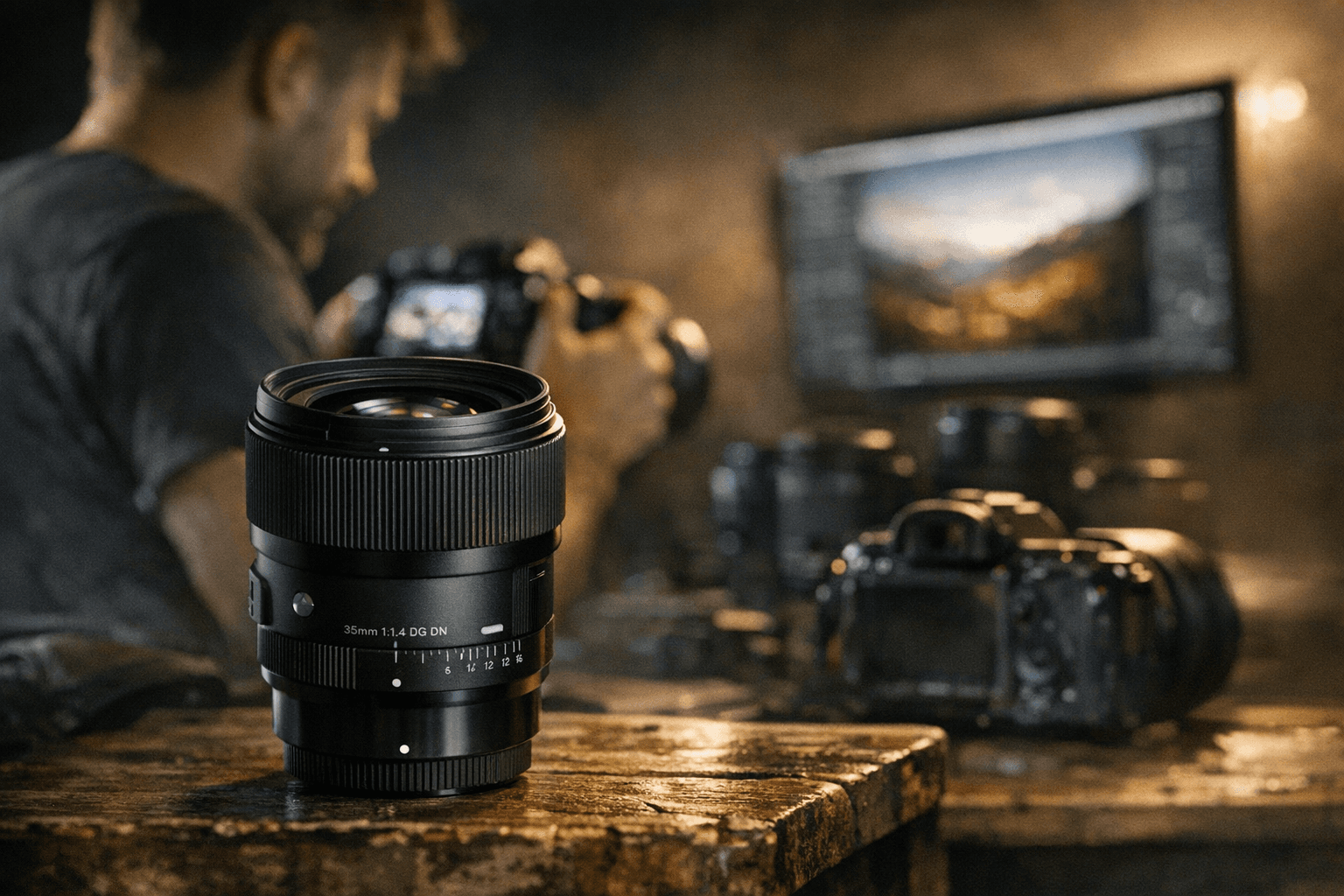
When Christopher Frost ran the Sigma 35mm f/1.4 DG DN Art Mark II through a 61-megapixel test body, he found center sharpness he called the best he had recorded from any 35mm lens. That result, published March 28 in a comparative ranking of seven autofocus full-frame primes built from Frost's multi-year testing database of 50-plus lenses, handed the new Sigma a narrow but decisive win over the Sony FE 35mm f/1.4 G Master. It does it for $1,059, roughly $550 less.
The top three slots were separated by thin margins, with the Sony GM also appearing near the summit, but the corners told the decisive story. At f/1.4, the Sigma's center is already the sharpest in the field; by f/2.8, the corners have caught up and the result across the full frame on a 61-megapixel sensor is something earlier lens generations could not deliver. That matters because 2026 mirrorless cameras have normalized high-resolution sensors that previously exposed every optical weakness.
The lens itself shifted substantially in the hand from its 2021 predecessor. Announced February 24, the Mark II is 14 percent shorter and 20 percent lighter, dropping from 645 grams to 530 grams. For street and travel work, that difference is immediate and cumulative across a full day. Coma is well-contained at f/1.4, making the lens usable for night scenes and astrophotography without stopping down. Sunstars appear clearly from f/8. Bokeh is smoother than the earlier version with clean specular highlights, though some mild cat's-eye shaping appears toward the frame edges. Chromatic aberration is visible at f/1.4 but substantially controlled by f/2.8. Barrel distortion measured under one percent. For portraits, the combination of center bite wide open and creamy out-of-focus rendering gives it genuine flexibility rather than the clinical flatness that pure sharpness rankings can imply.
Frost's methodology is worth understanding before treating the ranking as a final verdict. He weights faster maximum apertures more heavily because correcting an f/1.2 design is optically harder than an f/1.8, which means some lenses scoring lower in the raw chart are penalized by their smaller aperture rather than poor engineering. A budget lens also placed in the final seven, underscoring that third-party optical engineering in 2026 is no longer a consolation tier.
Sharpness is also the wrong priority for several common shooting situations. Sony shooters who rely on focus breathing compensation on the a1 or unlimited burst rates tied to first-party lens protocols will find the Sony GM integrates more deeply with those bodies. Flare resistance and autofocus behavior under low-contrast conditions are not captured by a resolution score. Travelers prioritizing pack weight might look at the smaller Sony FE 35mm f/1.8 rather than either f/1.4 option.
For photographers picking a single 35mm prime for mixed use on a high-resolution Sony or L-Mount body, the Sigma Mark II occupies all three positions in a rational shortlist: best value in the tier, strongest all-round optical package, and the most thoroughly proven option on sensors above 45 megapixels. The Sony GM remains a credible answer for shooters whose workflows are built around Sony-native features. Everyone else is now asking a sharper question than they were two years ago, because the baseline for corner performance wide open has moved.
Know something we missed? Have a correction or additional information?
Submit a Tip

