Stanley Greenberg's Waterworks Captures New York City's Hidden Water Infrastructure
Stanley Greenberg spent years fighting for access to NYC's water infrastructure, completing 362 black-and-white images across three decades before 9/11 shut the doors permanently.
Few photographers have fought harder for access than Stanley Greenberg did to document New York City's water system. He asked repeatedly for permission to photograph the infrastructure and was denied for years before access was finally granted in 1997. He completed the initial body of work in 2001, just months before the September 11 attacks shut down access to City infrastructure for good.
The result is Waterworks, a sweeping black-and-white photographic portrait comprising 362 images made between 1992 and 2024. First published in 2003, the project documents a system that Greenberg describes as vast, complex, and invisible to the casual observer, from interior structures he could only access during that narrow pre-9/11 window to above-ground signs of the water system hidden in plain sight across the five boroughs and beyond.
Greenberg's connection to the subject runs deeper than most documentary photographers'. While working at the New York City Department of Environmental Protection, he saw the city's water systems up close firsthand. He later returned to the agency to help catalog its long-neglected archives, an extensive collection of 10,000 photographs and drawings dating back to 1840. It was around that time he also began work on Invisible New York, a book featuring some of the city's concealed water structures.
The DEP's relationship with Waterworks was complicated from the start. The agency tried to block the book's release when it was published in 2003, only to later purchase 200 copies.

Though the 2003 publication marked a major milestone, Greenberg kept shooting. After publishing several other books he returned to water infrastructure, this time concentrating on what could be found above ground without interior access. His research methods were unusually rigorous: he studied city planning documents, reviewed property records, consulted old and new maps, walked the routes of all three of the city's water distribution tunnels, and bicycled sections of upstate aqueducts. That sustained fieldwork pushed the total image count to 362, with photographs extending through 2024.
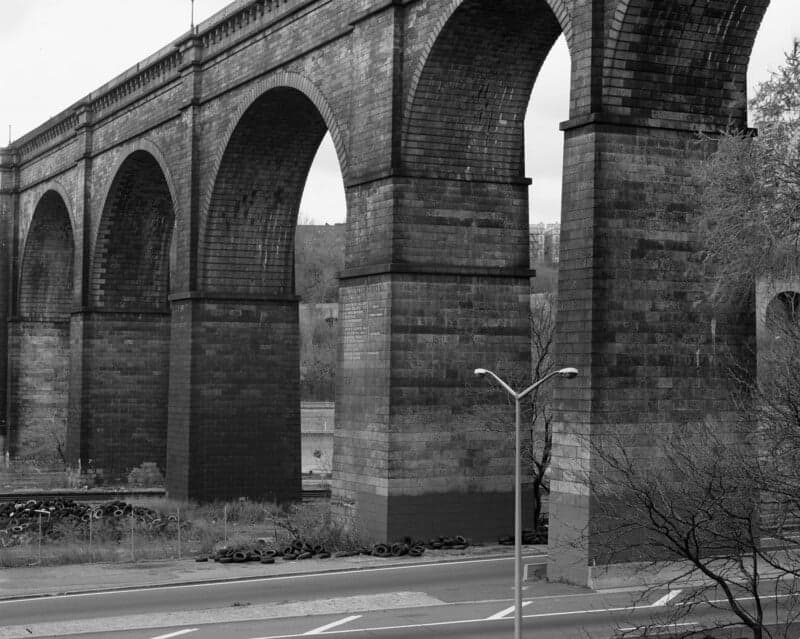
The visual approach throughout is committed black and white. One representative image captures a massive stone railway viaduct with tall arches spanning a road, piles of tires stacked near the base, leafless trees occupying the foreground. It is the kind of structure most New Yorkers pass without a second glance, which is precisely the point Greenberg has spent three decades making.
Know something we missed? Have a correction or additional information?
Submit a Tip

