Three-Light Portrait Lighting Setup Hobby Photographers Can Recreate for Professional Results
A practical, repeatable three‑light portrait system (key + fill + hair/background) you can build in a small studio with modest gear for flattering, pro results.
A three‑light portrait rig, one key, one fill and one hair/rim or background light, is the sweet spot between simplicity and control. Use this guide to set each light’s role, reproduce three tested recipes from experienced teachers, and avoid the common pitfall of light spill using Scott Robert Lim’s distance rule.
1. Key (main) light, principal shaping light and starting point
The key light is the primary light that sculpts the subject’s face and sets overall exposure. Choose a modifier to control softness: an octobox for softer wrap, a beauty dish for slightly harder, or a softbox for general use; VisualEducation’s examples use softboxes to produce a “bright and stylish” result. Place the key at the angle that matches your aesthetic (45 degrees for classic Rembrandt/loop, or higher and angled down for flattering shadows as Kayleigh June recommends). Use Scott Robert Lim’s distance rule when positioning the key: “Generally the distance from your main light to your subject is the same distance that the light is going to travel behind your subject,” and he illustrates this with, “So if the main light is three feet from your subject, it’s going to travel three feet behind your subject and then drastically fall off.” To avoid unwanted background illumination Lim says, “That means I better pull my subject away from the background at least three feet. I usually like to stay six feet away just to make sure no light from my main light reaches that backdrop.”
2. Fill light, control contrast and lift shadow detail
The fill light reduces or controls the shadow contrast created by the key without defeating the key’s shape. Fill can be a second softbox, a reflector (white or silver), or a lower‑powered speedlight; Kayleigh June’s one‑light progression explicitly recommends using a “white or silver reflector angled underneath the model’s face” to “illuminate the eyes and create pretty catchlights.” When you want a consistent, even fill, place a square softbox or octobox opposite the key at reduced power; for clamshell setups, deploy two matched lights in front about one metre apart, “raised high and angled down,” to create a “beautiful glowing effect” and “incredible reflective catchlights in the subject’s eyes,” as Kayleigh June describes. Remember the fill’s purpose is supportive: let the key remain the dominant directional source.
3. Hair / rim / background light, separate subject and add dimension
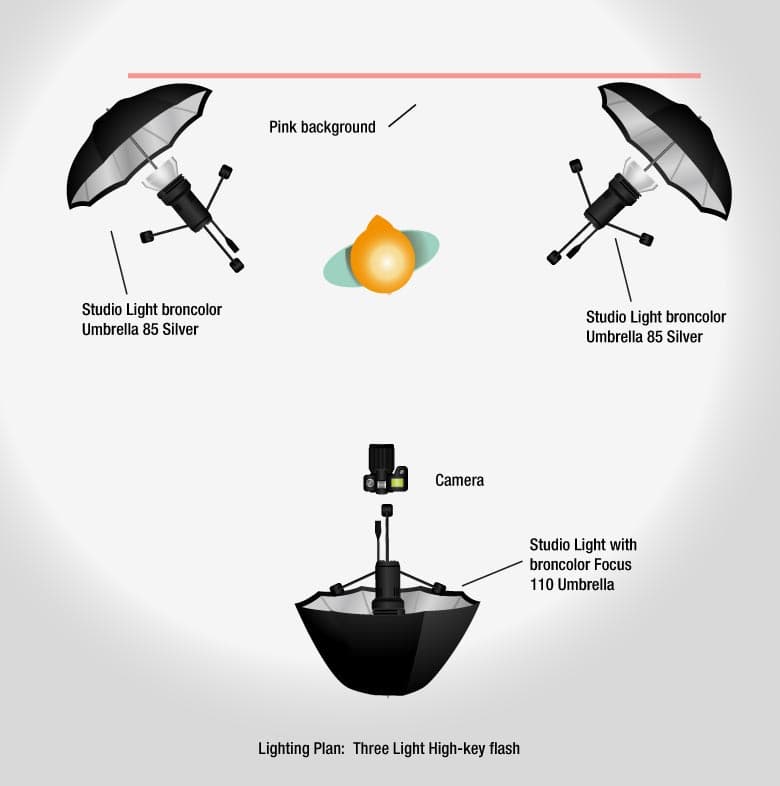
The rear or background light removes the subject from the backdrop and adds three‑dimensionality. Sources treat this light interchangeably as a hair, rim or background light depending on placement. VisualEducation’s high‑key recipe uses “Two silver umbrellas create the rim lighting that’s visible on the model’s face and bare shoulders, while a Focus 110 umbrella from the front fills in the shadows and adds extra illumination on the background.” For contouring on three‑quarter length portraits, VisualEducation recommends “two stripboxes, used in an L‑shape” plus a background light to “give soft shadows down one side of the model, perfect for contouring and adding three dimensionality.” If space is tight, place a second light at a 45‑degree angle facing the backdrop, PetaPixel notes that this should be “to the side, behind the subject, and out of the shot,” and a square softbox “is fine for this.”
- Bright and stylish (VisualEducation): two softboxes + one background light + reflector. The tutorial says, “The combination of the background light and side light create a really punchy, three dimensional image and the position of the lights, although set in a small studio, allows the model a fair bit of flexibility for movement.” Use this for lively, moveable posing in a compact space.
Three proven recipes you can reproduce
- Three‑light high‑key fashion (VisualEducation): two silver umbrellas as rim lights + a Focus 110 umbrella in front to fill and add background illumination. VisualEducation: “The Focus 110...means you can easily control the hardness or softness of the shadows, depending on the look you're going for.”
- Strong, bold and dynamic (VisualEducation): two stripboxes in an L‑shape + background light for three‑quarter length portraits. The article states, “The two stripboxes, used in an L-shape, give soft shadows down one side of the model, perfect for contouring and adding three dimensionality.”
- Start: one light + reflector, place a single light directly in front, raise it high and angle down, and use a white or silver reflector beneath the chin to “illuminat[e] the eyes and create pretty catchlights.” Choose an octobox for softer wrap or a beauty dish for a bit more punch.
Small‑space progression (PetaPixel / Kayleigh June)
- Progress: clamshell (two lights), two square softboxes positioned like a “clam” about one metre away, raised and angled down, create glowing skin and strong catchlights.
- Finish: add a background/backlight, position the third light at a 45° angle to the backdrop, behind and to the side of the subject, to convert your clamshell or one‑plus‑fill setup to a full three‑light system.
- Octobox, soft, even wrap (recommended by Kayleigh June for softer one‑light work).
- Beauty dish, harder, more sculpted look (PetaPixel notes it’s ideal if you prefer harder light).
- Softbox (square or rectangular), versatile, even fill or key. VisualEducation uses softboxes for “bright and stylish” looks.
- Stripbox, narrow, directional soft shadow for contouring; VisualEducation uses two in an L‑shape.
- Silver umbrella, strong rim highlights; VisualEducation uses two for rim lighting on face and shoulders.
- Focus 110 umbrella, front fill plus background control; VisualEducation: “means you can easily control the hardness or softness of the shadows.”
- Reflector (white/silver), cheap, portable fill to lift shadows and create catchlights (PetaPixel).
Modifiers and what they do (cheat sheet)
- Distance rule: follow Scott Robert Lim’s practical guidance about spill: “If the main light is three feet from your subject, it’s going to travel three feet behind your subject and then drastically fall off... I usually like to stay six feet away just to make sure no light from my main light reaches that backdrop.” Doubling the distance is his conservative safety advice: “If you double the distance just to be safe you can ensure the light won’t travel behind the subject and light up the background.”
Practical tips, pitfalls and Scott Robert Lim’s rule
- Allow movement: VisualEducation emphasizes that some setups “allow the model a fair bit of flexibility for movement,” which matters if you shoot dynamic posing in a small studio.
- Catchlights and angle: clamshell and reflector techniques explicitly help “illuminate the eyes and create pretty catchlights” and a “beautiful glowing effect” according to Kayleigh June, use higher, angled lights for flattering facial shadows.
- Use Scott Robert Lim’s published studio example as a starting baseline: “Photo by Scott Robert Lim. Sony Alpha 7 IV. Sony 50mm f/1.2 G Master. 1/200‑sec., f/8, ISO 100.” These settings are an explicit example accompanying his images; adjust based on your flash sync, modifiers and power.
Sample camera settings and credits
Final note This three‑light framework, key, fill, hair/rim, is the practical foundation Scott Robert Lim urges you to “know...like the back of your hand”: “As you become more comfortable with lighting, you should work your way to this three‑light setup. You really need to know how to do it like the back of your hand because you can do so much with it.” Start with one simple combination (one light + reflector), move to a clamshell or paired softboxes, then add the third light when you understand spill and spacing; the recipes above show how modest gear produces flattering, professional results in both small home studios and more formal setups.
This article was produced by Prism’s automated news system from verified source data, official records, and press releases, then run through automated quality and moderation checks before publishing. The system is built and supervised by the people who set the standards it runs under. Read our full AI policy.
Did this article answer your question?