VSCO survey finds 83 percent of photographers already use AI workflows
Nearly 90 percent of surveyed working photographers are already using AI, but the real story is where it saves time: culling, keywording, scheduling and client admin.
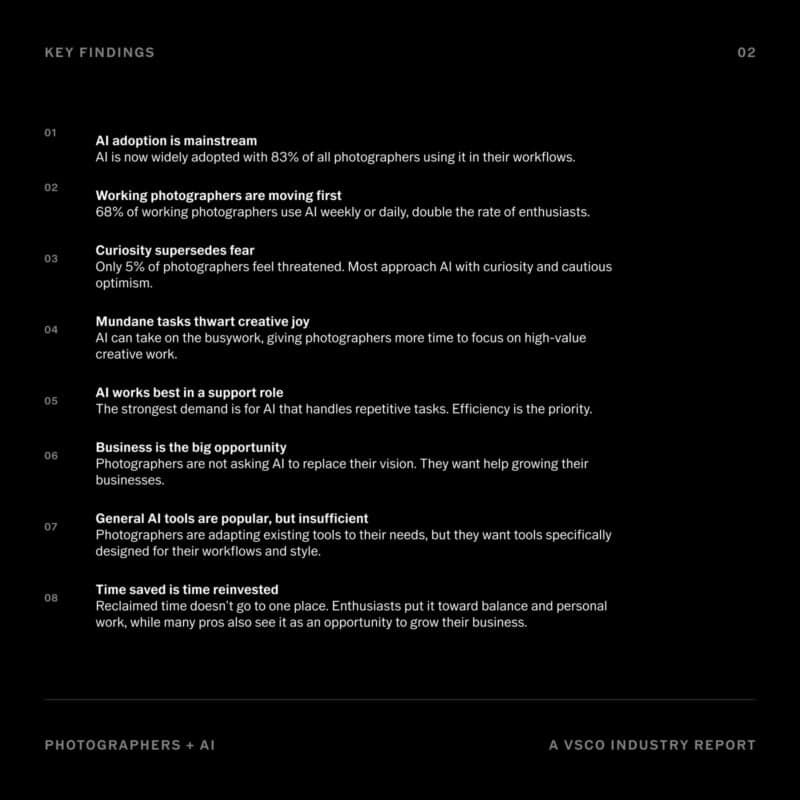
Nearly 90 percent of surveyed working photographers are already using AI in some part of their workflow, a sign that the debate inside photography has moved well past novelty and into daily labor. VSCO’s new industry report found that 83 percent of the 401 photographers surveyed in the United States and Canada were already using AI, and among working photographers the pace was even faster, with 68 percent saying they used it weekly or daily.
The survey, fielded in December 2025 and built with a 95 percent confidence level and a plus or minus 5 percent margin of error, split respondents between 56 percent working photographers and 44 percent enthusiasts. Travel and lifestyle shooters were the most common genres represented, followed by landscape, nature, wildlife and portrait work. VSCO said the study was conducted independently of its own user base, and the findings pointed to a profession that is treating AI less like a spectacle and more like a tool.
That practical turn showed up in the numbers. More than half of respondents used AI weekly or daily, 63 percent said they use generic AI tools such as ChatGPT or Claude, and 38 percent said they were using AI more than they had a year earlier. Fewer than 5 percent said they felt threatened by AI. The stronger signal was curiosity, caution and a growing appetite for tools that handle work photographers do not enjoy.

VSCO chief executive Eric Wittman focused on time management, noting that nearly half of photographers spend between a quarter and half of their working hours on tasks that do not feel creatively satisfying, including file organization, planning, communication and promotion. That is why the strongest demand is for AI that can help with keywording, culling, email, scheduling, invoicing and file organization. For many photographers, the issue is no longer whether AI belongs in the workflow, but which parts of the workflow it should be allowed to speed up.
That divide matters. A separate thread in the industry has kept running through copyright, labeling and training data, even as day-to-day adoption accelerates. In 2023, a Royal Photographic Society survey found 95 percent of respondents still believed traditional photography was needed, 85 percent said training AI on images without permission or payment was unfair, and 95 percent believed AI could fuel fake news and lying. In February 2025, the Association of Photographers reported that 58.1 percent of respondents had lost commissioned work to generative-AI services. Against that backdrop, VSCO’s 2026 data suggests the field is splitting cleanly between two debates: generative image-making and workflow efficiency. The latter is already winning in studios, inboxes and editing queues.
This article was produced by Prism’s automated news system from verified source data, official records, and press releases, then run through automated quality and moderation checks before publishing. The system is built and supervised by the people who set the standards it runs under. Read our full AI policy.
Did this article answer your question?