Ava Ignatowich breaks down pickleball patterns for smarter third-shot play
Ignatowich turns third-shot theory into three repeatable patterns, so retreat players can train drives, drops, and speed-ups without overcomplicating the kitchen.

Ava Ignatowich’s lesson starts with sequences players can rehearse on a clinic court: a third-shot drive into a fifth-shot drop, or a crosscourt dink into a down-the-line speed-up. Most players already use those patterns, but they use them without enough intention, and that is where the points leak away. It fits a weekend at a resort round robin, a retreat, or a social doubles block.
Why the third shot is the real hinge
The double-bounce rule puts the serving team in a built-in hole, which means the third shot is not just another rally ball. It is the shot that has to carry you from the baseline toward the kitchen line, and that kitchen line is where most points are won. The third shot drop exists for a reason: it helps neutralize that disadvantage and lets you move forward safely instead of sprinting into trouble.
For intermediate players, the gap is rarely “I have never seen this pattern.” The real gap is “I know this pattern, but I cannot spot it early enough or repeat it cleanly under pressure.” The third shot is a transition shot, not a hero shot.
Pattern one: drive first, drop second
The cleanest pattern for players stuck between levels is the third-shot drive followed by a fifth-shot drop. Ignatowich’s logic is practical: a firm drive can press the other team early, force a weaker return, and make the next drop easier because the opponents are already defending instead of setting up.
If your third-shot drive gets returned, the usual answer is a fifth-shot drop, not another blast. In a clinic setting, the temptation is to keep swinging harder when you feel rushed. The smarter move is to use the drive as a transition tool, then absorb the next ball and bring the rally back to the kitchen.
The trap is the transition zone, one of the toughest places to play. It is nicknamed “No Man’s Land” for a reason: opponents can drive balls at your feet there, and if you linger, you hand them easy points. The fix is not fancy. Move through that area quickly, reset the ball, and get out of the firing line before the other team gets comfortable.
Pattern two: crosscourt dink, then punish the opening
The second pattern Ignatowich points to starts with a crosscourt dink exchange and ends with a down-the-line speed-up when the right ball shows up. That is the kind of sequence players see all the time in social doubles, but seeing it and owning it are different things. The useful part of the lesson is that it makes the transition from soft play to attack feel trainable instead of random.
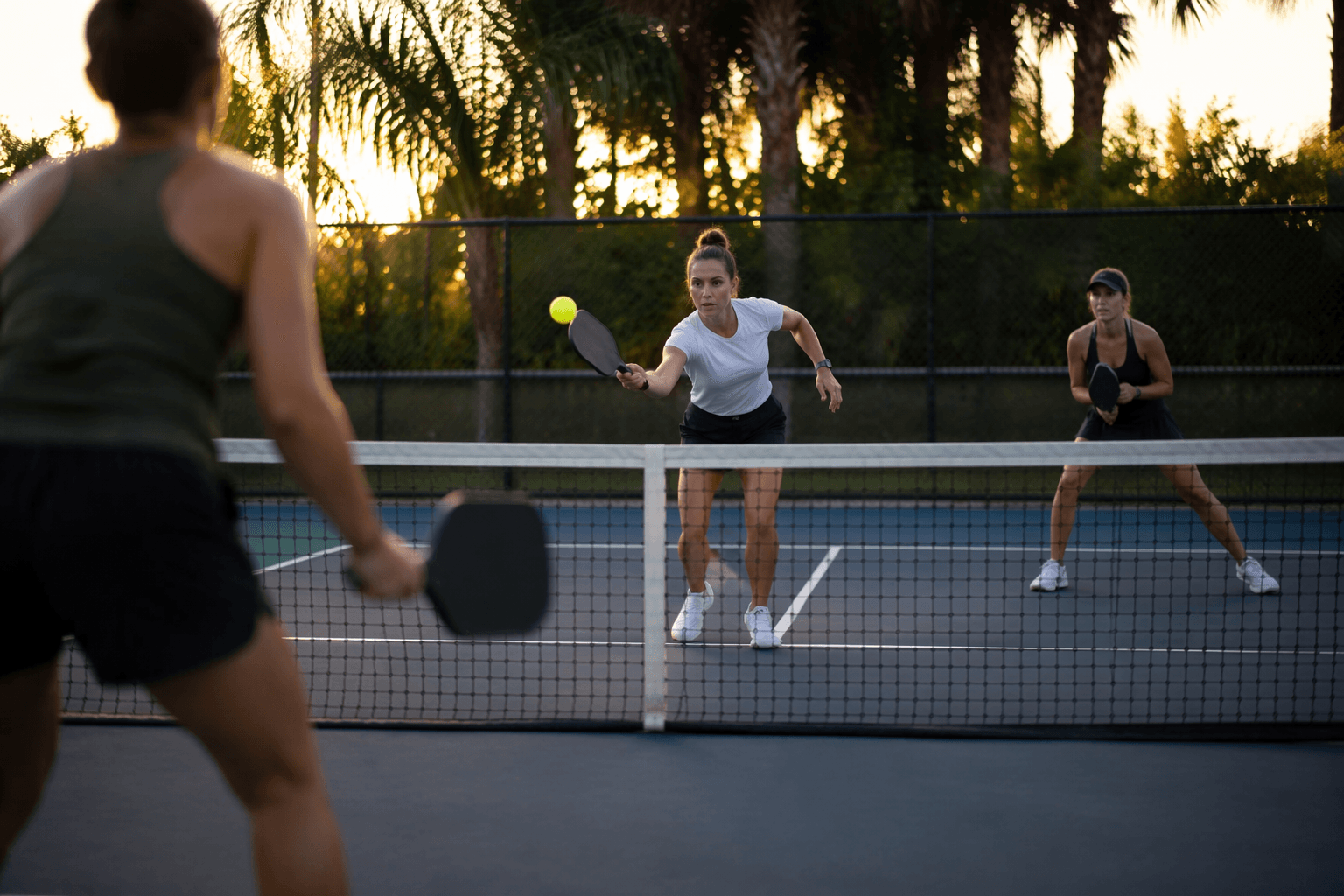
A dink down the line and the speed-up chance it creates are one connected sequence. That is exactly how it should be trained. If you only work on the dink by itself, you never learn what to do when the ball floats a little high and the lane opens. If you only work on speed-ups, you start forcing balls that were never there.
- start in a crosscourt dink exchange
- recognize the ball that sits up or drifts into the right lane
- take the down-the-line opening without hesitating
- reset the rally if the speed-up does not finish the point
The better retreat drill is the one that feels like live play:
That sequence builds the one thing mid-level players usually lack most: timing. Stronger players separate themselves through positioning, communication, and timing more than raw talent.
Pattern three: play the transition, not the panic
The third pattern is less about a single shot and more about understanding the job of the third shot itself. Whether you choose the drop or the drive, the goal is to move from the baseline to the kitchen line and take control of the rally. That means the best third-shot decisions are the ones that help you keep moving forward without handing away pace.
The lesson breaks that movement into repeatable pieces. A drive is not a separate identity from a drop, and a dink exchange is not separate from a speed-up. They are all parts of the same transition game, and if you can spot the pattern earlier, you waste less motion and make fewer desperate swings.
A weekend with a few focused sessions is not enough time to reinvent your game, but it is enough time to sharpen one pattern at a time. One court can work on drives and fifth-shot drops, another can live in kitchen exchanges, and another can train the moment a dink opens into a controlled speed-up.
Why Ignatowich’s voice carries weight
Pickleball.com lists her as a USA Tour Pro, age 24, right-handed, turned pro in 2024, and based in Delray Beach, Florida. Her player page also shows multiple 2026 tournament videos.
This article was produced by Prism’s automated news system from verified source data, official records, and press releases, then run through automated quality and moderation checks before publishing. The system is built and supervised by the people who set the standards it runs under. Read our full AI policy.
Did this article answer your question?