Cancer survivor Mark Palm finds healing, purpose through pickleball and service
Mark Palm’s path from B-cell lymphoma to Naples shows how pickleball can carry recovery, family, and mission work across oceans.
Naples is the showcase. Papua New Guinea is the test case.
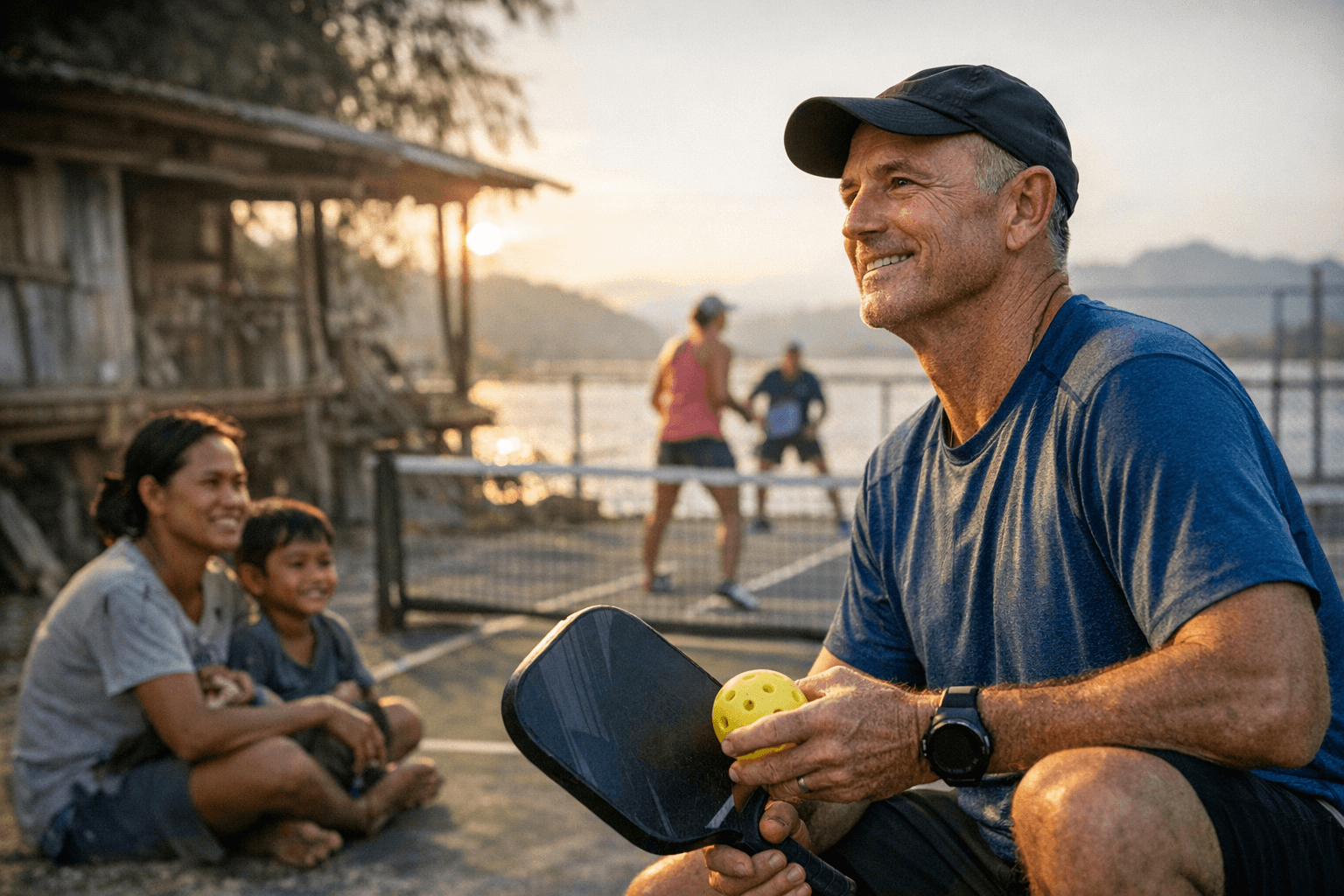
At the 2026 Franklin US Open Pickleball Championships, the contrast could not be sharper: one of the sport’s biggest stages sits in Naples, Florida, where the 10th anniversary event runs April 11 to 18 and draws more than 3,450 athletes from 40 countries and about 55,000 spectators. A world away, in Papua New Guinea, pickleball has been carried into villages so remote that the nearest road can be about 50 miles away through swamp. That span, from a polished tournament center to an isolated village court, is where Mark Palm’s story becomes bigger than one player, one bracket, or one comeback.
Palm is 51 now, cancer-free, and competing as a pro after discovering pickleball in 2019 while traveling for nonprofit work. He says he quickly got hooked, and the game took on a deeper role after he was diagnosed with B-cell lymphoma. Through six rounds of chemotherapy, he kept coming back to the court as energy returned, using pickleball as both movement and a mental marker of recovery. The sport was not just distraction. It became a way to measure what healing looked like, one session at a time.
That is part of why his appearance in Naples matters. Palm played in the Split Pro category with his 22-year-old son, Drake, a format that pairs one player over 50 with one under 50. The family connection adds warmth, but the result was less sentimental than it was honest: Palm and Drake lost their match that Sunday. For retreat and tournament travelers, that matters because it captures what many players recognize instantly. Pickleball does not need a perfect outcome to feel meaningful. The value is often in the shared rep, the travel, and the fact that the court is where people keep showing up.
The healing arc is only one layer of the story.
Palm’s recovery fits what cancer survivorship guidance has long emphasized: physical activity can support health during and after treatment, and emotional strain after treatment is common enough that distress screening and support are recommended. In Palm’s case, the benefits were visible in real time. Returning to play meant his body was doing more, but it also meant his mind was getting a lift from routine, progress, and contact with a game that rewards patience.
That arc is familiar to anyone who has watched pickleball become more than recreation. The game gives structure without feeling clinical. It offers competition without demanding an all-or-nothing identity. For players coming off illness, injury, or a hard stretch of life, that can make a retreat, clinic, or destination event feel less like a vacation package and more like a reset with purpose.
Palm’s story is also a reminder that the emotional center of pickleball is often family. Drake is on the court with him, but his wife, Kirsten, and children Sierra and Nolan are part of the larger picture too. This is not a lone-athlete narrative. It is a family system built around movement, service, and the kind of shared schedule that lets a sport travel across generations.
Samaritan Aviation shows how pickleball travels when a community carries it.
Palm’s work off the court is the other reason this story resonates so strongly. He and his wife started Samaritan Aviation in 2000 with a friend, Sam, and full-time aviation operations in Papua New Guinea began in 2010. Palm is the CEO and founder, and the nonprofit’s mission is direct: emergency medical flights and care at no cost for people who live far from hospitals.
The scale is striking. Papua New Guinea has more than 10 million people, and Samaritan Aviation says about 80 percent live in remote villages far from medical care. The organization says its four aircraft serve more than 350,000 villagers. Palm has said the operation is funded roughly 80 percent by donations and 20 percent by the Papua New Guinea government, a financing mix that underscores how dependent remote health access can be on a patchwork of support.
That same network is where pickleball enters in an unexpectedly practical way. Palm and his family have helped introduce the game to villages they serve, including one about 50 miles from the nearest road in a swamp. That detail changes the way you think about the sport’s spread. Pickleball is often discussed through club growth, indoor facilities, and tournament fields, but Palm’s story shows a different export model: one that moves through relationships, trust, and repeated visits by people already doing meaningful work.
What retreat planners can take from the Palm model.
For pickleball retreats, the lesson is not that every trip needs to be a humanitarian mission. It is that the strongest destinations often offer a sense of purpose beyond court time. Naples has the scale, atmosphere, and event gravity of a national showcase. Papua New Guinea shows the opposite end of the spectrum, where the game can become a bridge, a morale boost, and a social anchor in places with very different daily realities.
A few practical takeaways stand out:
- A retreat becomes more compelling when it has a clear identity, not just a court count.
- Family-friendly formats matter because pickleball often travels with parents, adult children, and multigenerational groups.
- Health and recovery framing is powerful when it is grounded in real lived experience, not marketing language.
- Communities respond when the sport is attached to something larger, whether that is service, travel, or a destination story people want to repeat.
- Split-format play, like the over-50 and under-50 pairing Palm used with Drake, can widen the door for mixed-age travel groups.
Those are the ingredients that can help the next surprising pickleball travel market emerge. The sport does not just expand where courts are built. It grows where people already gather for something else, then realize the game fits their lives too.
Palm’s story lands because it connects all of that in one arc: diagnosis, recovery, competition, family, and service. A player who found pickleball on the road in 2019 now stands in Naples, the sport’s U.S. hub, while also helping carry it into villages in Papua New Guinea. That is not a side note in pickleball’s growth. It is the blueprint for how the game keeps moving, one ambassador, one destination, and one community at a time.
This article was produced by Prism’s automated news system from verified source data, official records, and press releases, then run through automated quality and moderation checks before publishing. The system is built and supervised by the people who set the standards it runs under. Read our full AI policy.
Did this article answer your question?