How a Surfer-Turned-Engineer Built Six Zero Through Pickleball Innovation
Six Zero started as a workshop fix for cracked, pricey paddles, and it now shows how player-builders are shaping pickleball’s next gear standard.
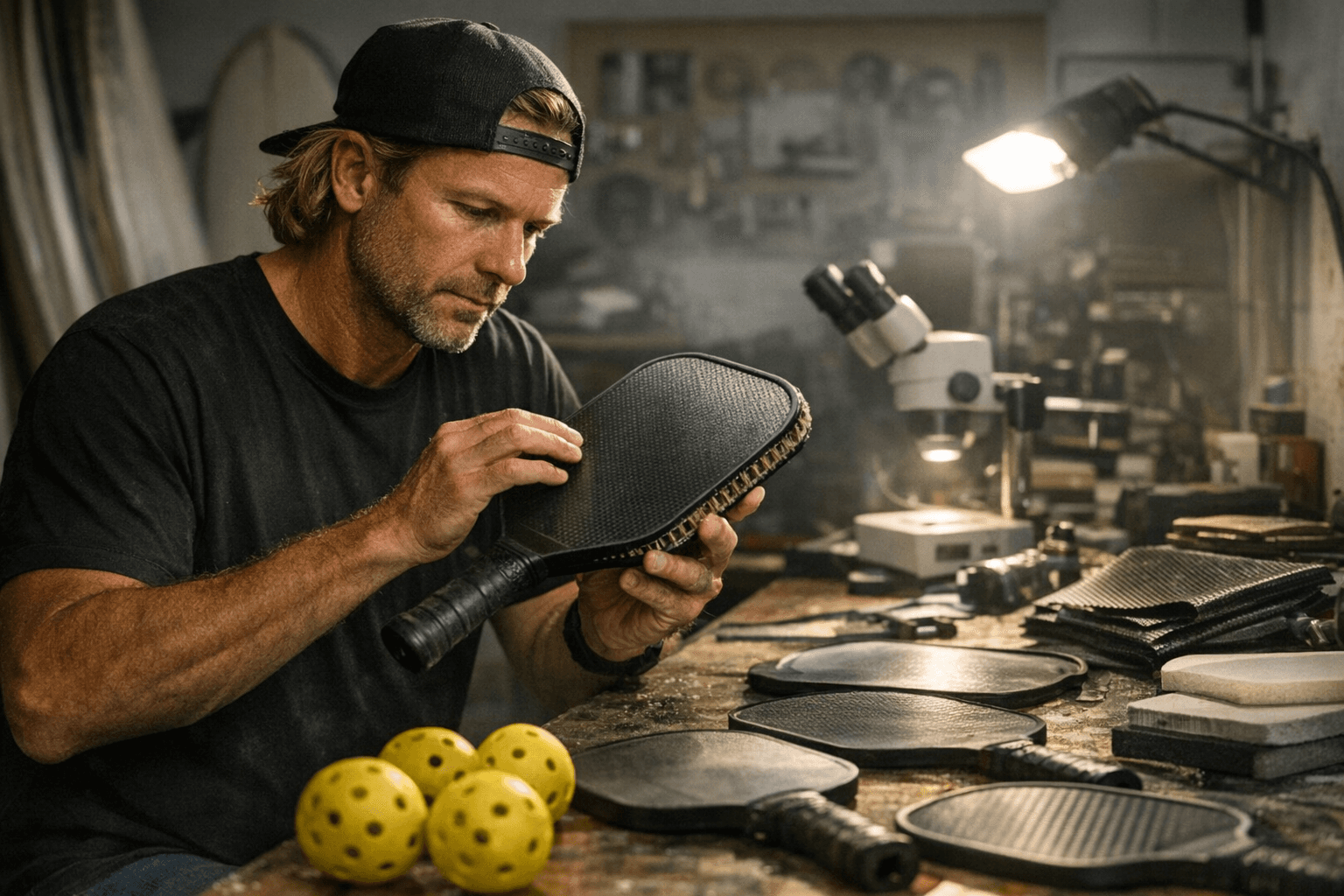
From surfer to engineer to pickleball builder
Six Zero’s most revealing origin story is not the sleek paddle itself. It is the fact that the brand began with a very ordinary on-court complaint: the paddles available in Australia were expensive, fragile, and not built to hold their feel. Dale Young, who grew up on the Sunshine Coast with surfing, junior tennis, and an engineering background, came back to Australia in 2021 after more than a decade in Tanzania working on humanitarian relief projects, looking for a slower pace and more family time. Pickleball entered his life almost by accident, after his mother kept urging him to try it. He assumed it was for older players. Then he stepped on court, got hooked, and saw a business problem hiding inside a fun sport.
That is the larger lesson in Six Zero’s rise: a lot of pickleball innovation still starts with players who are also builders. Young and his father began making prototypes in a workshop, testing them with friends and family, then revising and rebuilding again and again. The company says that process ran through hundreds of iterations, which matters because it shows the design philosophy was shaped by real play, not just branding. In a sport where retreat players may hit the same paddle through clinics, open play, challenge matches, and a final evening round robin, that kind of feedback loop is exactly where useful equipment starts.
Why Six Zero’s design story matters
Six Zero’s own history frames the company as Australian and family-owned, founded by Young with a point of view about value, durability, and performance. PickleballCentral adds important texture to that story: Young was introduced to pickleball in 2020, and because the available options in Australia were limited, poor-quality, and expensive, he started making home-made paddles. The breakthrough came from combining a full carbon seam around the paddle perimeter with hot-mold technology, a simple idea that became a high-performance and more robust construction approach.
The company says 18 months of research and development led to its Gen 2 thermoformed paddles, which it says were later adopted and copied globally. That is a telling detail for anyone watching the gear market. In pickleball, the brands that tend to matter most are not always the loudest; they are often the ones solving a stubborn practical problem first, then forcing the rest of the market to catch up. Six Zero’s name also signals that mindset. PickleballCentral reports it comes from DUPR, where 6.0 is considered professional level, which gives the brand a clear competitive ambition without losing its workshop roots.
The product side reflects the same philosophy. PickleballCentral says Six Zero’s development team includes composite engineers, high-level players, marketing and ecommerce specialists, and customer support personnel, all working on short turnaround cycles to design, build, test, and improve prototypes. That mix is part technical lab, part player room. It is also why the brand’s story feels less like a glossy launch and more like a community of builders answering questions the court keeps asking back.
What retreat players should take from that
For pickleball retreat and travel players, the real question is not whether a paddle looks impressive in a demo. It is whether the brand’s philosophy translates into an advantage after six or eight sessions in a long weekend. Six Zero’s origin suggests three qualities that matter in retreat settings:
- Durability that holds up under repeated play, not just one showcase hit
- Consistency in feel, so your paddle does not change character halfway through the weekend
- Design credibility, meaning the company is building around how people actually swing, reset, counter, and dink over and over
That is where the engineering story becomes practical. Retreats compress a lot of court time into a few days, and that exposes weak gear fast. A paddle that cracks, loses edge integrity, or plays differently by day three can disrupt the whole experience. A paddle built from a feedback-heavy design process is more likely to feel like a tool you can trust from the first drill to the final open play block.
The sport around the paddle is growing fast
Six Zero did not emerge in a small or sleepy market. Pickleball Australia said in December 2024 that its membership had passed 15,000, while Australian Sports Commission data showed well over 90,000 people playing pickleball in Australia. Its website now lists 26,430 members, 409 clubs, more than 100 tournaments, 334 referees, and 100 coach members. That is not just hobby growth; it is infrastructure.
The Australian Sports Commission also says AusPlay switched from phone to online data collection in July 2023, creating a new participation baseline. Its latest release page says the next data drop was scheduled for late April 2026 for data collected from January through December 2025. Put simply, the sport is still moving fast enough that the official picture keeps getting sharper. Brands that understand that pace, and keep iterating with it, are better positioned than brands built only for a snapshot of the market.
Why standards now matter as much as style
This is also the moment when equipment credibility has become harder to fake. USA Pickleball’s 2025 Equipment Standards Manual says more than 5,000 paddles and 400 balls have been tested since the Equipment Evaluation Committee began in 2016. The same manual added a Paddle/Ball Coefficient of Restitution test and updated specifications for paddle surface finish, gloss, and shiny edge guards. It also says approved equipment must be listed in its database to be legal for sanctioned events.
That matters because the pickleball market is entering a phase where performance claims need evidence. The more the sport matures, the more players care about consistency, legality, and repeatability. Six Zero’s engineering-first identity fits that environment unusually well. A brand that grew out of hundreds of prototype revisions, a carbon seam idea, hot-mold production, and hands-on player testing is speaking the same language as a sport that is tightening its standards.
The deeper takeaway is simple: the most useful pickleball innovation still comes from people who feel the problem first. Dale Young was not chasing a category trend when he began building paddles. He was solving the exact kind of frustration that retreat players notice immediately when they are out on court all weekend. In a sport that now rewards durability, testing, and technical clarity, that is not just a good origin story. It is a blueprint for where the next real advantages will come from.
This article was produced by Prism’s automated news system from verified source data, official records, and press releases, then run through automated quality and moderation checks before publishing. The system is built and supervised by the people who set the standards it runs under. Read our full AI policy.
Did this article answer your question?