Pickleball Globe warns static drills stall real match improvement
Static drilling feels productive, but it can freeze your game in place. The quickest retreat-camp gains come from reps that look and move like live rallies.
The fastest improvement comes from making practice look like a real rally
If you want to leave a weekend camp playing better, the mistake is usually not lack of effort. It is practicing in ways that feel tidy but never happen in a match. Pickleball Globe’s breakdown of seven common errors lands because it calls out the gap every retreat coach sees in clinics and social play: players rehearse clean, stationary shots, then wonder why those same shots break down once points get messy and fast.
That warning matters more now because the sport keeps expanding. USA Pickleball’s 2025 Annual Growth Report said there were 24.3 million U.S. players, marking the fourth straight year pickleball was the fastest-growing sport in the country. The Pickleheads database also added more than 2,300 new locations in 2025, reaching 18,258 places to play nationwide and 82,613 total known courts. There is more access, more players, and more reason to spend retreat time on the reps that actually carry over.
Why static reps stall match progress
The core problem is simple: a shot is never just a shot. In a live rally, you are moving, recovering, reading spin, and trying to win space, not just painting lines. USA Pickleball’s own coaching materials line up with that reality, saying the dink is a fundamental shot, getting to the kitchen line improves your winning chances, and drilling specific shots is the fastest and most effective way to improve.
That last part is the key for retreat players. Specific drilling helps only when it matches the situation you will face in games. If your practice never includes footwork, recovery, or the pressure of a ball coming back faster than expected, the rep teaches comfort, not transfer.
Crosscourt dinks need feet, not just hands
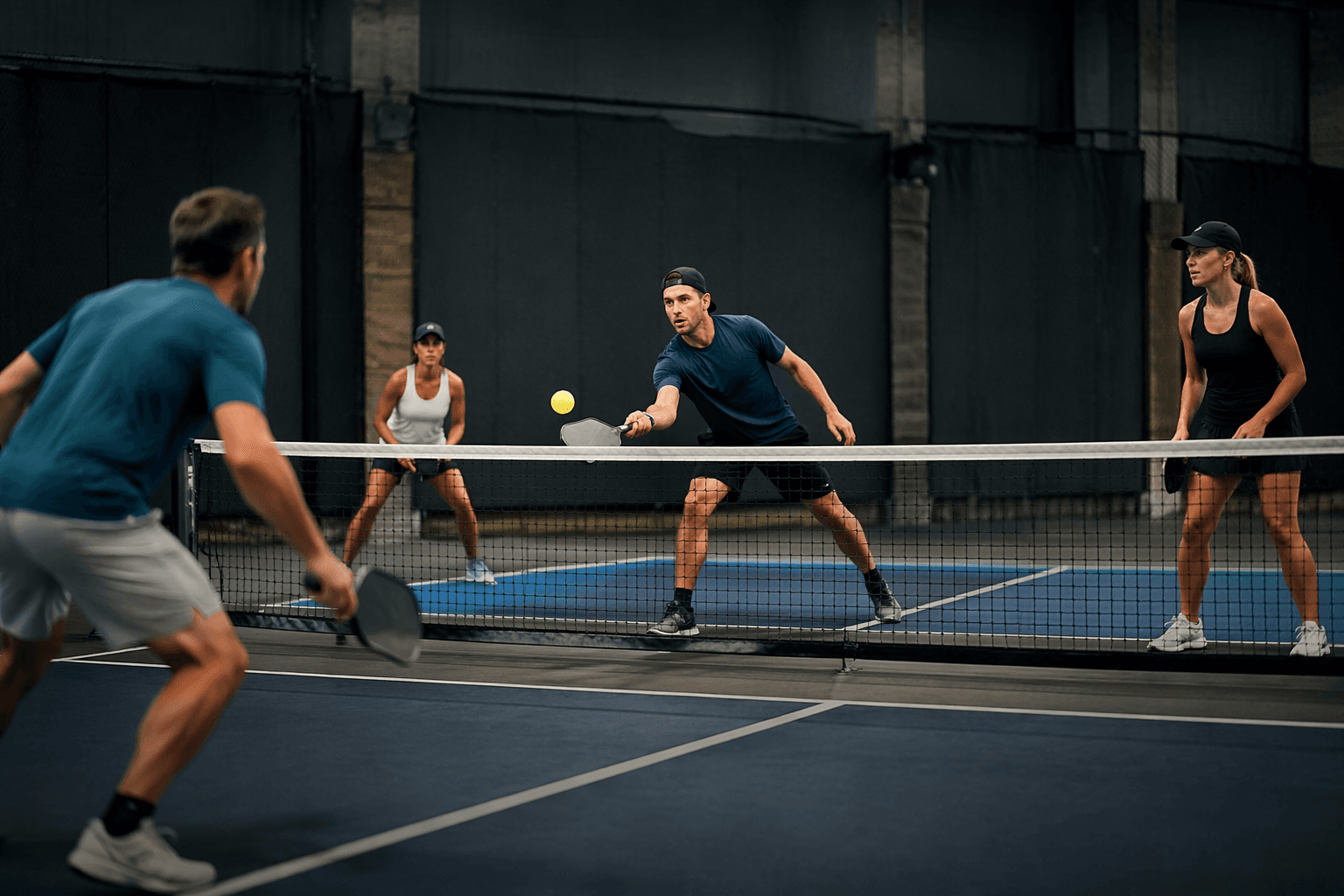
A lot of players treat crosscourt dinks like a standing contest at the sideline. That is the mistake. In real play, you are not frozen by the Non-Volley Zone line, which USA Pickleball’s rulebook places 7 feet from the net and includes as part of the NVZ. You have to hit, recover, and be ready for the next ball.
The quick fix at a retreat is to make every dink rep include movement after contact. Hit the ball, then recover into position instead of admiring the placement. That one adjustment pays off fast because it teaches balance and spacing, two things that disappear first when a rally speeds up.
Returns should launch you forward, not leave you planted
Another common clinic habit is the lazy return drill: stand still, hit deep, and call it done. That does not resemble the real point. A good return should already be carrying you toward the kitchen line, because getting there sooner changes the whole point structure.
At a camp, this is one of the easiest habits to clean up. Start the return with forward momentum, then recover toward the transition and kitchen line as soon as the ball leaves your paddle. You will feel the difference immediately in doubles play, because your partner gets better shape behind you and you arrive in position instead of chasing it.
Fast hands must train both counters
Fast-hands drills can become flashy very quickly. Players love the sound of quick exchanges, but too many reps only favor the forehand side, which is a bad habit once a body shot or backhand counter shows up in a match.
The better version is simple: train both forehand and backhand counters until the reaction feels symmetrical. That matters at retreats because the pace of a good clinic basket or fire drill often outruns the pace of casual open play. If you only feel comfortable on one side, your “fast hands” disappear the moment the ball is aimed at your weaker half.
Baseline drives are not the whole plan
Repeated baseline drives can feel like work, but they can also become a dead end if you treat them as the whole game. In actual points, a drive usually needs to lead somewhere, whether that is a transition ball or a controlled drop. Otherwise you are just hitting hard and hoping the point resolves itself.
For a retreat player, the quickest payoff is to connect each drive to the next ball. Drive, then immediately prepare for the reply that lets you move forward or reset the point. That sequence builds real match habits, because it teaches you that pace is a tool, not a strategy.
Dinking has to be active, not sleepy
This is where a lot of social play goes wrong. Players dink like they are killing time, not trying to earn the kitchen. But USA Pickleball is blunt about why the soft game matters: the dink is a fundamental shot, and getting to the kitchen line improves winning chances.
The fix is not more dinks, it is better dinks. Keep them intentional, with pressure and purpose, instead of floating them around in a neutral rally. Retreat sessions are ideal for this because you can repeat the same ball shape while demanding better footwork, better patience, and a better sense of when to attack.
Take balls out of the air when the moment is there
One of the smartest habits in the Pickleball Globe breakdown is also one of the most practical: take more balls out of the air when the situation allows. Letting everything bounce gives opponents time to reset. Taking a ball early can steal that time back.
This is especially useful in a short camp window, where you want fast feedback. Practice recognizing the balls you can intercept without forcing the shot. The payoff is immediate because you shorten the exchange and start learning the kind of timing that wins hand battles and kitchen exchanges.
Spend practice on shots that actually show up in matches
The final mistake is the easiest to spot in a retreat setting: spending too much time on flashy shots that look cool but rarely matter. If a move does not appear in real rallies, it should not dominate your practice block. The sport rewards boring competence far more than highlight-reel ambition.
That advice also fits the growth of the game itself. USA Pickleball’s 2024 Annual Growth Report had already shown 15,910 locations nationwide in the Pickleheads database and 68,458 total known courts, with 4,000 new locations and 18,455 new courts added that year. With more people playing at more venues, the level gap is getting smaller, which makes reliable, match-shaped execution even more valuable.
Why this also protects your body
There is a durability angle here too. Hospital for Special Surgery and the American Academy of Orthopaedic Surgeons both note that pickleball’s rise has come with more injuries, including overuse problems like tennis elbow, sore shoulders, back injuries, and fractures from falls. HSS also points out that people sometimes push too hard because the sport is fun and easy to play for long stretches, while AAOS OrthoInfo warns that bad technique can lead to injury and recommends lessons from a pro.
That is another reason static reps fail. They can hide bad movement patterns while making you feel busy. Match-realistic drilling, on the other hand, exposes how you move, how you recover, and whether your technique holds up when the pace rises.
The retreat lesson is the same one tucked inside all seven mistakes: if the drill never looks like the point, the point will expose it. The players who improve fastest are not the ones who hit the most balls in the neatest pattern. They are the ones who make practice honest enough to survive the first live rally on Monday.
This article was produced by Prism’s automated news system from verified source data, official records, and press releases, then run through automated quality and moderation checks before publishing. The system is built and supervised by the people who set the standards it runs under. Read our full AI policy.
Did this article answer your question?