What paddle performance really means, and how to measure it
Paddle marketing gets noisy fast. The real edge comes from knowing which numbers, like RPM, ball speed, torque, and PBCoR, actually describe performance.
The first thing to know about paddle performance
Matt Khoury’s explainer gets to the heart of the current paddle conversation: performance only matters when it can be measured. Terms like explosive power and maximum spin sound useful, but they lose value fast unless they connect to numbers a tester can verify. That matters more now because the sport is booming, with SFIA estimating 19.8 million U.S. players in 2024 and 24.3 million in 2025, while USA Pickleball said its membership reached 104,828 in 2025.
The growth is not just a participation story, it is a safety and standards story too. A 2025 medical study found pickleball-related emergency department injuries rising from 1,313 in 2014 to 24,461 in 2023, which helps explain why governing bodies are tightening the language around equipment. When more players enter the game and more bodies end up in clinics, vague marketing claims stop being harmless fluff and start becoming a real problem.
Power is not a vibe, it is a measurement
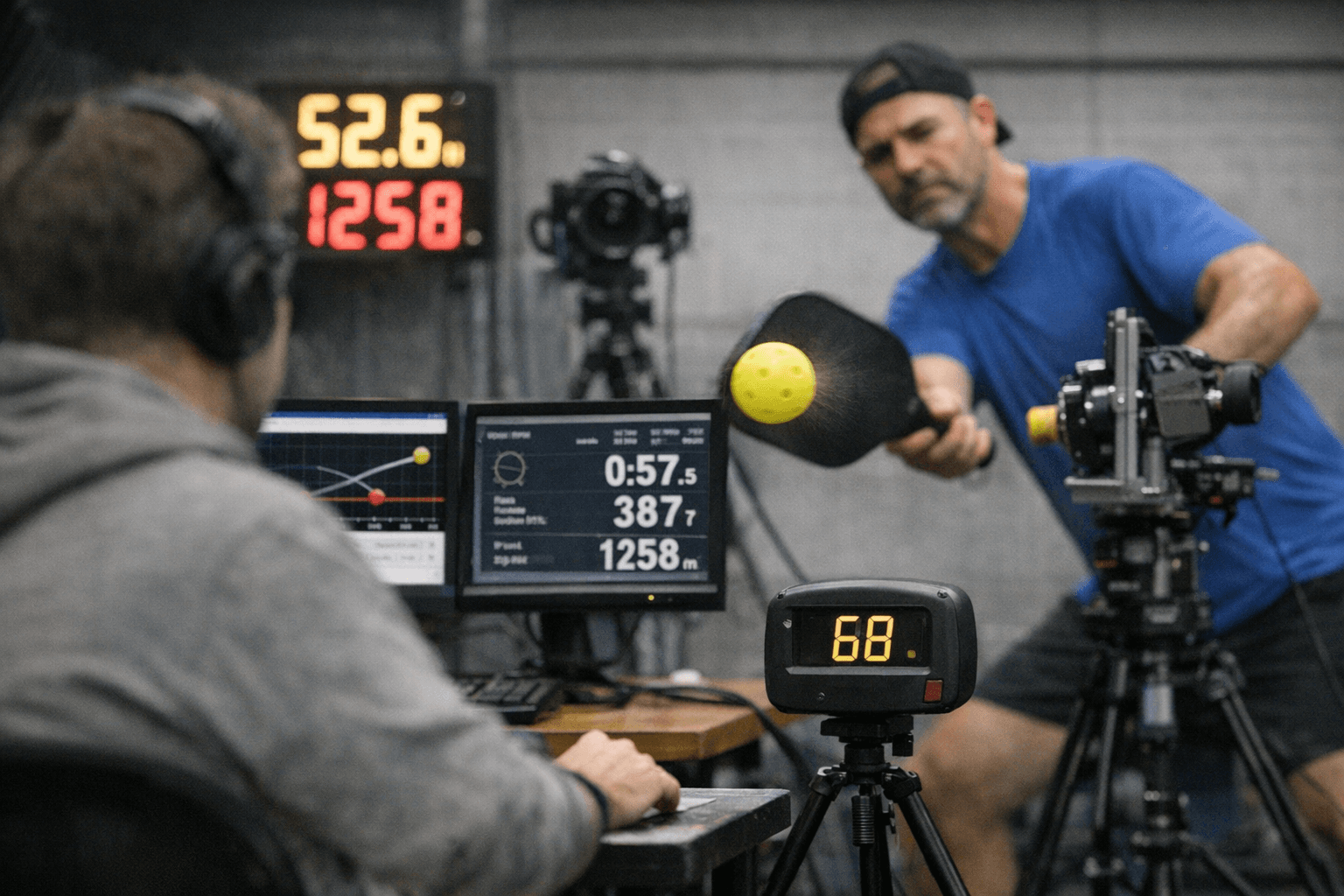
If you want to understand a paddle like a tester, start with ball exit velocity. That is the cleanest way to translate power into something observable: how fast the ball leaves the face after contact. Khoury’s framework points to two basic ways to measure it, a static rebound test and a dynamic live-shot test.
In a static rebound test, a ball is fired at a mounted paddle and a radar gun captures the result. That setup isolates the paddle more than the player, which is useful when you want to compare equipment on more equal footing. In a dynamic test, a player swings and the resulting shot speed is measured in live play, which better reflects how the paddle behaves in real hands, under real timing, with real mechanics.
That distinction matters because a paddle can look lively in a lab and feel different in a match. The best comparison is the one that tells you what kind of speed the paddle produces, how consistently it does it, and whether that speed comes from a face that rewards centered contact or only a perfectly timed swing.
What PBCoR adds to the picture
USA Pickleball’s 2025 Equipment Standards Manual says the rules are intended to ensure consistent performance and fair competition. One of the clearest tools in that effort is PBCoR, the Paddle/Ball Coefficient of Restitution test, which is designed to characterize paddle power by measuring the trampoline response of the paddle-ball collision.
That is an important shift in how the sport talks about power. Instead of relying on broad impressions, PBCoR aims to provide quantitative measures of power, which makes it easier to compare one paddle with another and easier to police claims that sound better than they play. USA Pickleball also said a spin-rate test was underway, and later described the PBCoR launch as part of a broader response to new paddle coatings and the growth of the sport.
Spin is measurable, and so is control
Spin gets marketed as feel, touch, or bite, but the actual number behind the claim is RPM. High-speed cameras can count rotations per minute and turn a fuzzy promise into a concrete readout. If a paddle is advertised as generating more spin, the meaningful question is not whether it sounds aggressive, but how many rotations per minute it creates under controlled testing.
Surface compliance matters here too. USA Pickleball says paddle surface compliance includes surface roughness, coefficient of friction, and coefficient of restitution measurements. Those are not marketing flourishes, they are the properties that help determine whether the face can grip the ball, how much energy it returns, and whether it stays within the boundaries of fair competition.
This is where a paddle’s surface story gets more complicated than the box copy. A rough face can help with spin, but it still has to fit within the standards that govern texture and energy return. The more the sport measures these traits, the harder it becomes for a claim like maximum spin to survive without a number attached.
Stability, swing weight, and forgiveness tell you how a paddle behaves when you miss center
A paddle can be powerful and still be a handful. That is where torque, twist-weight style measurements, swing weight, and forgiveness enter the conversation. Torque and twist weight help show whether a paddle stays square when contact happens off-center, which matters every time a block, counter, or hand battle lands outside the sweet spot.
Swing weight describes how the paddle feels in motion, especially how much effort it takes to accelerate and handle at the net. Forgiveness is the practical result of all that engineering: how much the paddle preserves speed, direction, and control when the ball misses the center of the face. In everyday play, that often matters more than a headline number because it determines whether a paddle saves you on a rushed volley or punishes you for being a few millimeters late.
For buyers, this is the hidden layer of performance. A paddle can promise firepower, but if it twists on contact or feels slow in hand, it may not be the right fit for fast doubles or the kind of all-court play that shows up at retreats and round robins.
Why the material label does not tell the whole story
One of the most useful points in the explainer is that carbon fiber versus fiberglass is not a simple control-versus-power split. That shorthand sells paddles, but it does not explain how they actually play. Core stiffness, face thickness, edge construction, and weight distribution can matter more than the material label on the box.
That is why construction often beats thickness as a predictor of real behavior. A 16mm thermoformed paddle can sometimes outperform a 13mm traditional design on raw ball speed, which is exactly the kind of result that trips up shoppers who assume thinner always means faster or thicker always means softer. The broader lesson is simple: the face material is only one piece of the machine.
If you are comparing models, look past the buzzwords and ask what the construction is doing. A face material may hint at the feel, but the core, edge, and mass distribution decide how the paddle lives in your hand and what happens when the ball gets there.
The rulemakers are moving toward a more quantified game
The standards side of pickleball is catching up to the equipment side. ASTM International launched a pickleball subcommittee in 2024, and its first priorities included test methods for power and spin. ASTM said those methods are being developed because manufacturers’ advances have created challenging test conditions and unintended variation, which is another way of saying the technology moved faster than the testing rules.
That timing matters because the sport is no longer small enough to rely on reputation and anecdote. USA Pickleball’s 2025 standards, ASTM’s work, and the growth in participation all point toward the same future: a game where equipment claims are increasingly expected to survive measurement. In January 2026, USA Pickleball and Pickleball Instruments announced a field-testing program for amateur events beginning with the 2026 Golden Ticket Tournament in Glendale, Arizona, marking the first time lab-style paddle checks were planned for onsite amateur competition.
That is the clearest signal yet that paddle performance is becoming a regulated part of the sport, not just a talking point. For anyone buying gear now, the smart move is to shop like a tester: ask what was measured, how it was measured, and whether the number tells the same story as the feel. The paddles that will matter most are the ones whose performance can stand up in both a warmup and a test fixture.
This article was produced by Prism’s automated news system from verified source data, official records, and press releases, then run through automated quality and moderation checks before publishing. The system is built and supervised by the people who set the standards it runs under. Read our full AI policy.
Did this article answer your question?