Pickleball paddle performance fades long before visible failure, study finds
Most paddles fade before they break. If your spin or control has slipped after 50 to 200 hours, replacement may beat waiting for a crack.
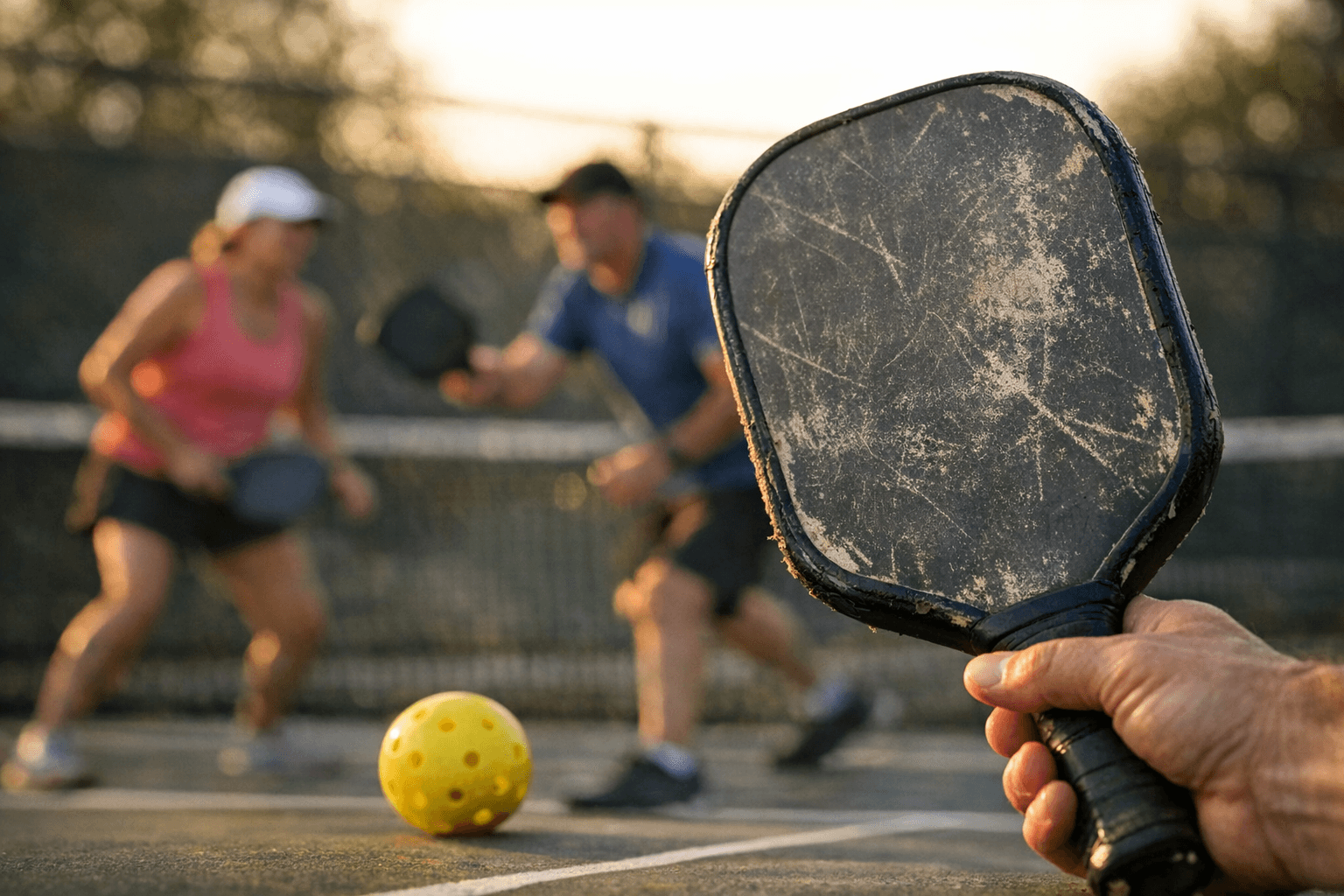
The thing most players miss: paddles usually get worse before they get broken
A paddle does not usually die in one dramatic moment. It fades, and that is the expensive part. The face smooths out, spin drops, the core starts to feel softer, and by the time the paddle looks truly damaged, the performance loss has often been building for weeks or months.
That is why replacement should be a buyer’s decision, not just a repair instinct. If you are trying to decide whether a paddle still deserves a spot in your bag before a retreat, clinic, or tournament, the real question is not whether the frame cracked. It is whether the paddle still plays the way it did when you trusted it most.
What wears out first, and why that matters
The first warning sign is usually surface texture wear. When the face smooths out, spin is the first thing to fall, and that can happen in roughly 50 hours of hard play. For a player who leans on heavy topspin serves, sharp third-shot rolls, or soft resets that need bite, that loss shows up fast even if the paddle still looks fine.
After that comes core compression, which tends to show up in the 100- to 200-hour range, depending on construction and how aggressively the paddle is used. This is where the paddle can start to feel less lively, less predictable, and less consistent from shot to shot. The paddle may still be physically intact while losing the pop and control that made it worth buying in the first place.
That split between structural durability and performance retention is the key to smarter buying. A paddle can survive on the outside and still be washed on the inside. In practical terms, a recreational player might keep one for a year or two, while a competitive player chasing peak performance may turn over paddles every three to six months.
The failure modes that actually end a paddle’s useful life
Not every decline looks the same. Face wear and surface smoothing chip away at spin first. Dead spots from compression usually show up later and can make certain parts of the face feel flat or inconsistent. Adhesive failure, delamination, and cracking are the hard-stop failures that can end a paddle’s life outright.
The terminology matters more than most players realize. People often use delamination as a catch-all for any paddle that feels dead, but manufacturers and reviewers separate core crush, disbonding, and true delamination. That distinction matters because one paddle may be failing structurally while another is simply aging out of peak performance.
For retreat players, this is not an academic argument. If you are stacking court hours across multiple sessions a day, the wear rate moves faster than it does for a weekend player. A paddle that still survives a casual schedule can feel noticeably dulled after a heavy camp week.
Why the standards conversation is changing now
USA Pickleball has pushed the equipment conversation beyond simple approval stickers. Its equipment standards are meant to support consistent performance and fair competition, and the organization says its testing simulates on-field conditions. It also introduced Paddle/Ball Coefficient of Restitution, or PBCoR, in Q4 2024 to measure paddle performance and limit the trampoline effect.
The Jan. 2025 revision of the 2025 Equipment Standards Manual added PBCoR testing and updated coverage for surface finish, gloss, and shiny edge guards. That matters because the industry is no longer treating paddle performance as a vague feel issue. It is moving toward more formal measurement, including more quantifiable spin testing instead of relying only on subjective grit descriptions.
USA Pickleball’s equipment submission FAQ adds another layer: manufacturers must provide attestations about materials and construction in addition to certification testing. In plain English, the game is getting less forgiving of marketing language and more interested in whether the paddle still behaves the same way under real play.
Pickleball.com has also framed durability as a current industry issue, with coverage focused on core crush, paddle testing, and fair play. That is a signal to buyers that the market is shifting, not standing still. If the standards are tightening, the useful life of a paddle is no longer just about how long the shell lasts. It is about how long the paddle keeps meeting the performance bar.
What warranties do and do not tell you
Warranty language can look reassuring, but it does not always match the way players experience wear. Selkirk says its paddles are guaranteed against workmanship and manufacturer defects for the lifetime of the paddle after warranty activation, while its SLK line carries a one-year warranty. Engage says its paddles have lifetime warranty coverage. Maverix says its core warranty lasts one year, while non-core components are covered for six months.
The fine print matters even more than the headline. Maverix says normal core softening, power reduction, and responsiveness changes are considered wear and tear, not defects. That is the most honest part of the warranty conversation, because it reminds you that a paddle can be outside coverage and still be in service, and it can be in service while no longer being at its best.
So when you are weighing replacement, do not ask only whether the warranty still covers the paddle. Ask whether the paddle still earns its place in your tournament bag. Those are different tests, and they produce different answers.
A practical checklist before you leave for a retreat or tournament
Before a big trip, check the paddle the same way you would check shoes before a long run. You want to catch decline before it costs you points.
- Spin is the first tell. If serves, rolls, and resets need more effort to produce the same shape, the face may have smoothed out.
- The paddle feels less lively. If the ball comes off with less pop than it used to, core compression may be creeping in.
- Certain spots feel dead. A paddle that used to respond evenly but now has a flat or inconsistent area has probably started to lose integrity.
- Control gets less trustworthy. If your dinks and blocks start to wander without a technique change, performance retention may be slipping.
- Visible cracks or delamination are final-warning signs. At that point, the paddle has moved from fading to failing.
This is the buyer’s lesson hidden inside the durability debate: replacement is not about waiting for a dramatic break. It is about knowing when the paddle has already drifted far enough from its original behavior that it is costing you points, confidence, and consistency.
For serious retreat play, that is the real math. A paddle that lasts longer on paper is not always the better buy if it stops performing well after 50 hours of hard use. The smart cutoff is not visible failure. It is the moment the paddle no longer gives you the spin, pop, and consistency you paid for.
This article was produced by Prism’s automated news system from verified source data, official records, and press releases, then run through automated quality and moderation checks before publishing. The system is built and supervised by the people who set the standards it runs under. Read our full AI policy.
Did this article answer your question?