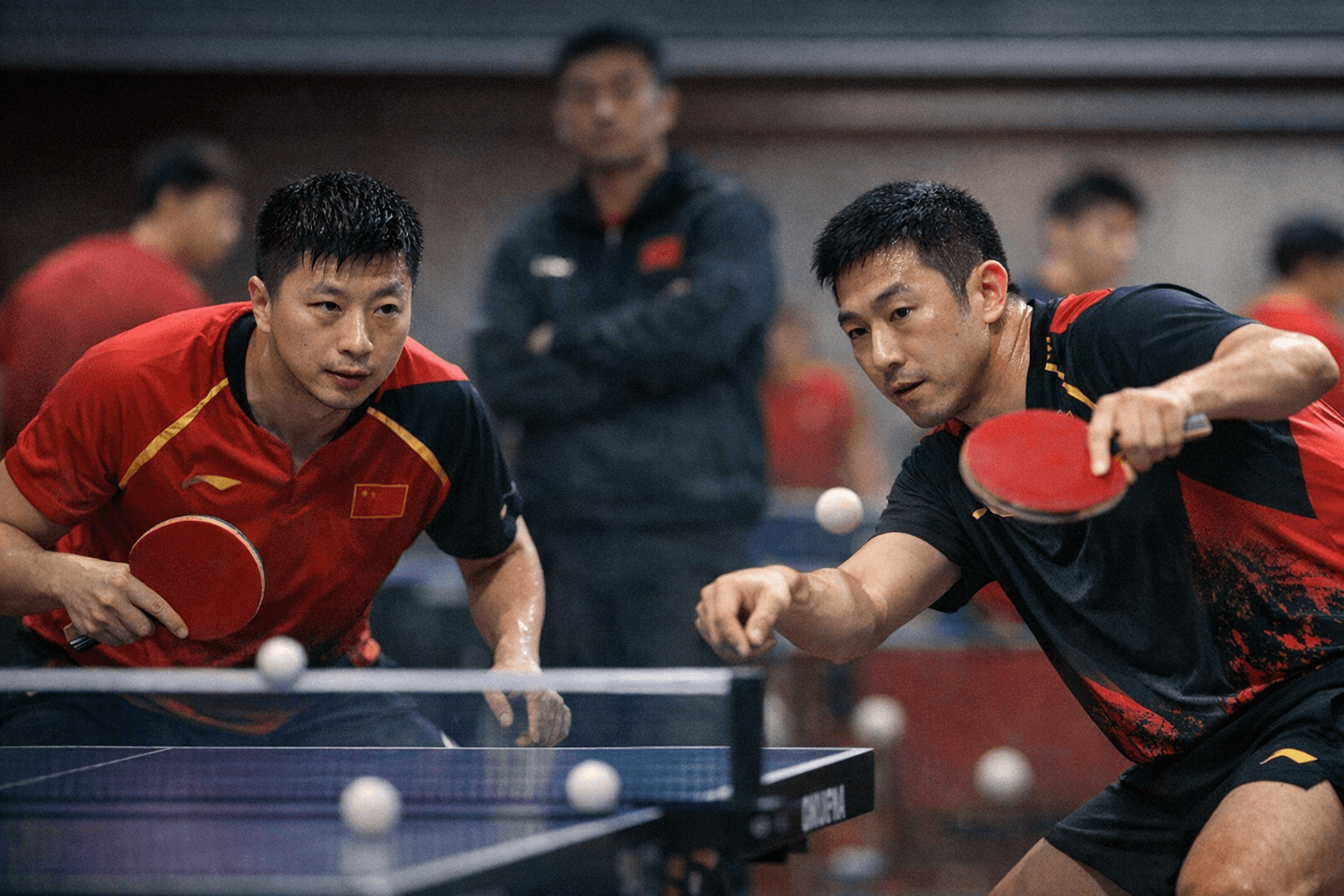
England aim to peak for London 2026, coaches say
England’s coaches want a peaking team, but the real test is whether Sheffield form holds against Japan, France and Germany under home-World pressure.

What “best shape” really means for England
England are talking about peaking at exactly the right moment, but in table tennis that phrase has a much harder meaning than simple fitness. Best shape means the squad can survive a 13-day Worlds, absorb pressure from a home crowd, and still have enough variation in style to bother top seeds who have seen every tactic in the book.
That is the reality check around London 2026. A confident camp is useful, but confidence alone does not win a centenary World Team Championships. England need depth, clean serve-receive patterns, and the kind of match toughness that keeps a young player from leaking points when the score reaches 8-all.
- Fresh legs for a long event
- Enough depth that one flat performance does not sink the team
- Styles that can disrupt elite opposition, not just keep rallies going
- Composure when the arena is loud and the expectation is local
Sheffield is the rehearsal room, not the finish line
John Murphy and Carlo Agnello are supervising the final preparation block at Sheffield’s Elite Training Centre, and the setup says a lot about how seriously this build-up is being handled. Some players have already gone to Czechia for WTT Feeder Havirov, which turns the run-in into a blend of competition, recovery and tuning up rather than a single all-or-nothing camp.
That matters because the final weeks before a Worlds are usually where teams either sharpen their patterns or burn themselves out. England are trying to do the former. The full group is set to come back together in Sheffield with athletes from India, Australia and Spain in the mix, which is exactly the sort of international sparring you want before a home event. Different styles in training are worth more than endless drills against the same ball flight.
Murphy and Agnello are not just chasing a good first session on the table. They are trying to make sure England arrive in London with the right blend of intensity and freshness, because once the match schedule starts, there is very little room for overtraining or hesitation.
London 2026 is a huge stage, and the draw is not soft
The ITTF World Team Table Tennis Championships Finals run from 28 April to 10 May 2026, and this one is not just another major event. London 2026 is the centenary edition, marking 100 years since the first World Table Tennis Championships were staged in England in 1926. The event will bring together 64 men’s teams and 64 women’s teams, 128 in total, across Copper Box Arena and OVO Arena Wembley.
England’s host-nation place in Stage 1A gives them access to the main event, and all Stage 1A teams advance to Stage 2. That does not make the opening rounds easy, it just means seeding becomes the prize. The higher you finish in the group, the better your position for what comes next.
The women’s draw is a proper stress test. England landed in Group 2 with Japan, Germany and France, which is about as far from a soft landing as you can get. Japan are chasing their first women’s team world title since 1971, so England are not just facing quality, they are facing a side that has its own historical edge and its own pressure to break a long title drought.
The men also get no breathing room. England open against Korea Republic in Stage 1A, and that immediately sets the tone for the tournament: this is about readiness, not ceremony. Home advantage only matters if the squad can use it before the match speed takes over.
The women’s group is young on purpose
The women’s line-up tells you a lot about England’s thinking. Table Tennis England named eight players for the home Worlds on 22 March, then later completed the women’s squad with Alyssa Nguyen. The core picture includes Tin-Tin Ho, Jasmin Wong, Tianer Yu and Ella Pashley, with Nguyen adding another teenage option to the mix.
That is not a luxury selection. It is a statement that England want this event to be both a target and a stepping stone. Tianer Yu and Ella Pashley made their major competition debuts at the European Team Qualification Event in January 2025, so London 2026 is part of a fast-moving development path, not a one-off spotlight.
The presence of 14-year-old Alyssa Nguyen sharpens the point. Home Worlds can either overwhelm a young player or accelerate her learning in a way that no training camp can match. For England, the bet is that exposure to this level now will pay off later, even if the immediate results are uneven.
The crowd is the benefit and the burden
Table Tennis England said in March that well over 20,000 tickets had already been sold, and that is the sort of number that changes the temperature of a tournament before the first serve. The two London venues will bring scale, noise and expectation, which is exactly what a host nation wants and exactly what a fragile squad can struggle with.
This is where “best shape” becomes mental, not just physical. The home crowd can lift a player through a tight third game, but it can also make every wobble feel louder. England’s challenge is to treat the atmosphere as fuel rather than a scoreboard running in the background.
The upside is obvious: shared sparring, a familiar base in Sheffield, and a squad that can train inside the same kind of attention it will face in London. The downside is just as clear: if the early results dip, the pressure will arrive fast, because the venues, the ticket sales and the centenary label will not let the event feel ordinary.
How to judge whether England are really building toward a breakthrough
The useful lens here is not whether England look upbeat in training. It is whether they have enough table-tennis substance to turn that mood into points against elite opposition. Watch for three things when the matches begin:
- Whether the serve and receive game is clean under pressure
- Whether England can rotate players and styles without losing rhythm
- Whether the younger names hold their level when the crowd and the scoreline both get loud
If England can do those things, the talk about peaking will feel earned. If not, the home Worlds will still be a massive moment, but mostly as a confidence boost rather than proof of a genuine leap. In table tennis, the truth usually shows up fastest in the first few returns.
Know something we missed? Have a correction or additional information?
Submit a Tip