MLTT Championship Weekend preview, four teams chase title in single-elimination sprint
MLTT’s title weekend is a pressure test: one Golden Game can erase a season, and Carolina’s balance may be the hardest build to knock out.
MLTT’s playoff format strips away comfort
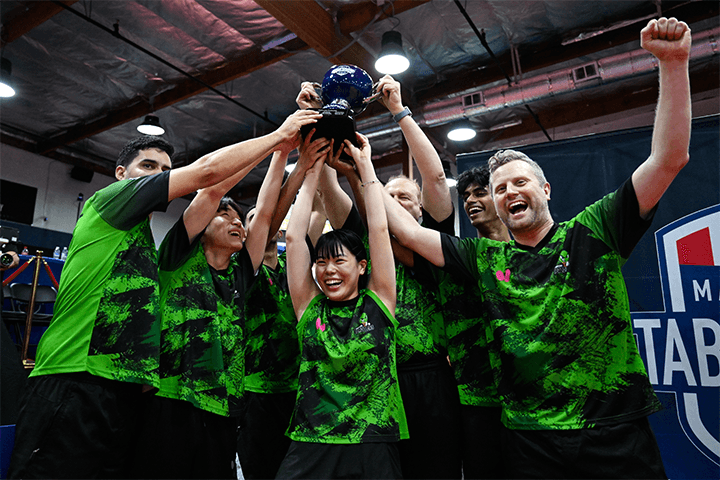
Championship Weekend is where Major League Table Tennis stops looking like a long season and starts looking like a knife fight. The semifinals hit on Saturday, April 18, with the 3rd Place Match at 1:00 PM PT and the final at 4:30 PM PT on Sunday, April 19, and the whole thing ends with one team lifting the trophy.
That is why this bracket matters so much to ping pong culture. MLTT launched in 2023, which makes this its third Championship Weekend by 2026, and the format keeps proving the same point: no lead is safe, the Golden Game can flip conventional match logic, and the finals do not use a five-point cap on carryover lead. In other words, one clean weekend is worth more than a season’s worth of nice-looking numbers.
Carolina Gold Rush look like the cleanest weekend build
If you want the team most comfortable with chaos, Carolina is the safest answer. The Gold Rush are the defending 2024-25 Season Champs, and their case is built on balance from top to bottom, not just one headline name. Enzo Angles and Chen Sun are both MVP winners, Sun has been the league’s best Singles 2 player this season, and Angles and Kai Zhang form one of the strongest doubles pairings in the league.
That combination matters in a single-elimination sprint because Carolina can score in more than one lane. Chen Sun, Eugene Wang, and Angles give them lineup anchors who can produce points in both singles and doubles, which is exactly what you want when one ugly stretch can wreck a bracket. A team like Carolina does not need every table to break its way, and in MLTT that kind of roster insulation is gold.
Princeton’s title path runs through elite top-end production
Princeton Revolution enters with a different kind of weapon. The Power Rankings point to Cho Seungmin as the top individual player in the field, and Benedek Olah gives the Revolution experience, composure, and a steadying hand when the points get tight. That is a dangerous combo in a playoff where one player can swing the entire feel of a tie.
Princeton’s problem is not star power. It is whether the rest of the lineup can stay close enough to let Cho do what he does best, which is tilt a match almost by himself. In a full season, that kind of top-end punch can keep you in the conversation. Over one weekend, it can absolutely carry a team, but it also leaves very little margin if the other tables go cold.
Chicago’s edge is that they can start fast and stay ugly
Chicago Wind may have the clearest semifinal identity in the field. Robert Gardos, Emmanuel Lebesson, and Jeongwoo Park form one of the strongest three-player cores in the competition, and that gives the Wind a real shot to control a match before the pressure pushes it into the Golden Game territory. They do not need perfection; they need early control.
The other thing Chicago has is recent proof against Carolina. The Wind beat the Gold Rush 18-3 on October 3, 2025, and 15-6 on February 1, 2026, which means they have already shown they can break Carolina’s rhythm. That does not guarantee anything in a playoff, but it does tell you Chicago is not walking in scared. If the Wind can make Carolina chase from the start, they become the kind of opponent nobody wants in a single-elimination bracket.
Portland is the dangerous underdog because it can change shape
Portland Paddlers is the weirdest team left, and that can be an advantage. The Paddlers finished the regular season 16-2 with 260 points, the best record in the league, but they also had to manage a shorthanded roster and lean on flexibility to get here. Jens Lundqvist, Nikhil Kumar, Sid Naresh, and free-agent help give them enough pieces to shuffle pairings and survive awkward spots.
That matters more in MLTT than in a lot of team formats because tactical courage is rewarded. Portland can hide a weakness, adjust a lineup, or ride a hot hand without needing the same script every night. If a team is built to survive one bad table and still hang around long enough to reach the Golden Game, this is it. Portland’s first-ever Championship Weekend appearance also gives it the emotional edge that often shows up in knockout play, where nothing feels routine and every point feels personal.
The title likely swings on Carolina’s doubles table against Chicago
The matchup that should decide whether the bracket behaves or blows up is Carolina vs. Chicago. Carolina’s best route is to let its balance show early, especially through Angles and Kai Zhang in doubles and Sun in Singles 2, because that is where the Gold Rush can turn a tense tie into a manageable one. Chicago’s route is simpler and more brutal: bank points with that three-player core and force Carolina into a chase.
That is the one lineup decision worth circling. If Carolina protects its doubles strength and gets steady production from the middle of the order, it can survive almost anything. If Chicago keeps the match close enough to drag it into a late Golden Game, the Wind’s recent success against the Gold Rush starts to feel very real. In MLTT, that is the difference between looking like the best team and actually becoming the champion.
This is why Championship Weekend feels less like a standard club tie and more like chess with a speed clock. Portland has the record, Princeton has the star, Chicago has the punch, and Carolina has the most complete roster. On a weekend where one mistake can end a season, the team that can win in more than one way usually gets to keep playing when the rest are packing up.
Know something we missed? Have a correction or additional information?
Submit a Tip