Sony AI’s Ace robot defeats elite ping pong players in breakthrough test
Sony AI’s Ace did more than rally, it beat elite human players under ITTF rules. The breakthrough points to a new kind of training partner for high-speed, high-spin table tennis.
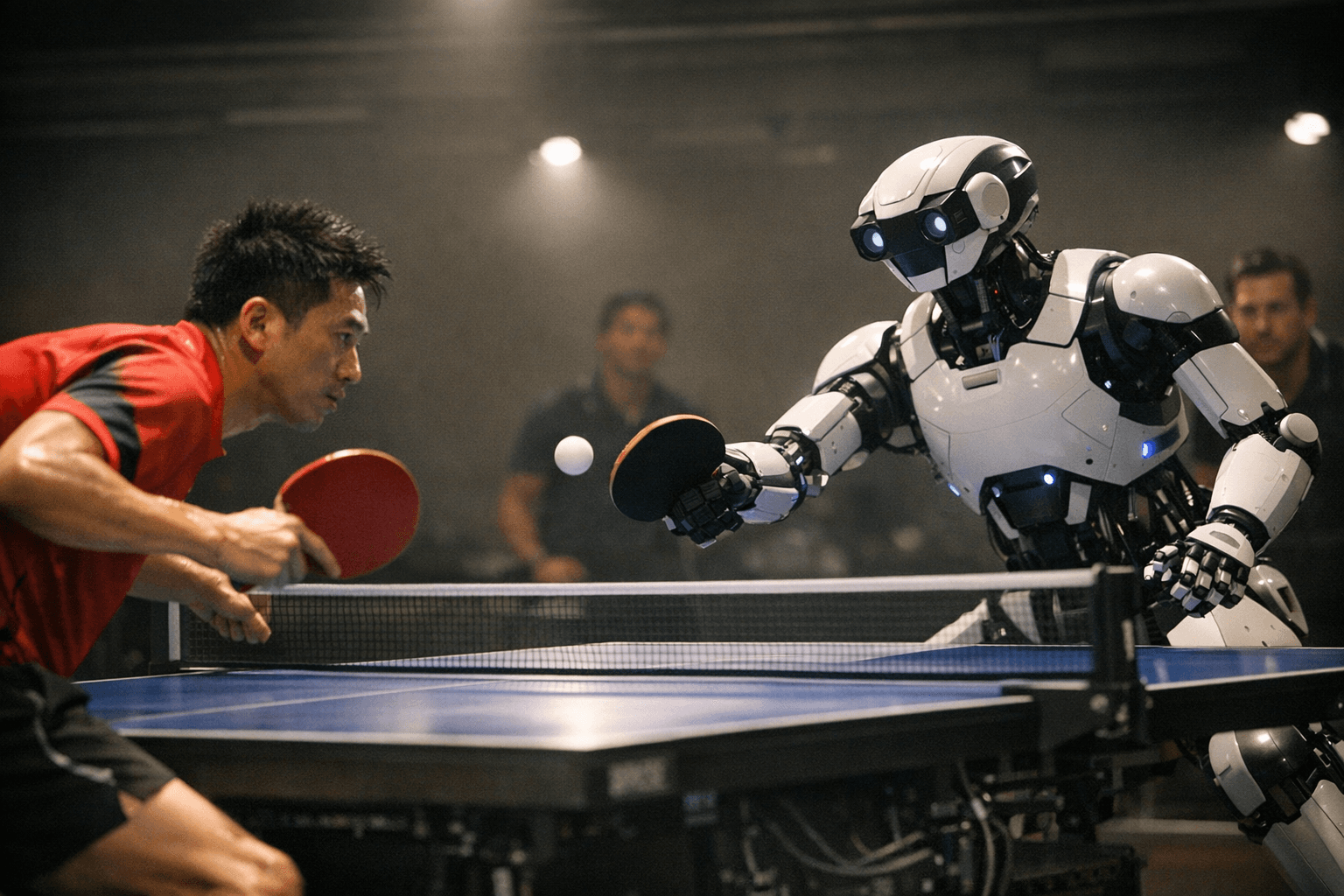
If a robot can now rally with and beat elite table tennis players, the big question is no longer whether the machine can keep up. It is what that means for coaching, sparring and player development when the first real-world autonomous system competitive with elite human players is already returning the kind of pace and spin top players see across the net every day.
Sony AI’s Ace reached that line in a study published in Nature on April 22, 2026. The paper, Outplaying elite table tennis players with an autonomous robot, says the system combined event-based vision sensors with model-free reinforcement learning and produced several victories while also consistently returning high-speed, high-spin shots. Nature said the game’s demands are brutal: balls can exceed 20 m/s and the gap between shots is often less than 0.5 seconds.
The evaluation took place in April 2025 against five elite players and two professional players under official ITTF rules. Sony AI said licensed umpires from the Japan Table Tennis Association refereed the matches, and the company built an Olympic-sized table tennis court at its Tokyo headquarters for the tests. That setup matters. This was not a lab toy flipping balls back in a controlled demo, but a full-speed comparison against players with more than 10 years of experience.
Ace’s hardware is built for the pace. AP reported that the robot has nine camera eyes around the court and an eight-jointed arm with the degrees of freedom needed to track the ball, read its logo to estimate spin and move the racket fast enough to answer back. Sony AI said the project extends the company’s earlier superhuman racing agent, Gran Turismo Sophy, into the physical world, where sensing and control have to work in real time against unpredictable human opponents.
The deeper story for the sport is that Sony AI is treating table tennis as a proving ground for robotics beyond games. The company said more than 40 years of work led here, starting with the first robot ping-pong prototypes in 1983, after hundreds of designs failed to match human reflexes, precision and adaptability. Sony AI and Nature both frame Ace as a milestone for fast physical interaction, with possible applications in manufacturing and service robotics. For table tennis, though, the immediate impact is sharper: elite-level robot sparring is no longer science fiction, and the training partner of the future may finally be able to handle the speed, spin and chaos of the modern game.
Know something we missed? Have a correction or additional information?
Submit a Tip