Teen Lowri Hurd Wins Double Gold on International Para Table Tennis Debut
Lowri Hurd, 18, claimed two golds and a bronze on her international para table tennis debut in Spain, partnering a fellow first-timer to beat the European silver medallists for women's doubles gold.

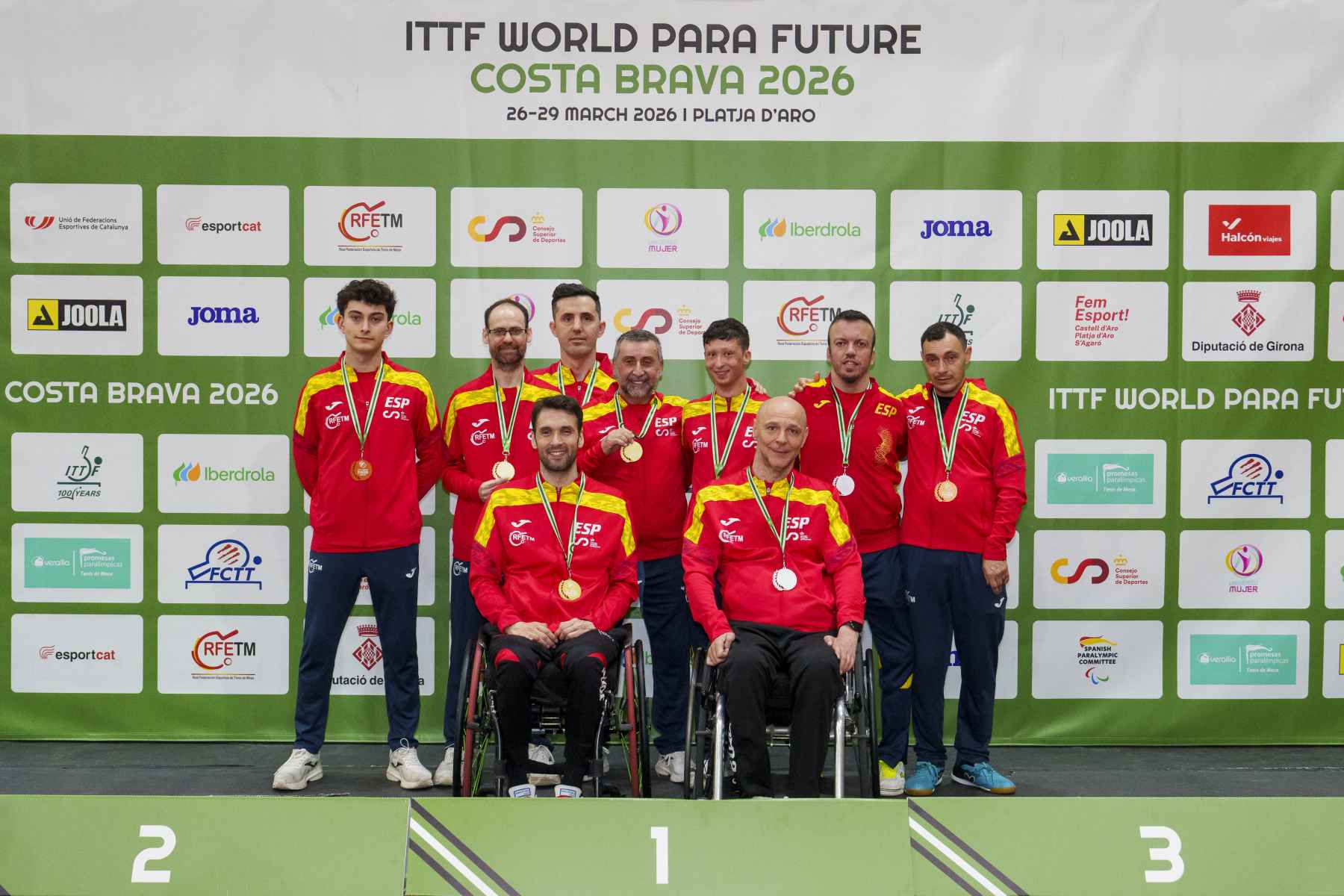
Lowri Hurd arrived at the ITTF World Para Future Costa Brava in Platja d'Aro, Spain with no international caps and left with two gold medals and a bronze, completing what has to rank as one of the most complete debut performances the Great Britain para table tennis programme has produced in recent memory.
The Grantham College student won gold in the women's class 20 doubles alongside 15-year-old Victoria Sorribes Barba of Spain, gold in the mixed class 20 doubles with Max Flint, and bronze in the women's class 9-10 singles. Three events entered, three podiums, on a single international debut.
"It's great to get two gold medals at my first tournament and something I did not expect," Hurd said. "It's just super nice to really get stuck into competing in the Para world."
Hurd trains at Grantham College's Table Tennis Academy in Lincolnshire, one of Britain's longest-running player development centres. Launched in 2002 as the first academy of its kind in the UK, it has produced more than 20 England internationals and eight GB internationals. That environment evidently prepared her for the deep end: in the women's doubles opener, she and Sorribes Barba, who was also on her international debut, were drawn against European silver medallists Alexa Szvitacs and Zsofia Arloy from Hungary. The pair dropped the second set 17-15 and found themselves 2-0 down before fighting back to level at 2-2, taking the deciding set 11-8 for a 3-2 win. They carried momentum through the group and knockout stages to claim gold in the final.
"It was an amazing feeling to beat the European silver medallists twice and the partnership with Victoria gelled very quickly," Hurd said.
Two debutants defeating the European silver medallists on their very first outing together is the kind of scoreline that shifts a coaching programme's conversation from age to ceiling.
The mixed doubles run with Flint, 21, from Guildford, required persistent nerve across several matches. After a straight-sets opening win against Jacob Boulay and Thulir Hector of Canada, Hurd and Flint dropped the first set against Kazakhstan's top seeds Marat Surtubayev and Altynay Yerzhankyzy before recovering to win 3-1. Their decisive final round-robin match pitted them against Hu Runtao and Huo Xinran, the No.1 pair from China, who took the first set before Flint and Hurd won the next three to claim gold 3-1.
"Max and I played very well for our first time together and we clicked very well," Hurd said. "Our games worked well together, and it was a nice feeling to end on a gold with a GB teammate."
Flint pointed to the tactical mindset that carried them through: "Going in with no expectations as it was our first time playing together, focusing on playing free and not worrying too much about the outcome. Playing against China was a really good experience."
Hurd's triple podium adds to a strong British performance across the event, which included Tom Matthews' gold in the men's class 1 singles. Table Tennis England describes Hurd's results as positioning her as a player to watch as she moves from national prospect to dependable international performer.

Para classifications: what they mean for your game
Para table tennis divides competitors into three broad bands, each of which shapes how the game is actually played at the table.
Classes 1 to 5 are wheelchair events. Class 1 covers athletes with the most limited trunk and arm function, sharply restricting lateral reach; class 5 players have greater trunk mobility and can cover more of the table. Against a class 1 player, wide cross-table angles and spin-heavy serves are far more effective than they would be against a standing opponent, because the recovery range is physically constrained. The closer a player is to class 5, the more you need to use the full table rather than relying on width alone.
Classes 6 to 10 are standing events for players with physical impairments affecting the legs, arms, or both. Class 6 involves the most significant functional limitation; class 10, where Flint competes, is the closest to open competition. Foot speed and balance vary substantially across this range, making deep placement to the crossover point and high-spin short serves standard tactical tools: they demand movement or precision that a player with limited footwork may struggle to produce under pressure.
Class 20, previously designated class 11 under earlier ITTF classification rules, is for athletes with intellectual impairments. Play in this category looks closest to non-disabled table tennis in terms of movement and stroke production, but effective tactics centre on consistency, disrupting established rally patterns, and applying pressure that tests decision-making over sustained exchanges. Hurd holds classifications in both the 9-10 range and class 20, which is why she was able to compete in three different events at Costa Brava.
Supporting para table tennis near you
If Hurd's debut medals have made you curious about getting involved, the entry points are more accessible than they might appear.
Table Tennis England coordinates the club pathway that feeds into the national development programme Hurd came through; their club finder lists para-friendly sessions by area and is the most direct route to finding local play. British Para Table Tennis manages the national squad programme and publishes details of regional training opportunities alongside information about classification assessments, the formal process through which athletes are assigned a playing class based on their functional ability at the table.
Most affiliated clubs welcome new participants, volunteer table time, and players willing to serve as practice partners for para athletes. Attending local para competition days, many of which are free for spectators, is one of the most practical ways to support the competitive infrastructure that turns a Grantham College student into a double international gold medallist.
Know something we missed? Have a correction or additional information?
Submit a Tip