New FFT-powered audiovisual demos run natively on Sega Dreamcast
A new Dreamcast homebrew project turns live FFT data into terrain demos on native hardware, built with raylib, GLdc, and sh4zam’s shz_fft().
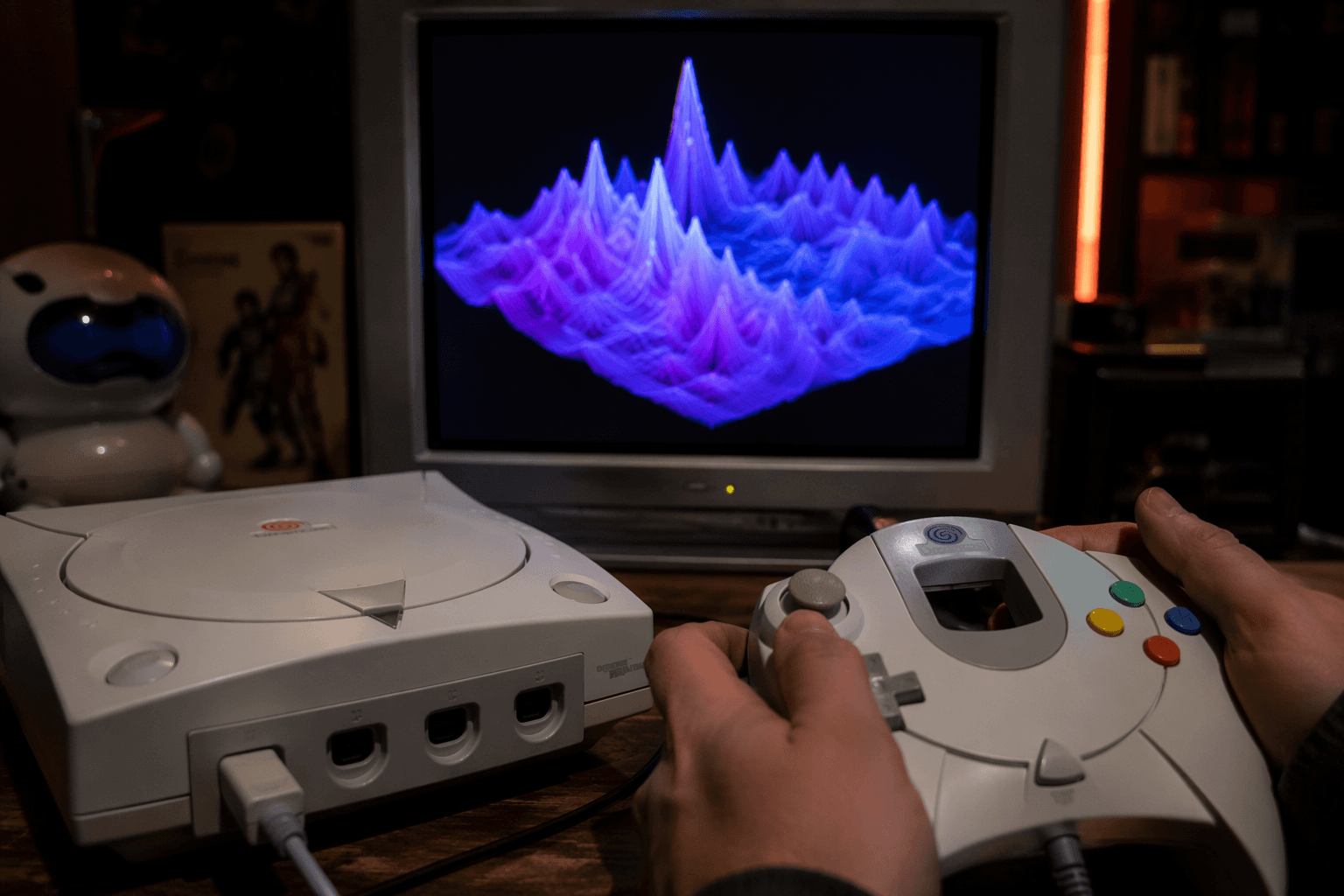
meisei4’s fffftt brought real-time FFT audiovisual demos to native Sega Dreamcast hardware, using fixed-function graphics and live audio analysis instead of pre-rendered effects. The project’s name expands to fixed function and fast Fourier transform testing, and its own description frames it as an audio-geometry exhibit for fixed-function graphics signal visualization.
That setup matters because the demos are not just decorative. fffftt includes FFT bands terrain, waveform terrain, and FFT terrain, then layers in chroma, onset strength, spectral flatness, Hilbert envelope, and RMS to drive the visuals. The project also converts Shadertoy media into ADPCM WAVs for Dreamcast use, with controls for cycling tracks, pausing, seeking, resuming, and moving the light source. On original hardware, that is a direct proof that the console can still handle interactive, audio-reactive scene logic rather than simple playback.
The build sits on a contemporary Dreamcast toolchain: raylib, OpenGL 1.1 fixed-function rendering, GLdc, and sh4zam’s shz_fft(). The repository shows 87 commits and names components for GLdc, mathworks, raylib_dc, and sh4zam, which makes it look less like a one-off proof and more like a coordinated stack test. GLdc is an actively developed Dreamcast OpenGL implementation that aims at most of OpenGL 1.2, while raylib4Dreamcast is a separate raylib port for the console. GLdc was publicly announced on Dreamcast-Talk in September 2018 as a new OpenGL 1.1+ implementation, and it began as a fork of libGL before being refactored further.
That lineage is the real story behind the visuals. fffftt shows that Dreamcast homebrew in 2026 is no longer limited to small fixed demos or nostalgia projects. It can combine modern scene-building habits from Shadertoy-style work, real-time DSP, and native fixed-function rendering in a way that stretches the SH-4-era platform without leaving it behind.
The same kind of workload also gives emulation and development testing more teeth. Libretro’s Dreamcast documentation still points to Dreamcast and NAOMI development workflows in Flycast, so a fast-moving audio-graphics stress test like fffftt is useful both as a showcase and as a practical benchmark. On a console that launched in 1998, the fact that live FFT terrain still runs natively says the ceiling has not settled yet.
This article was produced by Prism’s automated news system from verified source data, official records, and press releases, then run through automated quality and moderation checks before publishing. The system is built and supervised by the people who set the standards it runs under. Read our full AI policy.
Did this article answer your question?