Verified ROMs, Clean Metadata, and Checksums Build Lasting Game Archives
A disorganized ROM dump is just data; a verified, checksummed archive with clean metadata is a preservation artifact that survives emulator migrations and hardware generations.
Building a ROM collection that actually lasts requires more than filling a hard drive. The difference between a dump that's playable in five years and one that's become unverifiable noise almost always comes down to three things: consistent naming, cryptographic proof of integrity, and documented provenance. Projects like the Internet Archive's emulation initiatives and community-maintained BIOS packs on GitHub prove that reproducible packaging isn't perfectionism — it's the foundation everything else rests on.
Canonical Filenames and Directory Structure
Before touching a checksum tool or a metadata editor, establish a naming schema and commit to it across every file in the collection. A widely adopted pattern looks like this: `<system>/<releaseID> - <Title> (<region>) [<media>].ext`. The structure is predictable enough that automated tools — scrubbers, database matchers, ROM managers, even simple Python scripts or rsync jobs — can parse and enforce it without manual intervention.
Consistency here isn't cosmetic. When a collection grows to thousands of titles across dozens of systems, a uniform schema is what separates a searchable archive from a pile of files. It also eliminates the duplicate-detection problem that plagues collections assembled from multiple sources over many years. Settle on the schema early, apply it with tooling rather than by hand, and every subsequent workflow becomes dramatically faster.
Cryptographic Checksums: The Integrity Backbone
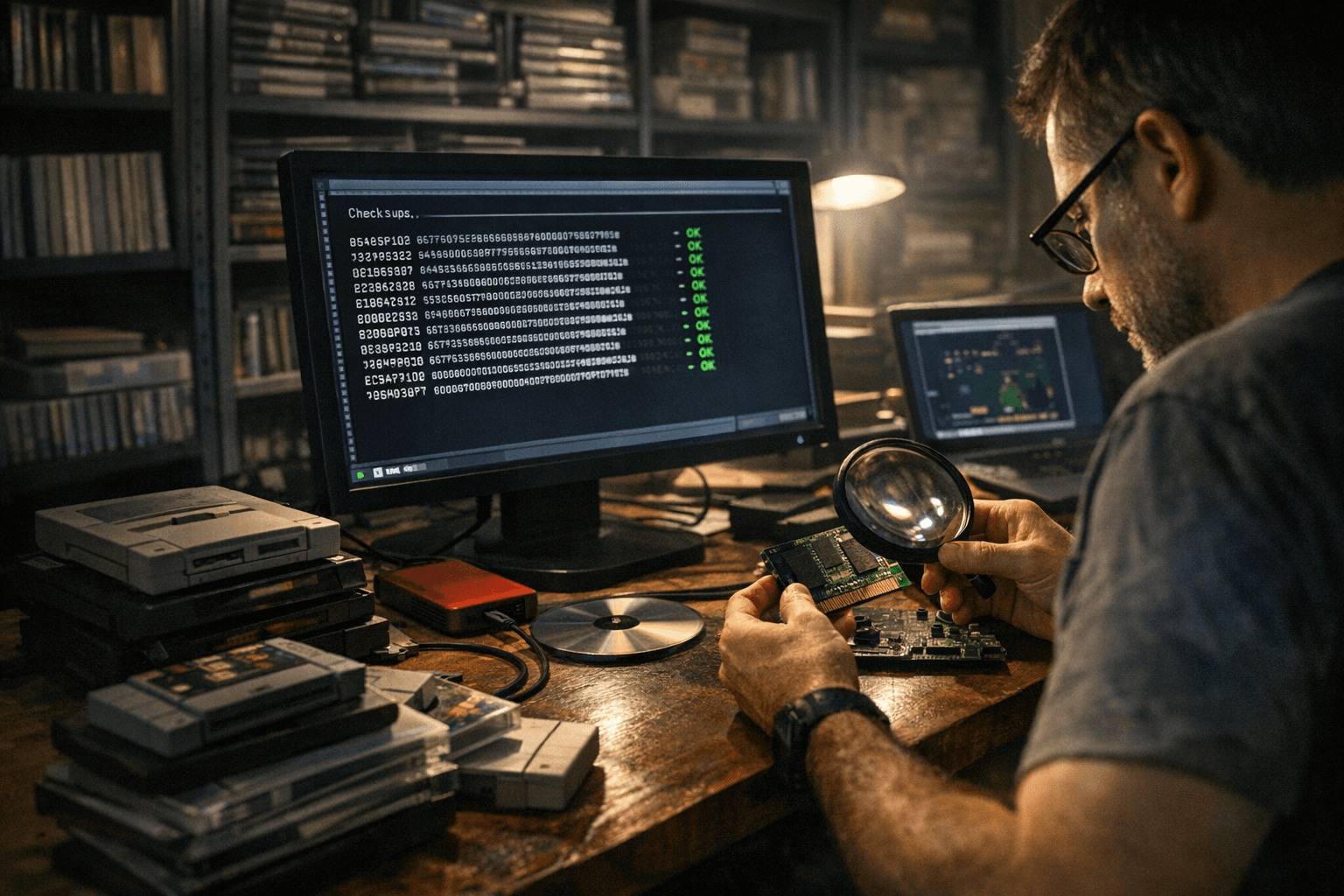
Every archive in a serious collection needs a SHA-256 manifest. SHA-1 remains acceptable where backward compatibility with older databases is necessary, but SHA-256 is the current standard for new work. The manifest file should be immutable, stored alongside the archive it describes, and — if the collection will be shared or mirrored — cryptographically signed.
The practical payoff is bitrot detection. Storage media degrades, files get accidentally modified during migrations, and mirrors introduce silent corruption more often than most people expect. A manifest-driven verification pass, run periodically, catches all of it. Many public mirror hosts already depend on SHA-256 manifests as their baseline trust mechanism, which means a well-maintained manifest also makes your archive immediately legible to collaborators who've never seen it before.
BIOS and Firmware: A Separate, Verified Asset
BIOS and firmware files are not ROMs, and treating them as such creates provenance headaches that compound over time. Keep a dedicated, versioned BIOS pack with its own manifest and a clear index that maps each BIOS image to the system and core that expects it. The Abdess/retrobios project on GitHub is a practical model: a curated BIOS collection structured for cross-frontend compatibility, where every image is accounted for and traceable.
Never bundle BIOS files with game ROMs in a way that obscures where each component came from. If a BIOS image is later found to be incorrect or from an unexpected revision, you need to be able to swap it cleanly without disturbing the rest of the archive. Versioned BIOS packs with their own manifests make that replacement straightforward rather than forensic.
Recording Provenance Metadata
For each archived item, capture four things at minimum: origin (where the dump came from), dump method, date, and any verification checks performed (hashes, test results). Store this as machine-readable JSON or YAML alongside the media file, not in a separate spreadsheet that will inevitably fall out of sync.
This metadata serves two distinct audiences. For legal and ethical risk assessment, provenance records clarify what you have and where it came from. For future archival work, they tell the next person, or the next emulator developer, exactly what they're working with. The Internet Archive's emulation programs have demonstrated repeatedly that well-documented collections become reusable building blocks; undocumented ones become research problems.
Formats and Containers Built for Longevity
Format choices made today determine what's recoverable in a decade. For optical disc images, `.bin/.cue` pairs remain a widely supported, lossless option. For long-term storage where bandwidth allows, uncompressed formats or archival `.7z` compression preserve fidelity without introducing format-specific dependencies that might not survive software ecosystems changing.
For disc-based systems, preserve sector-level image formats that include subchannel data and TOC information where relevant, not just the data track. Keep the original raw dump even if you also maintain a working copy optimized for day-to-day emulation. The two-copy strategy, one archival and one operational, means future format migrations don't require re-dumping hardware you may no longer have access to.
Automated Verification and Mirror Strategy
Manual verification doesn't scale. Set up periodic cron jobs or CI-style automation to re-verify manifests against stored archives, alert on hash mismatches, and replicate confirmed-good copies to geographically separate mirrors. Geographic distribution isn't paranoia: it's the only practical defense against localized data loss events, whether that's a failed drive, a flooded basement, or a hosting service going dark.
For larger volunteer-run projects, include fetch-throttling scripts in the toolkit so that contributors pulling from public hosts don't inadvertently generate traffic that looks like a denial-of-service attack. Resumable download support matters too; a partial transfer that can't be resumed is often abandoned, which defeats the mirroring strategy entirely.
Legal and Ethical Sharing: Documentation as Protection
A well-maintained archive without a clear access policy is an incomplete archive. Document what the collection contains, who may access it, and how to request access. For anything intended to be public-facing, metadata-rich catalogs and browser-based emulation exhibits (where licensing permits) are substantially safer territory than wholesale redistribution of copyrighted material.
Platform policies and local laws vary, and no single policy covers every situation; the practical floor is having a written policy at all. An archive with explicit, documented rules about access and redistribution is far easier to defend, donate to an institution, or transfer to a successor than one operating purely on informal understanding.
Why the Discipline Compounds
Each of these practices is individually valuable. Together, they create something more: an archive that future verifiers can audit, researchers can cite, emulator developers can test against, and institutions can actually accept. Community-maintained BIOS packs and manifest-driven ROM collections on GitHub already demonstrate that this level of rigor is achievable at volunteer scale. The upfront investment in structure and documentation is paid back every time the collection survives a migration, a hardware failure, or a transition to an emulator that didn't exist when the archive was first assembled. For anyone serious about preservation, that compounding return is the whole point.
This article was produced by Prism’s automated news system from verified source data, official records, and press releases, then run through automated quality and moderation checks before publishing. The system is built and supervised by the people who set the standards it runs under. Read our full AI policy.
Did this article answer your question?