Akmon uses Rust to build a 3.4 MB autonomous coding agent
Akmon’s 3.4 MB Rust binary shows how to ship an autonomous agent that works on a MacBook, over SSH, in CI, and offline.
Why the single-binary choice matters
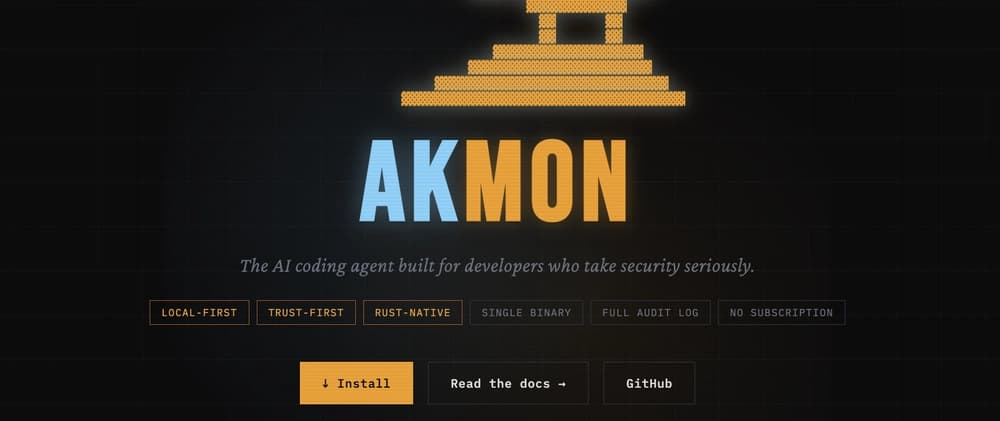
Akmon’s biggest lesson is also its most practical one: if your agent is meant to run anywhere a developer works, the packaging has to be boring in the best possible way. A single Rust binary gives the same behavior on a MacBook, a Linux server reached over SSH, a Docker container in CI, and even in air-gapped environments with no internet access. That portability is not just convenience. For an autonomous coding agent, it is part of the product, because every extra runtime or dependency becomes another place for the tool to fail before it ever gets to a prompt.

Rust makes that portability realistic because it can produce static, size-optimized executables without a managed runtime in the middle. Akmon leans on LTO and stripping to get the binary down to 3.4 MB, which is small enough to ship casually but still capable of handling a full agent workflow. If you are building your own agent today, that is the first architectural decision worth copying: optimize for the moment someone wants to drop the tool onto a machine and trust it immediately.
Keep the agent’s moving parts in separate crates
The second decision is less visible from the outside and more important once the agent grows teeth. An autonomous session has a lot happening at once: streaming completions arrive from an HTTP API, conversation history keeps expanding, permission prompts interrupt execution, and the terminal UI needs to stay responsive while all of that is in flight. Akmon answers that complexity by splitting the workspace into focused crates instead of letting one giant application absorb everything.
The structure is intentionally narrow. `akmon-cli` handles the binary entry point. `akmon-core` owns permissions and sandboxing. `akmon-config` deals with configuration. `akmon-models` wraps provider implementations. `akmon-tools` executes tools. `akmon-query` runs the agent loop. `akmon-tui` powers the terminal interface. `akmon-index` adds optional semantic search. That separation does more than make the codebase easier to read. It lets the compiler enforce boundaries, so architectural mistakes fail at build time instead of surfacing later as runtime surprises.
For anyone building an autonomous agent in Rust, this is the pattern to copy without hesitation. Keep the loop, the UI, the tool runner, the model provider layer, and the sandboxing concerns apart. The tradeoff is a little more crate choreography up front. The payoff is that the system stays legible when the number of moving parts doubles.
Abstract the model providers early
Akmon’s provider layer is another place where the design pays off by refusing to care too much about vendor differences. Through a single trait, it can talk to Anthropic, OpenAI, OpenRouter, Groq, Azure, Bedrock, Ollama, and other OpenAI-compatible endpoints without forcing the rest of the agent to know which backend is active. That is the kind of abstraction that looks obvious only after you have felt the pain of hard-coding a provider into the rest of the stack.
The real benefit is not just swapping endpoints. It is keeping the agent loop focused on agent behavior instead of API trivia. Once the provider layer speaks one interface, the rest of the system can treat streaming completions as a capability rather than a brand-specific special case. That matters when the agent is supposed to make decisions in real time and not become a tangle of conditional logic.
There is a tradeoff here too. A provider abstraction can hide useful differences between vendors, and sometimes those differences matter for performance, model behavior, or tool-call formatting. But Akmon’s approach suggests the right default: start with one trait and make provider-specific complexity live behind it. If you need a special-case path later, add it deliberately instead of letting provider quirks leak into every subsystem from day one.
Design the agent loop around interruption, not just generation
The agent loop is where the project stops looking like a CLI wrapper and starts behaving like an autonomous system. Akmon’s workflow has to juggle model output, tool execution, user permissions, and the live terminal surface all at once. That is why the article treats ownership and async not as language features to admire, but as the machinery that keeps the loop from collapsing under its own state.
This is the main place where Rust’s model matters in practice. Ownership gives the author a way to keep conversation history, prompt state, permission state, and tool results from bleeding together. Async makes it possible to stream completions while the interface remains interactive. The result is an agent that can feel responsive without turning into a race-condition factory.
If you are copying this pattern, the key move is to assume interruption is normal. The user may need to approve a command. The tool may need to wait on an external API. The conversation may need to grow while the UI keeps rendering. Building around those interruptions, instead of treating them as edge cases, is what makes the whole system workable.
Treat semantic search as an optional module, not a core dependency
Akmon’s `akmon-index` crate is a useful reminder that not every capability deserves to sit on the critical path. Semantic search is present, but optional, which is exactly the kind of decision that keeps a single-binary agent from becoming bloated or brittle. If the core loop can function without it, then the agent still ships cleanly and remains useful in constrained environments.
That modularity matters because autonomous coding agents accumulate features quickly. Search, retrieval, tool execution, configuration, permissions, and terminal presentation can all become reasons the system is harder to install or harder to reason about. By isolating semantic search, Akmon leaves room for a more capable workflow without making the entire agent depend on a feature that not every user will need.
The lesson for builders is simple: make the agent’s essential loop tiny, then layer optional intelligence on top. That preserves the portability that makes a 3.4 MB binary feel remarkable instead of fragile.
What to copy, avoid, and simplify
The blueprint Akmon offers is not “write more Rust” for its own sake. It is a practical stack of choices that reinforce one another. The single binary gives you portability. The crate layout keeps the system honest. The provider trait prevents backend lock-in from infecting the rest of the code. The async agent loop keeps streaming, permissions, and UI responsiveness in the same room without letting them trip over each other.
If you want to build an autonomous agent in Rust today, copy the parts that reduce surprise. Avoid letting provider specifics leak into core logic. Avoid a monolith that mixes UI, sandboxing, and model calls in one crate. And simplify aggressively wherever a feature is optional, because a tool that can run on a developer laptop, over SSH, in CI, and offline has already won a major fight before the first token is streamed.
That is the real value of Akmon’s design: it shows that an autonomous agent does not have to be heavy to be serious. In Rust, bounded complexity can still ship as one small binary, and that combination is exactly what makes the architecture feel ready for daily use.
This article was produced by Prism’s automated news system from verified source data, official records, and press releases, then run through automated quality and moderation checks before publishing. The system is built and supervised by the people who set the standards it runs under. Read our full AI policy.
Did this article answer your question?