Building a Rust HTTP/1.1 server to learn async and Tokio
Build a tiny HTTP/1.1 server and the async model stops being abstract: futures, Tokio, and request flow all click into place.
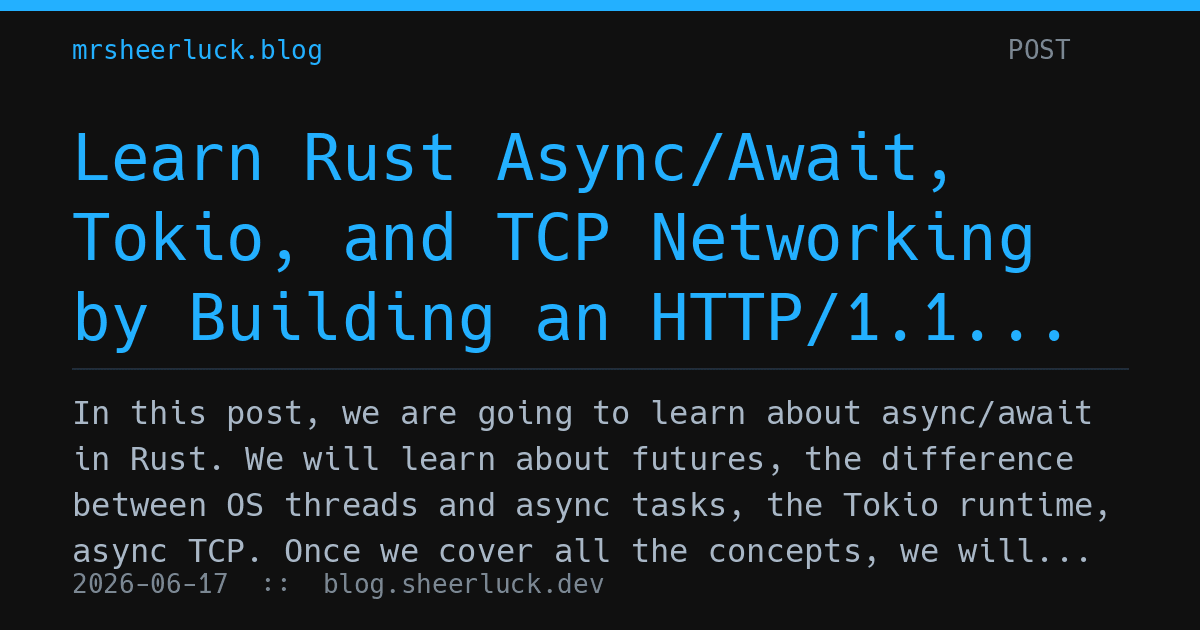
Watch a request move through an HTTP/1.1 server and async Rust stops looking like a type-system puzzle. Futures become the machinery that keeps I/O moving while work is still in flight.
Why start with a server
A server has to accept connections, parse messages, keep sockets open, and avoid stalling while it waits on the network. Those are exactly the problems async Rust was built to solve, and they are much easier to grasp when you can trace them through one project instead of memorizing the model in the abstract.
The build also sits in the right place on the Rust learning curve. By the time you reach it, ownership, borrowing, and basic syntax should already feel familiar. What this project adds is a second layer of reasoning: how those same ideas behave when the work is split across tasks, scheduled by a runtime, and driven by I/O instead of straight-line code.
The async model you need before you write the server
Rust async/await became stable in Rust 1.39.0 on November 7, 2019, after the core ideas for zero-cost futures were proposed in 2016.
Tasks are runtime-managed units of asynchronous work, while futures are the most granular unit of concurrency. In practice, that means a future is not doing work by itself. It is a value that represents work that may complete later, and the runtime is what keeps asking it whether it is ready to make progress.
Tokio is the runtime most people reach for first. It provides async I/O, networking, scheduling, and timers. Async Rust reduces the cost of doing many things at once, but it does not run on its own and needs a runtime to execute it.
Tasks, threads, and why the distinction matters
One of the most useful mental models in the whole exercise is the difference between OS threads and async tasks. Threads are managed by the operating system and are comparatively expensive to create and block. Tasks are lighter-weight units managed by the runtime, which can move them forward only when the work they represent is ready.
That separation is what makes Tokio useful for network code. A blocked thread sits idle while it waits for the kernel or the peer on the other end of the socket. A task can yield when it has nothing productive to do, letting the runtime schedule something else instead. If you have ever wondered why async feels so different from a plain threaded server, this is the reason: the control point shifts from the operating system to the executor.
Tokio is a multi-threaded runtime for executing asynchronous code, and Tokio says it is the most widely used runtime, surpassing all other runtimes in usage combined.
What changes when networking becomes async
The server build becomes interesting the moment you stop treating TCP as a stream of blocking reads and writes. In traditional blocking code, a connection can hold a thread while it waits for data, while a client pauses, or while the server finishes processing the current request. Async TCP changes that by letting the runtime interleave many connections without dedicating a thread to each idle wait.
That shift is why the tutorial starts with the behavior of asynchronous TCP networking before it reaches HTTP. If you can understand why a socket read returns control to the runtime instead of freezing the whole process, you already understand the operational logic behind a lot of Rust network services. The rest of the project is mostly about wiring that logic to request parsing and response generation.
The HTTP layer itself is not a toy protocol chosen for convenience. HTTP/1.1 is specified by the Internet Engineering Task Force in RFC 9112, published in June 2022, and that document covers message syntax, parsing, connection management, and related security concerns. It also obsoletes portions of RFC 7230.
Building the HTTP/1.1 server
Once the connection model is clear, the server becomes a practical demonstration of the whole async stack. It accepts a socket, reads bytes, turns those bytes into an HTTP request, and produces a response without blocking the rest of the program any more than necessary. That makes the project a live example of how Tokio’s scheduling, async I/O, and Rust’s type system cooperate.
The build follows the path a request takes through the code. You see how the server handles message flow, how parsing turns raw input into structured data, and how long-lived connections stay under control while the runtime continues working on other tasks.
At this level, frameworks like Axum stop feeling magical. They become a higher-level interface over the same underlying ideas: futures, tasks, async I/O, and runtime-driven scheduling.
What you can reason about after the build
After you finish a server like this, you can reason about more than syntax. You can look at a Rust service and ask where work actually waits, which parts belong to a future, and which parts the runtime is responsible for polling. That is the real payoff of the exercise: you learn to separate application logic from scheduling logic.
You also get a clearer feel for the tradeoffs that come with concurrency in Rust. Async code can handle many connections efficiently, but only if you respect the runtime model and avoid blocking where the executor expects progress to stay cooperative. A small HTTP/1.1 server forces every one of those decisions to show up in code you can follow line by line.
This article was produced by Prism’s automated news system from verified source data, official records, and press releases, then run through automated quality and moderation checks before publishing. The system is built and supervised by the people who set the standards it runs under. Read our full AI policy.
Did this article answer your question?