How Rust powers shared cores in cross-platform apps
Rust is becoming the shared core behind apps on iOS, Android, desktop, and web, cutting duplicate native work while tightening safety and parity.
Rust is moving into the part of app architecture users actually feel
The most interesting Rust adoption right now is not hiding in servers or kernels. It is sitting in the shared core of apps people use every day, where one code path can shape behavior across iOS, Android, desktop, and web. That shift matters because it changes how teams ship cross-platform features: instead of maintaining separate native implementations and hoping they stay aligned, they are pushing more business logic, media handling, encryption, and serialization into Rust.

That is the real story behind WhatsApp, Signal, and Proton. Each company is using Rust differently, but the logic is the same: write the risky or expensive part once, reuse it everywhere, and reduce the chance that one platform drifts away from the others. For messaging and privacy software especially, that can mean better feature parity, fewer maintenance headaches, and a stronger safety story.
Two patterns are emerging in cross-platform Rust
A useful way to understand the shift is to look at the two architecture patterns that keep showing up. In one model, used by Signal and Proton, Rust becomes a central shared core that carries a large share of the business logic and is reused across native clients. In the other, associated with WhatsApp, the platform layer stays mostly native while specific Rust libraries are introduced for safety-critical or performance-sensitive tasks.
Both approaches solve the same problem from different angles. Teams are trying to stop duplicating the same rules, transforms, and edge-case handling in separate codebases for different operating systems. When the shared behavior lives in Rust, the app can keep the same logic in lockstep across platforms, which is especially valuable when the product has to behave identically on phones, laptops, and browsers.
The appeal is not only convenience. Cross-platform apps often depend on cryptography, compression, and serialization behaving exactly the same way everywhere. If those pieces drift, interoperability breaks in ways users notice immediately, especially in messaging products where a message, attachment, or session state has to survive across devices.
Why messaging apps are leaning hardest on Rust
Messaging apps are a perfect stress test for this architecture because they combine high scale, high security, and high fragility. The analysis points out that many remotely exploitable bugs in messaging systems historically came from shared C libraries built for a very different threat landscape. Moving those high-risk layers into Rust does not eliminate logic bugs, but it does reduce the memory-safety risk that has long haunted shared systems code.
WhatsApp is the clearest large-scale example. Meta said in January 2026 that WhatsApp’s Rust-based media consistency library had been built and distributed to billions of devices and browsers, and that WhatsApp protects over 3 billion people with default end-to-end encryption. Meta also said it developed the Rust version of that media handling code in parallel with the original C++ version, a detail that helps explain how compatibility was preserved during the migration.
That parallel build matters because it shows how these migrations happen in practice. Teams are not always ripping out old code overnight. They are often running the Rust version alongside the incumbent implementation until behavior matches closely enough to ship at scale. Meta’s separate July 2025 engineering coverage also described rewriting decades-old C code in one of its core messaging libraries in Rust, which reinforces that this is part of a broader mobile modernization push inside the company.
How WhatsApp, Signal, and Proton use the model differently
WhatsApp: Rust as a targeted safety layer
WhatsApp’s approach shows how a company can modernize without moving every line of platform code at once. The app still has platform-dependent layers, but Rust steps in where consistency and safety are most important, especially in media handling. That is a pragmatic fit for a product that has to keep massive user populations, browser clients, and mobile clients all aligned.
This model is especially attractive when the existing native surface is large and deeply tied to each operating system. Instead of rewriting the whole app, teams can introduce Rust where the payoff is highest and let the rest of the native app continue doing what it already does well.
Signal: a formal shared core built for multi-device correctness
Signal’s stack makes the value of a shared core easy to see. Its documentation publishes technical specifications and software libraries for developers, including the Signal Protocol library. It also documents the Double Ratchet algorithm, which is used by two parties to exchange encrypted messages based on a shared secret key, and the Sesame algorithm, which manages message encryption sessions in asynchronous multi-device settings.
That is exactly the kind of logic that benefits from one reusable implementation. Signal ships apps for Android, iOS, Linux, macOS, and Windows, so any divergence in message encryption or session handling would be painful. A shared Rust core helps keep the protocol behavior consistent across all those clients while reducing the risk that one platform gets ahead of the others.
Proton: Rust as the center of the app itself
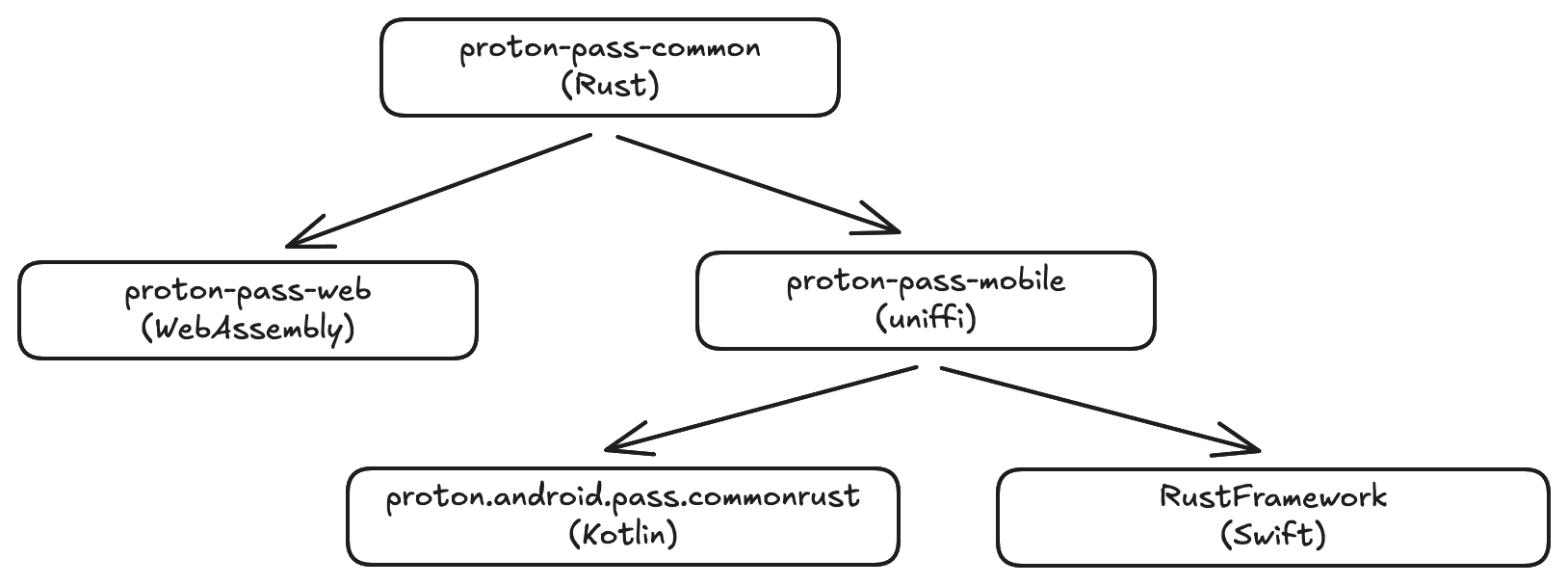
Proton has gone even further in some products. In August 2025, Proton said Proton Authenticator moved more core logic to Rust to improve data security, performance, and cross-platform consistency. In its mobile architecture writeup for Proton Mail, the company said the Rust core handles the entirety of the app’s business logic and that it pushed Rust into navigation logic as well.
That pivot was not abstract. Proton said it emerged in October 2023 after the company ran into quality, feature-parity, and engineering-velocity problems between its iOS and Android apps. The result is a more centralized core that reduces feature gaps and makes it easier to keep the mobile clients moving together.
What shared Rust cores change for teams shipping real products
The biggest practical change is that cross-platform shipping becomes less about duplicating effort and more about curating a single source of truth. When the same logic powers multiple clients, teams can spend less time reconciling native drift and more time improving the actual product. That is especially valuable in apps like WhatsApp, Signal, Proton Mail, Proton Pass, Proton Calendar, Proton Drive, and Proton Authenticator, where trust, correctness, and consistency are part of the product promise.
It also changes the risk profile. Rust does not magically fix app logic, but it gives engineering teams a stronger foundation for the code that is hardest to audit and most costly to get wrong. For consumer software that has to reach billions of devices, keep encryption aligned, and preserve behavior across platforms, that combination is hard to ignore.
The larger arc is clear now. Cross-platform teams used to reach for shared C and C++ libraries because they wanted reuse; today they are reaching for Rust because they still want reuse, but they also want a better answer to memory safety and long-term maintainability. That is why Rust is becoming the shared core beneath some of the most important apps on the market.
This article was produced by Prism’s automated news system from verified source data, official records, and press releases, then run through automated quality and moderation checks before publishing. The system is built and supervised by the people who set the standards it runs under. Read our full AI policy.
Did this article answer your question?