Iroh 1.0 launches with dial keys, not IPs, for Rust networking
Iroh 1.0 turns networking into dialing a key, not chasing an IP, after four years and 50-plus releases.
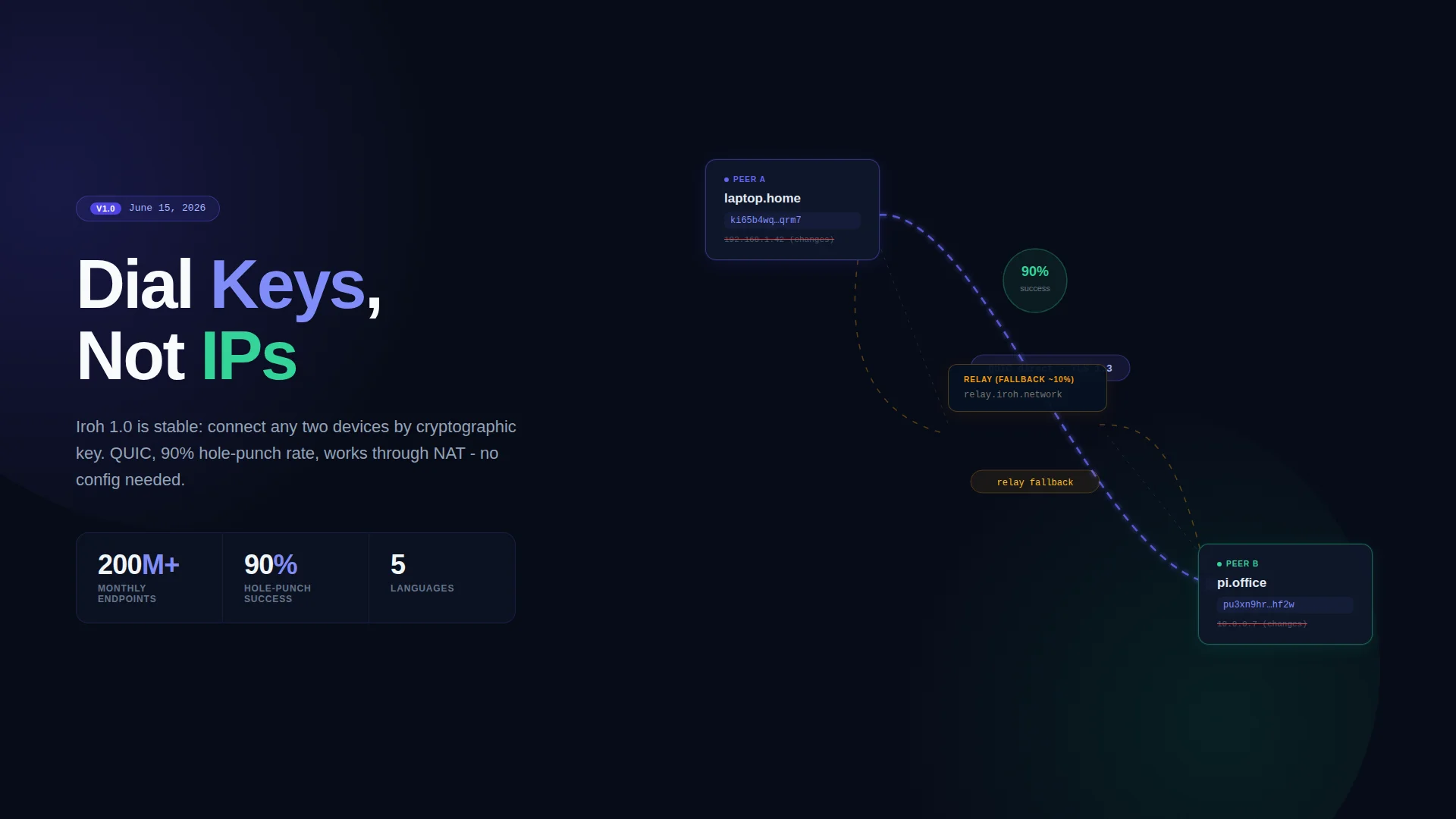
Iroh 1.0 landed with a message Rust developers will recognize fast: stop wiring your app to brittle IP addresses and dial a key instead. The June 15 release pushes a simple promise for peer-to-peer, local-first, and NAT-hostile software, stable identity and direct connections that survive network churn, with relays only as fallback. That pitch is not theoretical either, iroh says its public relays saw more than 200 million endpoints created in the previous 30 days.
The release caps a long stabilization run, not a sudden rewrite. Iroh’s first 1.0 release candidate, 1.0.0-rc.0, arrived in May after four years of work and more than 50 releases. The project’s own site now frames iroh as a modular networking stack written in Rust for fast, cheap, reliable connections over unreliable or intermittent networks, including Wi-Fi, cellular, ethernet, LAN, Bluetooth, and custom transports. The practical target is broad: video streaming, distributed AI training, secure chat, games, file transfer, and agent communication.

What makes iroh different is the amount of networking plumbing it tries to hide from the application. The team says it moved toward open standards and IETF drafts where possible, built its own QUIC multipath implementation, added QUIC NAT traversal for encrypted direct links, and leaned into local-first configuration so devices can find each other even when the internet is unavailable. The stack also supports browser and WASM use, custom connection logic, and alternative transports such as BLE, LoRa, WiFi Aware, and Tor. Direct links are preferred, with stateless relays stepping in when the path is blocked.
That is a meaningful simplification for Rust builders who have spent too much time on connection setup instead of protocol design. The project was founded by developers deeply involved with libp2p, but iroh deliberately keeps its core smaller than libp2p by leaving out a DHT, swarm, and gossipsub. The result is a narrower surface area aimed at the problems that matter most for application developers: how to connect, reconnect, and keep moving when the network is unstable.
The ecosystem story is wider than Rust alone. Iroh now lists official bindings in Rust, Python, Swift, Kotlin, and JavaScript, all sharing the same basic API for sending streams and datagrams over QUIC. That stable 1.0 API also restores FFI support for languages like Python, Node.js, Kotlin, and Swift, which makes the stack easier to adopt outside the Rust core.
Iroh’s roadmap once pointed to a late-2025 release, so the June 2026 launch shows the schedule slipped. But the focus sharpened along the way, and the result is clear in the slogan itself: dial keys, not IPs. For Rust networking, that is less a branding line than an attempt to turn secure direct connectivity into a primitive as ordinary as opening a socket, while the hard parts stay tucked behind the abstraction.
This article was produced by Prism’s automated news system from verified source data, official records, and press releases, then run through automated quality and moderation checks before publishing. The system is built and supervised by the people who set the standards it runs under. Read our full AI policy.
Did this article answer your question?