LiteLLM moves AI gateway to Rust for sub-1ms overhead
LiteLLM shifted its AI gateway to Rust to chase sub-1ms overhead, a sub-100MB binary, and a drop from 7.5ms to 0.05ms per request.
LiteLLM moved its AI gateway to Rust on June 22, aiming for sub-1ms per-request overhead and a binary under 100MB. Ishaan Jaffer framed the change as a runtime swap under the hot path, not a new version, and not a migration that forces customers to rewrite their integrations. The company said the gateway will keep the same config, database, and client-facing API shape, so the outward contract stays intact while the internals change.
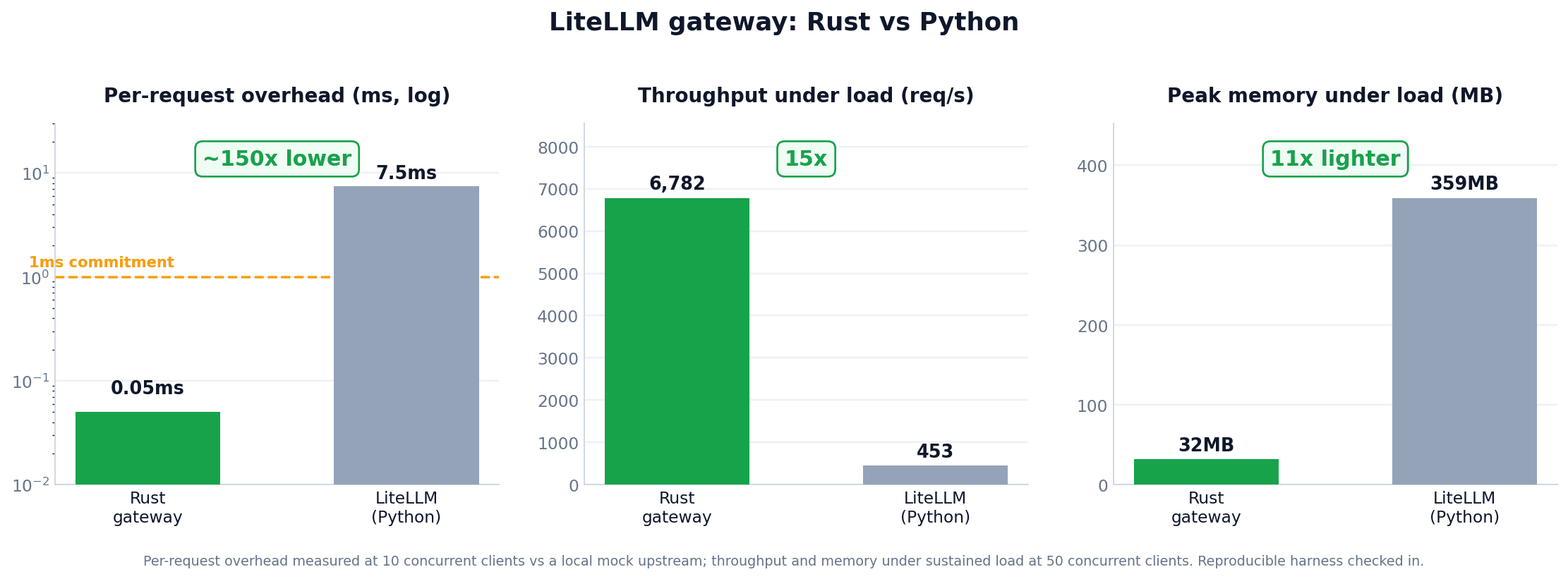
The reason is load behavior, not language aesthetics. LiteLLM said that under real traffic, CPU and memory climb with concurrency, and pods can get OOM-killed at exactly the wrong moment. In its benchmark harness, the Rust gateway delivered about 15x the throughput of the existing Python path, used about 11x less memory, and cut per-request overhead from roughly 7.5ms to about 0.05ms. For teams watching deployment density, autoscaling thresholds, and cost per request, those are the numbers that matter. They also explain why the rewrite was treated as an engineering response to a bottleneck, not a branding exercise.

LiteLLM is also taking a staged approach to the rollout. Each gateway route is being moved one by one, and every new Rust path only lands after parity and end-to-end tests pass. That matters in a gateway, where authentication, retries, and request routing sit right in front of high-volume traffic and any regression can ripple quickly through production. By keeping the migration route by route, LiteLLM is trying to get Rust’s latency and memory profile without turning the release into a risky wholesale rewrite.
The broader signal for Rust developers is plain: this is Rust being used where tail latency and memory pressure shape real operating costs. Gateways are exactly the kind of service where small overheads compound into slower responses, higher pod counts, and less headroom when concurrency spikes. LiteLLM’s move shows the calculus clearly. Once a gateway becomes the bottleneck, the question is no longer whether Rust is elegant. It is whether Rust changes the economics and the failure mode of the service in front of the load.
This article was produced by Prism’s automated news system from verified source data, official records, and press releases, then run through automated quality and moderation checks before publishing. The system is built and supervised by the people who set the standards it runs under. Read our full AI policy.
Did this article answer your question?