Rust Developer Implements Gzip Decompression From Scratch in 250 Lines
Ian Erik Varatalu's 250-line Rust gzip decompressor lit up Hacker News, offering a rare guided teardown of DEFLATE, Huffman coding, and LZ77 in a single, readable sitting.
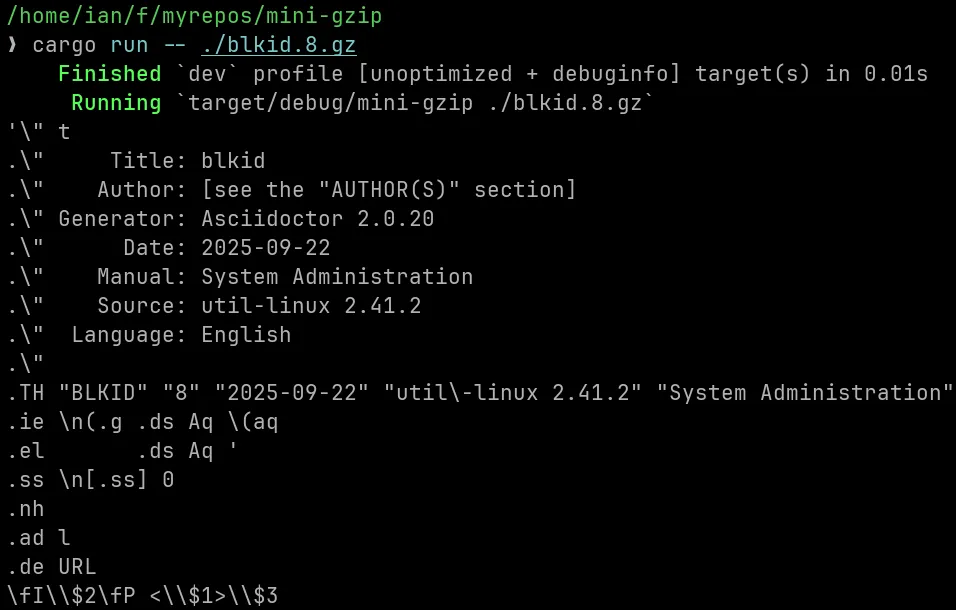
When Ian Erik Varatalu posted "Gzip decompression in 250 lines of Rust" to Hacker News on March 23, the thread quickly became one of the week's most-discussed technical writeups in the Rust community. By March 27, it had circulated across blog roundups and aggregators and triggered side conversations that rarely get started when someone just types `cargo add flate2`.
The motivation is stated plainly in the essay: "I wanted to have a deeper understanding of how compression actually works, so I wrote a gzip decompressor from scratch." That line explains precisely why the piece resonated. Most Rust developers have reached for flate2, which defaults to a miniz_oxide pure-Rust backend and optionally links against zlib-ng for higher throughput, without ever thinking about what's happening three layers below the API surface.
Varatalu's implementation peels those layers in order: gzip framing first, then the DEFLATE stream structure, then Huffman-coded block headers, then LZ77 backreferences. Each layer is built incrementally, which makes the code unusually readable for low-level format work. Three ideas drive most of the complexity.
The first is bit-level reads. DEFLATE doesn't respect byte boundaries; Huffman codes and length/distance pairs are packed across them in ways that feel deliberately adversarial to byte-oriented thinking. Varatalu handles this with a small bit-reader that holds a buffer and a count of remaining bits, expressed in idiomatic Rust with explicit error handling rather than the silent truncation common in C reference implementations.
The second is DEFLATE block types. A DEFLATE stream can contain uncompressed, fixed-Huffman, or dynamic-Huffman blocks. Rust enums are a natural fit here, and the implementation dispatches between them with pattern matching. This is one of the places where the type system does real work: a C implementation typically uses integer flags and fall-through logic; the enum representation makes illegal block states unrepresentable.

The third is Huffman decoding. The decoder has to reconstruct the Huffman tree from the block header before it can process a single symbol. Varatalu walks through how symbol 265, for example, signals a length in the 11-to-12 range, with the next bit resolving which, a technique that keeps the Huffman alphabet compact while supporting lengths up to 258 and distances up to 32768. A 32KB sliding window holds the backreference buffer for LZ77 lookups.
The shortcuts that hold the line count to 250 are real omissions, not sleight of hand. There is no CRC-32 verification of the decompressed output against the checksum stored in the gzip trailer, and the input reader is tied to a file or stdin rather than a generic trait boundary. Neither gap undermines the pedagogical value, and both mark clean extension points: adding CRC-32 validation requires reading the four-byte trailer and comparing it against the running checksum, which is a self-contained exercise in byte-level parsing. Refactoring the input behind a `Read` trait unlocks streaming decoding without large intermediate allocations, which is also how flate2's own `BufRead`-based API achieves its memory efficiency.
One Hacker News commenter observed that the structure maps closely to puff.c, the minimal DEFLATE reference bundled in the zlib source tree. That's accurate, and it's also the point: puff.c has been a teaching artifact for over three decades, and Varatalu's contribution is demonstrating how the same ideas read in Rust, where enums and the borrow checker absorb some of the defensive conventions that puff.c enforces through discipline alone.
The flate2 crate remains the correct choice for any production workload. Varatalu's 250 lines are a map of the territory, not a vehicle for crossing it — the thing worth reading before you decide how much you need to trust the vehicle.
This article was produced by Prism’s automated news system from verified source data, official records, and press releases, then run through automated quality and moderation checks before publishing. The system is built and supervised by the people who set the standards it runs under. Read our full AI policy.
Did this article answer your question?