Rust developer rebuilds Cargo-like build layer in Zig style
A tiny Zig-style build layer makes Cargo’s hidden work visible, but it also shows why most Rust teams keep Cargo in charge.
A 374-line Zig file and 79 lines of Ruby are enough to make Rust builders stop and stare. fnordig’s bygge-zig is not a proposal to replace Cargo, but it is a sharp reminder that the default Rust build stack is doing far more than most of us think about day to day.
What the experiment is really testing
On June 16, 2026, fnordig published “Build your project Zig-style” as a proof of concept: a build.zig file that can compile Rust projects. The author was coming from prior Zig experience and wanted to see what a more direct build approach would look like for Rust, rather than treating Cargo as an untouchable black box.
The headline number is the kind that instantly starts arguments in Discord and code review threads: 374 lines of Zig and 79 lines of Ruby versus roughly 80,000 lines of Rust that Cargo itself spans. That is not a serious apples-to-apples replacement claim. It is a stress test for assumptions, and it lands because it exposes how much invisible machinery Cargo carries for you.
What Cargo is actually doing for you
Cargo’s official docs are plain about its role: it is Rust’s package manager and build tool. It downloads dependencies, compiles packages, makes distributable packages, and uploads them to crates.io, Rust’s community package registry.
That sounds simple until you look at the edges. Cargo’s build-script documentation says some packages need to compile third-party non-Rust code, link to C libraries, or perform code generation before building. Cargo does not aim to replace other tools there, it integrates with them through custom build scripts. The reference goes even further, covering dependencies, workspaces, build scripts, registries, publishing on crates.io, and external tools.
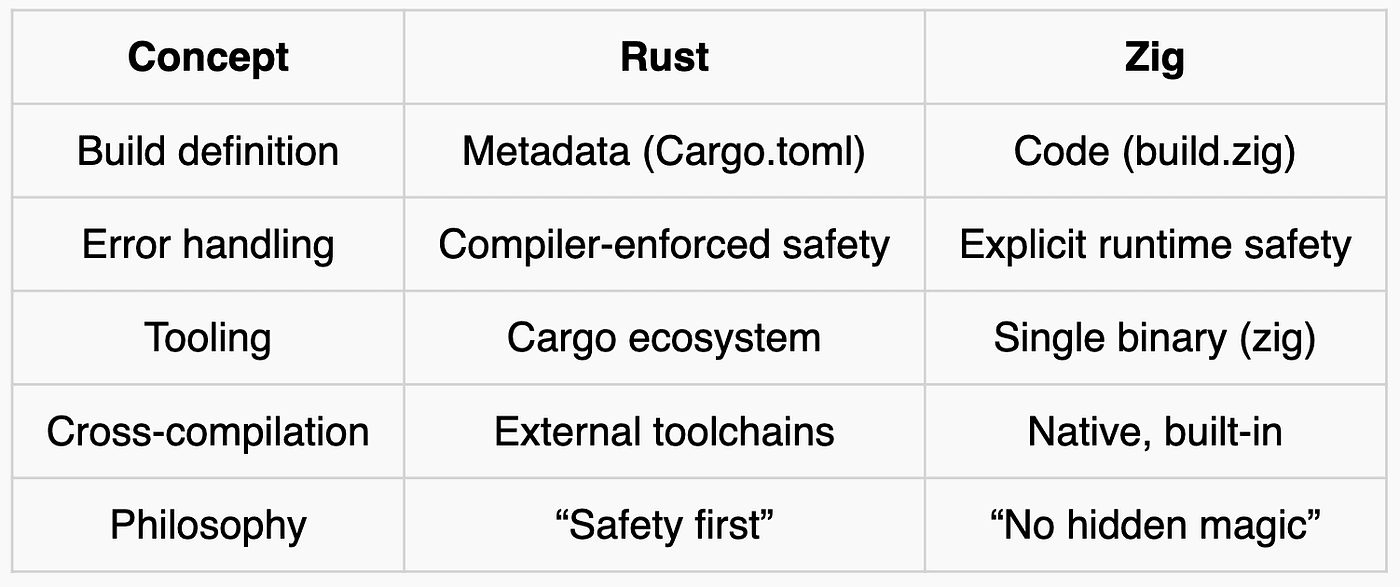
That is the real takeaway from the Zig-style experiment: the “default” Rust workflow is not just `rustc` with a nicer command line. It is a coordinated system for dependency resolution, build orchestration, code generation, and packaging conventions that keep the ecosystem coherent.
Why the Zig-style version feels liberating
For a power user, the appeal is obvious. A hand-rolled build layer makes the build graph legible again. You see what gets compiled, when it gets compiled, and which parts of the process are convention versus necessity.
That transparency is especially attractive if you care about reproducibility and cross-language integration. Cargo’s build scripts are there precisely because real projects often need to glue Rust to generated code, C libraries, or other non-Rust pieces. A custom build layer can make those steps feel less magical and more explicit, which is useful when you are debugging a strange CI failure or trying to understand why one target behaves differently from another.
The same logic applies to cross-compilation in a practical sense. The more of the build pipeline you can see, the easier it is to reason about where host tools end and target artifacts begin. The upside is control. The downside is that you are now responsible for the machinery Cargo usually hides.
Where the hidden complexity starts to matter
This is where the experiment stops being a neat toy and starts becoming a maintenance conversation. Cargo’s value is not that it is minimal. Its value is that it has already absorbed a huge amount of ecosystem knowledge about dependency graphs, build scripts, workspaces, publishing, and registry behavior.
Procedural macros are a good example. The Rust Reference says they run during compilation, and because of that they have the same security concerns as Cargo’s build scripts. That is exactly the sort of detail a custom build layer has to account for if it wants to behave like real-world Rust tooling instead of a one-off script. Once you are handling code generation, compiler plugins, and build-time execution, the maintenance burden rises fast.
In other words, a Zig-style build setup can be clearer than Cargo, but clarity is not free. Every special case you encode becomes your responsibility, and every platform edge case you support becomes part of your own release engineering story.
The scale Cargo is carrying now
This is also where the broader ecosystem context matters. crates.io is not a small side registry anymore. The crates.io API summary currently reports more than 286,000 crates and more than 340 billion total downloads, which gives you a sense of how much the package manager is supporting behind the scenes.
Rust’s stability story reinforces that point. Rust 1.0’s 10th anniversary was marked on May 15, 2025, and that milestone underscored how central Cargo has become to the language’s long-term identity. Cargo is not an accessory bolted onto Rust after the fact. It is part of the social and technical contract that makes the ecosystem feel dependable.
So should you actually try it?
If your goal is to learn what Cargo is really doing, absolutely. A build.zig experiment like bygge-zig is a great way to surface the tradeoffs Cargo normally shields you from, especially around reproducibility, cross-language integration, and build-time code generation.
If your goal is to ship and maintain a team project, the answer is much narrower. Cargo already gives you dependency resolution, workspaces, registries, publishing, build scripts, and the conventions that keep Rust projects interoperable at scale. Rebuilding that layer in Zig can be liberating for an experiment, but for most production code it is complexity you now own.
That is the paradox fnordig’s project puts on the table: the smaller build file looks freeing until you remember how much invisible work Cargo has been doing all along.
This article was produced by Prism’s automated news system from verified source data, official records, and press releases, then run through automated quality and moderation checks before publishing. The system is built and supervised by the people who set the standards it runs under. Read our full AI policy.
Did this article answer your question?