Rust fits some teams, not every project or stack
Rust’s wins are real, but they show up where scale, latency, and memory safety bite hardest. The smarter question is whether your team can afford the discipline Rust asks for.
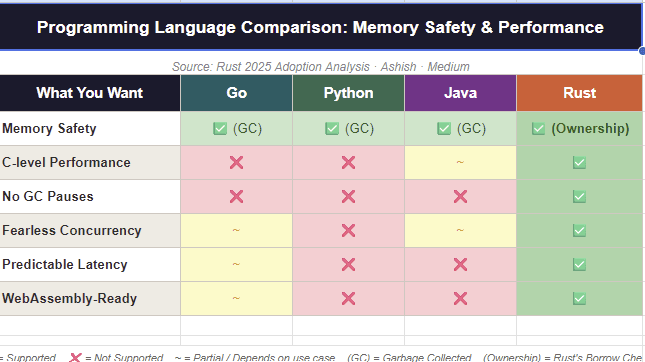
When Amazon Web Services, Cloudflare, and Discord all point to Rust, it is tempting to treat the language like a universal upgrade button. That is the wrong lesson. The better read is much narrower: each of those teams reached for Rust when a specific operational problem, a hot path, or a scale ceiling made the trade-off worth it.
Rust is not a vibe, it is a fit
Discord’s Read States service is a good example of the kind of pressure that makes Rust look obvious in hindsight. Discord said the service sits in a hot path, handles billions of read states, and absorbs hundreds of thousands of cache updates per second. In that environment, the Go version produced large latency spikes every few minutes because of Go’s memory model and garbage collector. That is not an abstract language debate. That is a production system telling you exactly where it hurts.
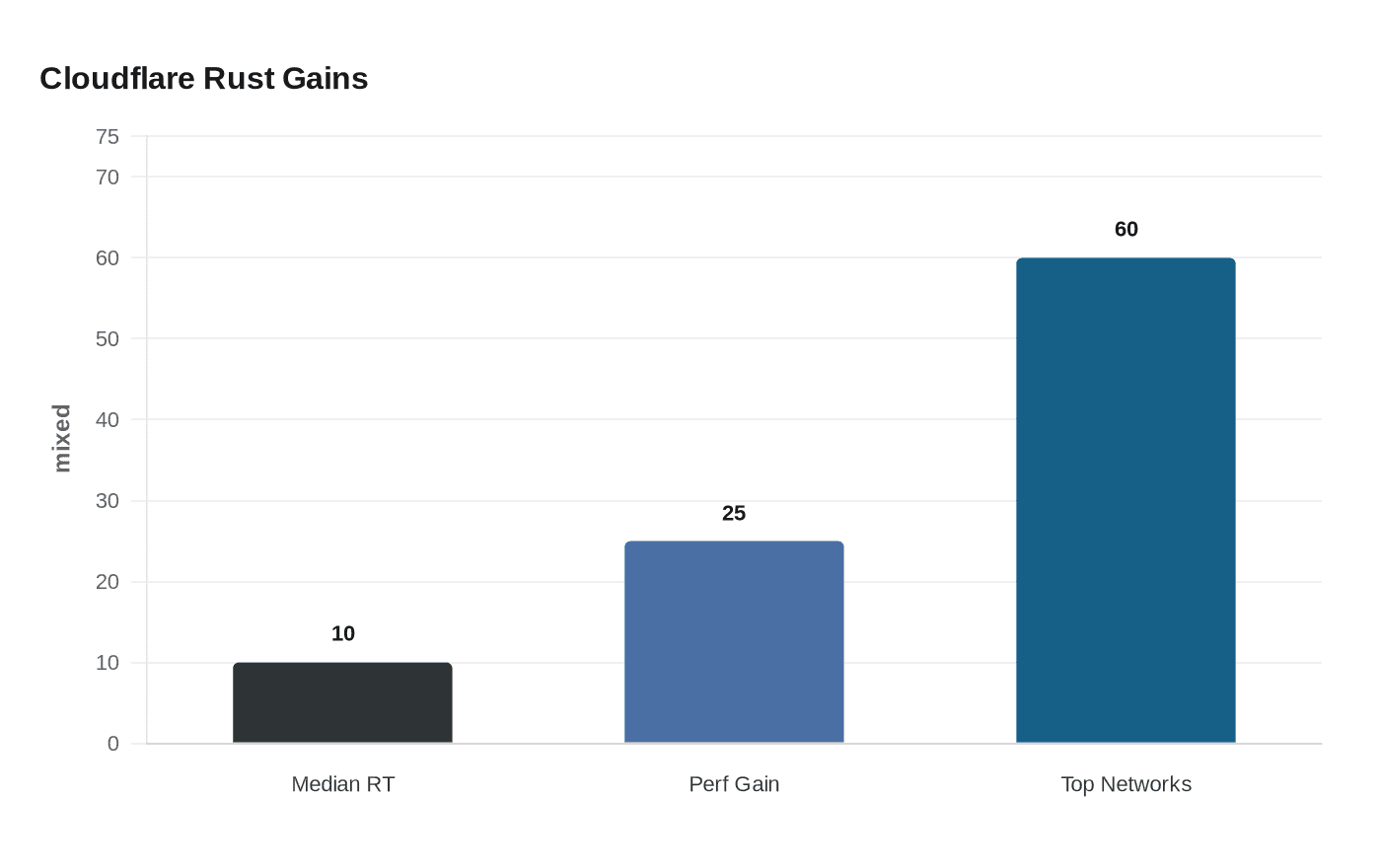
Cloudflare’s story points in the same direction. The company has said Workers can be written in 100% Rust with the workers-rs SDK, no JavaScript required. It also said Pingora, its Rust-based proxy, serves over 1 trillion requests a day while using only a third of the CPU and memory resources of the proxy infrastructure it replaced. More recently, Cloudflare said a Rust-powered upgrade cut median response time by 10ms and improved performance by 25% in third-party CDN tests. In April 2026, it said its Rust-based FL2 request-handling layer made Cloudflare the fastest network for 60% of the world’s top networks.
Amazon Web Services has also moved Rust closer to the mainstream. On 2025-11-14, AWS promoted Rust support in Lambda from Experimental to Generally Available, saying it is backed by AWS Support and the Lambda availability SLA. That matters because it signals that Rust is no longer confined to “special project” territory. It can now sit inside business-critical serverless work without looking like an unsupported experiment.
What those stories have in common
The common thread is not that Rust is trendy. It is that Rust pays off when the constraints are concrete. Discord wanted to avoid latency spikes in a service that was already under intense read and cache pressure. Cloudflare wanted to rebuild infrastructure for scale and efficiency, then measure the result in CPU, memory, median response time, and network performance. AWS made Rust a supported option for serious serverless workloads, which lowers the adoption risk for teams that need platform backing as much as they need performance.
That is why copying these companies blindly is cargo-cult engineering. Large teams often have the engineering depth to absorb a language shift, the appetite for migration work, and the operational maturity to benefit from Rust’s strong compile-time checks. Smaller teams may only inherit the pain: longer ramp-up, more upfront discipline, and a slower path to the first shipped feature. Rust’s reputation for memory safety and speed is deserved, but those advantages do not cancel out the cost of learning a new mental model.
The article’s deeper point is the one most migration stories skip: the real question is not whether Rust is “good.” It is whether Rust is the right answer for this project, this team, and this maintenance horizon.
A practical checklist for choosing Rust
Before you reach for Rust because a well-known company did, ask yourself a few hard questions:
- Is the code on a hot path where latency spikes, tail latency, or memory behavior are already hurting you?
- Are you fighting bugs that Rust’s compile-time checks are actually likely to prevent?
- Do you have enough team size and seniority to absorb a learning curve without freezing delivery?
- Is the migration cost justified by a performance win, a safety win, or both?
- Will this system live long enough that lower maintenance risk matters more than faster initial delivery?
- Do your debugging, deployment, and ops workflows benefit from Rust’s stricter discipline, or will they be slowed by it?
- Is your ecosystem mature enough for the crates, tooling, and integrations the project needs right now?
The strongest Rust fits tend to look like Discord’s Read States service or Cloudflare’s proxy and networking stack: high-throughput, performance-sensitive, and expensive to get wrong. The weakest fits are the ones where Rust is chosen mainly to feel modern, or because a feed full of success stories made the language look inevitable. A language can be a sharp tool without being the right tool for every bench.
Rust’s ecosystem is no longer a novelty, but it still asks for judgment
Part of Rust’s appeal is that it no longer feels like a fringe bet. The Rust project’s own book now assumes Rust 1.90.0 or later and edition 2024 idioms, which is a strong sign of a mature, evolving ecosystem rather than an experimental one. The Rust survey team said the 2024 State of Rust Survey ran from 2024-12-05 to 2024-12-23, with 9,450 starts and 7,310 completions. The United States accounted for 22% of respondents, Germany 14%, and the United Kingdom and France 6% each.
The language’s developer reputation has also been unusually durable. The Rust blog says Rust has been named Stack Overflow’s Most Loved, now Most Admired, language every year since its 1.0 release in 2015. That kind of goodwill helps explain why Rust keeps showing up in architecture discussions, from serverless to proxies to internal services. It also explains why the hype can get ahead of the judgment.
The decision is about pain, not prestige
That is the reality check hiding inside all the big-company success stories. Discord used Rust where Go’s garbage collector was creating latency spikes in a service that could not afford them. Cloudflare used Rust to drive down CPU and memory usage while scaling request handling to enormous volume. AWS made Rust a supported Lambda option because enough teams need it for production work that official backing now matters.
If your project has a similar pain point, Rust may be exactly the right answer. If it does not, the best thing you can copy from Amazon, Cloudflare, and Discord is not the language choice itself, but the discipline behind it: adopt Rust when the problem is real, measurable, and worth the cost. That is how Rust earns its place, and how it avoids becoming just another badge on a stack diagram.
This article was produced by Prism’s automated news system from verified source data, official records, and press releases, then run through automated quality and moderation checks before publishing. The system is built and supervised by the people who set the standards it runs under. Read our full AI policy.
Did this article answer your question?