Rust rewrite boosts Subway Builder large-map performance to 93% at max speed
Subway Builder’s large-map simulation jumped from 76% to 93% at max speed after a partial Rust rewrite, while its TypeScript modding layer stayed intact.
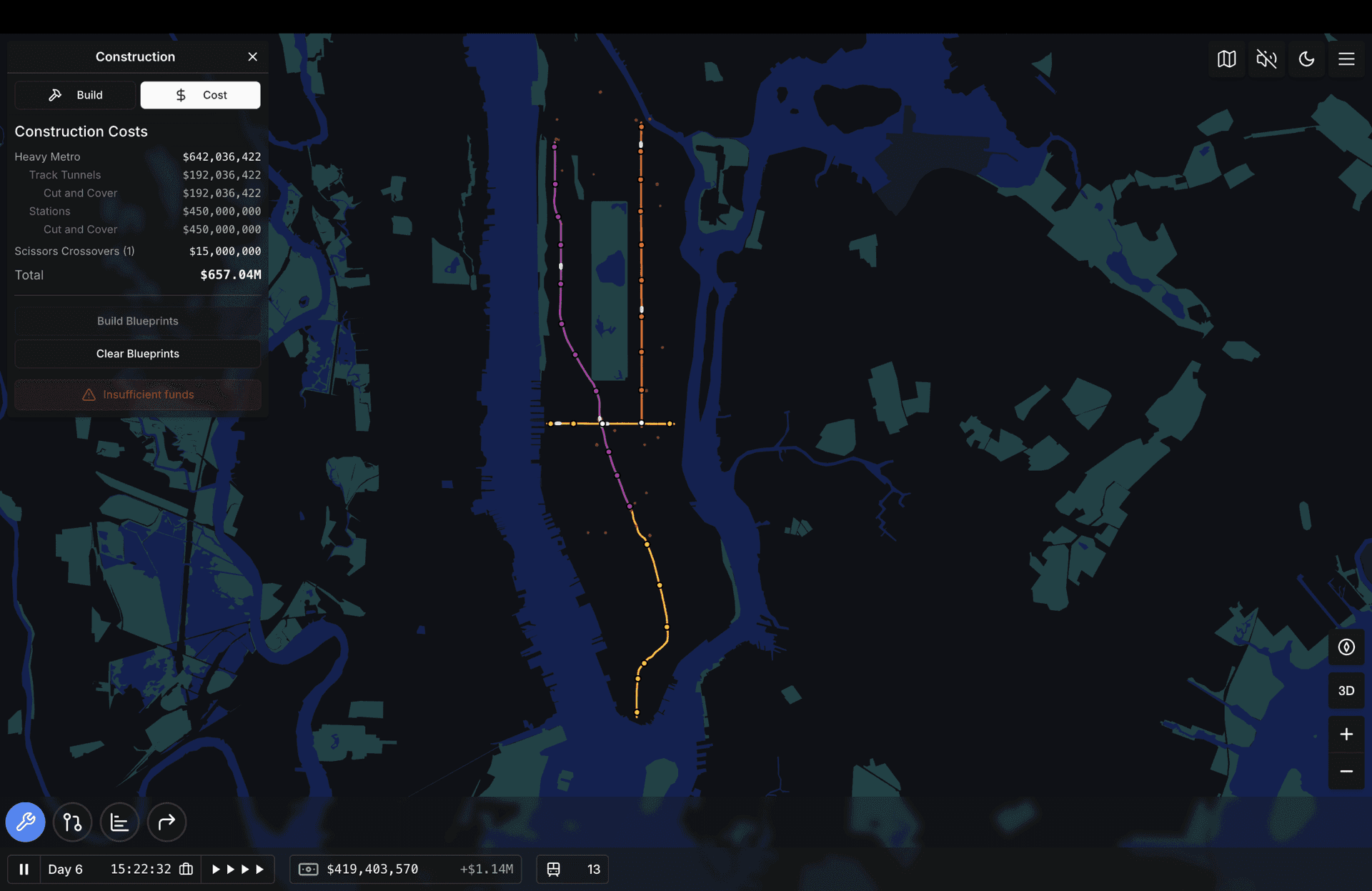
Subway Builder’s large-map simulation climbed from 76% to 93% at max speed after a partial Rust rewrite, a jump that lands hardest on the maps most likely to buckle first. Osaka, Greater LA, and Nagoya can exhaust renderer memory, so the gain is not just a prettier benchmark, it is the difference between a sprawling transit model and one that can keep moving when the city gets dense.
That performance work sits inside a game built around unusually heavy simulation. Subway Builder uses live data from cities in the United States and the United Kingdom, then generates millions of commuters from Census and Redistricter data and runs them through the same pathfinding algorithms people already carry on phones. When that kind of workload meets a large map, the app auto-scales its V8 heap to total RAM minus 2GB, with a floor of 2GB, and advanced users can push further by setting memoryLimitMB in settings.json as low as 1024 MB or by passing Chromium and V8 flags.

The rewrite looks incremental rather than ideological, and that is what makes it useful for Rust developers watching from the side. The public-facing modding stack still leans hard on TypeScript: the docs describe a fully typed API with hot reload and debugging tools, which means the project did not rip out the scripting layer to chase speed. Instead, the likely pressure point was the simulation and other performance-critical paths that sit below the modding surface, the parts that have to keep millions of commuters flowing without making the rest of the toolchain harder to use.
That split has been visible in the project’s broader rollout. The roadmap says the Public Beta launched in October 2025, then the general-improvements phase, including performance work, wrapped across Winter 2025 and Spring 2026. Steam currently lists a July 17, 2026 release, with credits for Colin Miller, EJ Fox, Curran Kelleher, Nate Maue, Alex Wohlbruck, Piero Maddaleni, and Brooks Flannery, and Borough Studio as publisher.
For anyone considering a partial rewrite of game or simulation code, Subway Builder offers a familiar Rust lesson in miniature: move the hot path first, leave the productive surface area alone, and let the results show up where the pressure is highest. In this case, that pressure showed up on the biggest maps, and the payoff was a climb from 76% to 93% exactly where the simulation had the most to lose.
This article was produced by Prism’s automated news system from verified source data, official records, and press releases, then run through automated quality and moderation checks before publishing. The system is built and supervised by the people who set the standards it runs under. Read our full AI policy.
Did this article answer your question?